15

How is it proved to be always true? It's a fundamental principle in Physics based on all of our currents observations of multiple systems in the universe. Is it always true to all systems? Because we haven't tested or observed them all. Would it be possible to discover/create a system that could lead to a different result?

How are we 100% sure that energy is always conserved? Finally, why did we conclude it's always conserved? What if a system keeps doing work over and over and over with time?

Brick
  • 5,247
AxtII
  • 697
  • 3
  • 11
  • 22

5 Answers5

19

While anna v's answer is true of course, there is Noether's theorem which states, as Wikipedia puts it, that

any differentiable symmetry of the action of a physical system has a corresponding conservation law.

This is a mathematical theorem, so it doesn't rely on empirical evidence but on rigorous proof. The most popular symmetries we find in physical systems are

  • the invariance with respect to translations in time (i.e. the physics is the same today as it is tomorrow) which implies the conservation of energy by Noether's theorem,
  • the invariance with respect to translations in position (i.e. the physics in New York is the same as in Tokyo) which implies the conservation of momentum,
  • and the isotropy of space (meaning that there is no preferred direction) which implies the conservation of angular momentum.

There are tons more, depending on the physical system you are looking at. Symmetry is really at the heart of modern physics. It should be noted that these conservation laws are only true in closed systems. E.g. if an external force is applied to a body, it will start to accelerate and its energy, momentum and angular momentum change. This is totally consistent though, as the external force breaks the symmetries in time (the force starts acting at one point in time and stops on another), position (the force may change depending on where you are) and direction (the force points in one direction, i.e. one direction is preferred). However, as you expand your definition of the system to include the origin of the force (e.g. another celestial body), symmetry is restored and the total energy, momentum and angular momentum of both bodies will be conserved again.

Is this proof of the conservation of energy? Certainly not! Those assumptions on the symmetry properties (in particular with respect to time) are exactly that -- assumptions which are based on your observations. But I would find it extremely irritating if the laws of physics were to change tomorrow. (Also, it would render my education useless.) I think this is more fundamental than the conservation of an abstract quantity which we call energy, but you still can't go without faith and scepticism.

Jonas Greitemann
  • 3,979
  • 17
  • 40
15

How is it proved to be always true? It's a fundamental principle in Physics, that is based on all of our currents observations of multiple systems in the universe, is it always true to all systems? Because we haven't tested or observed them all. Could it possible that we discover/create a system that could lead to a different result?

A physical theory, and also the postulates on which it is based can only be validated, that means that every experiment done shows that the theory holds and in this case energy conservation holds. A physical theory can be proven only to be false even by one datum, and then the theory changes. Example: classical mechanics fails at relativistic energies, when mass turns into energy, and classical energy is not conserved. A relativistic mechanics was developed that still has conservation of a more generally defined energy.

How are 100% sure that energy is always conserved? Finally, why did we conclude it's always conversed?

We cannot be sure, as I said above. If we find even one case where the newer energy definition fails than the postulate fails and new propositions will be studied. It has not failed up to now in our laboratory and observational experiments.

In any case, the framework is important, classical conservation of energy still holds for non relativistic energies, for example.

In general relativity conservation of energy-momentum is expressed with the aid of a stress-energy-momentum pseudotensor. The theory of general relativity leaves open the question of whether there is a conservation of energy for the entire universe.

For cosmological matters see another entry in this forum on the law of conservation of energy.

anna v
  • 236,935
0

Previous answers such as "all classical equations for energy are constructed to make energy conserved" or using Noether's theorem are correct, but here is another way to look at it.

In quantum mechanics, the energy of an object $\psi$ is defined to be $E(0)=<\psi |H|\psi>$, where $e^{iHt}$ is the transformation that moves $\psi$ along in time and the Hamiltonian $H$ is called the generator of time translation. Then the energy at a later time t is $E(t)=<\psi|e^{-iHt} H e^{iHt}|\psi>=<\psi |H|\psi>=E(0)\quad$ because $[e^{-iHt},H]=0\quad$ because $[H,H]=0$.

In briefer words, energy is conserved in time because it is the generator of time translation and obviously commutes with itself.

Gary Godfrey
  • 3,428
-1

Law of conservation of energy states that the energy can neither be created nor destroyed but can be transformed from one form to another.

Let us now prove that the above law holds good in the case of a freely falling body.

Let a body of mass 'm' placed at a height 'h' above the ground, start falling down from rest.

In this case we have to show that the total energy (potential energy + kinetic energy) of the body at A, B and C remains constant i.e, potential energy is completely transformed into kinetic energy.
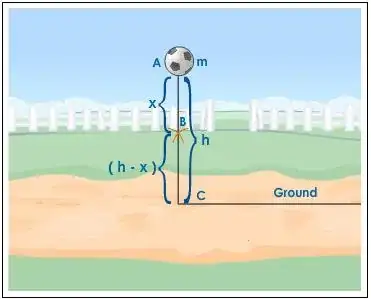
enter image description here

At A, Potential energy = mgh

Kinetic energy Kinetic energy = 0 [the velocity is zero as the object is initially at rest]

\ Total energy at A = Potential energy + Kinetic energy

Total energy at A = mgh …(1)

At B, Potential energy = mgh

= mg(h - x) [Height from the ground is (h - x)] Potential energy = mgh - mgx

Kinetic energy The body covers the distance x with a velocity v. We make use of the third equation of motion to obtain velocity of the body.

v2 - u2 = 2aS Here, u = 0, a = g and S = x

Kinetic energy = mgx

Total energy at B = Potential energy + Kinetic energy

Total energy at B = mgh …(2)

At C, Potential energy = m x g x 0 (h = 0)

Potential energy = 0 Kinetic energy

The distance covered by the body is h v2 - u2 = 2aS

Here, u = 0, a = g and S = h

Kinetic energy

Kinetic energy = mgh

Total energy at C = Potential energy + Kinetic energy = 0 + mgh

Total energy at C = mgh …(3) It is clear from equations 1, 2 and 3 that the total energy of the body remains constant at every point. Thus, we conclude that law of conservation of energy holds good in the case of a freely falling body.

-1

A simple solution can be like this-

Firstly, we find the rate of change of kinetic energy. The process is as follows. $$\frac d{dt}\left(\frac 12 mv^2\right)=\textbf{F}\cdot\textbf{v}$$

Now imagine this case of a constant force acts on the body which is equal to $-mg$ (minus indicates downward direction). So, the RHS of the equation is $-mgv$. Now the velocity is the rate of change of vertical position of the body. So the RHS of the equation becomes $ -mg\cdot\displaystyle\frac{dh}{dt}$. Now this is the rate of change of $-mgh$. Therefore we see that the rate of change of kinetic energy $=$ negative rate of change of potential energy. So,these two always add up to give the same sum and we can say the energy (sum of kinetic and potential energy) is always constant.

Harmonic
  • 274