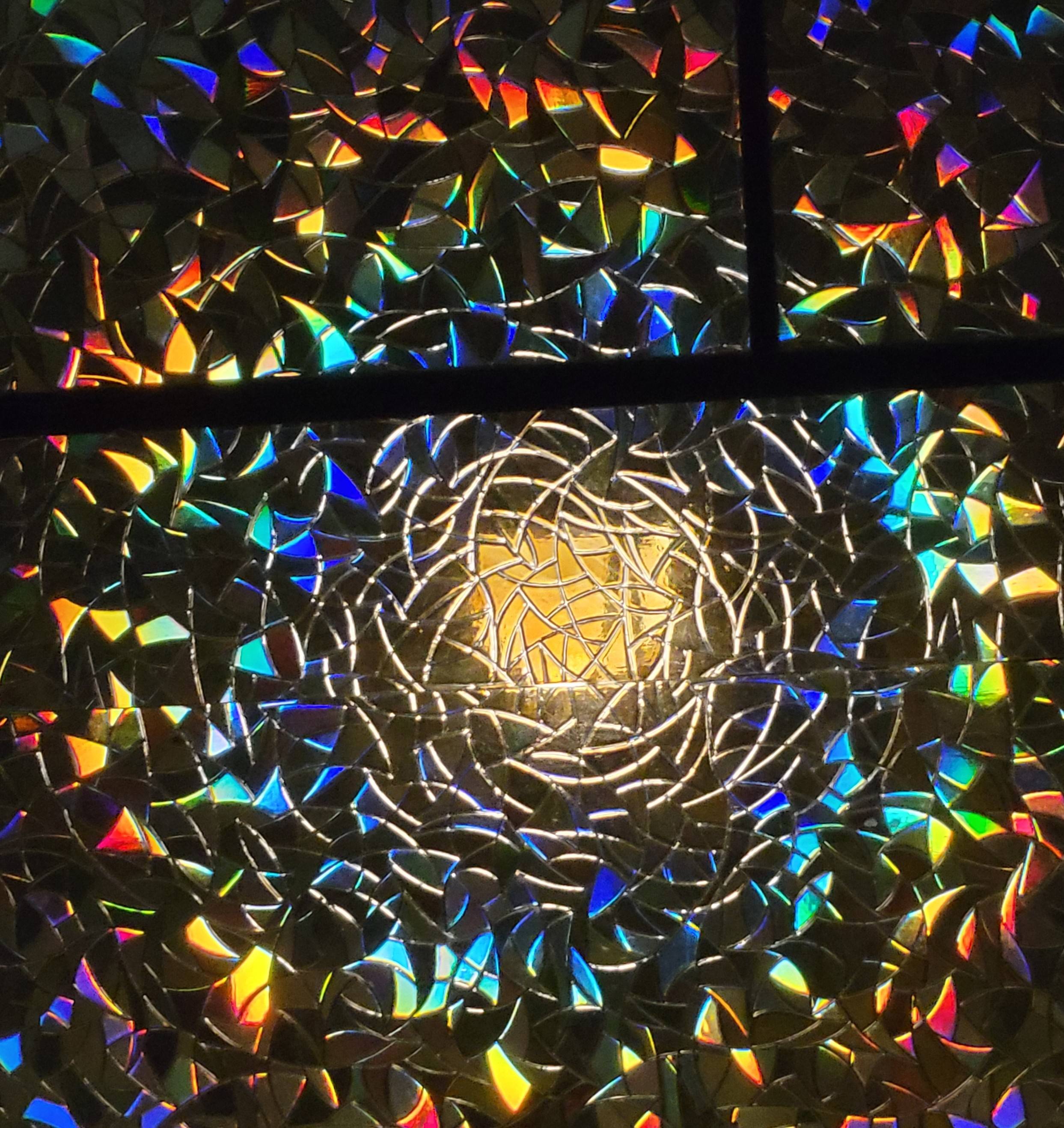
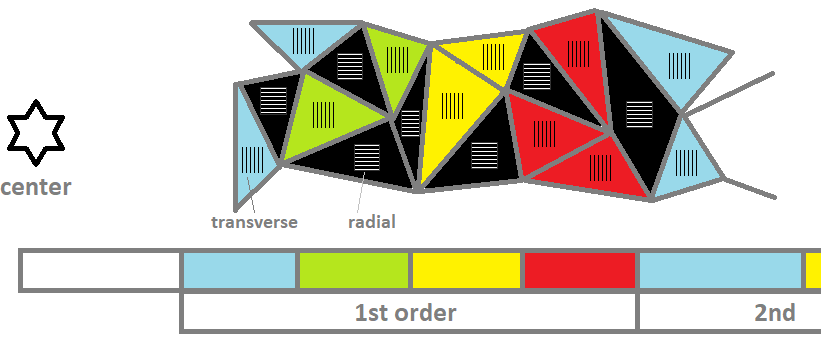
There are two possible explanations for what you are seeing:
First, the fundamentals:
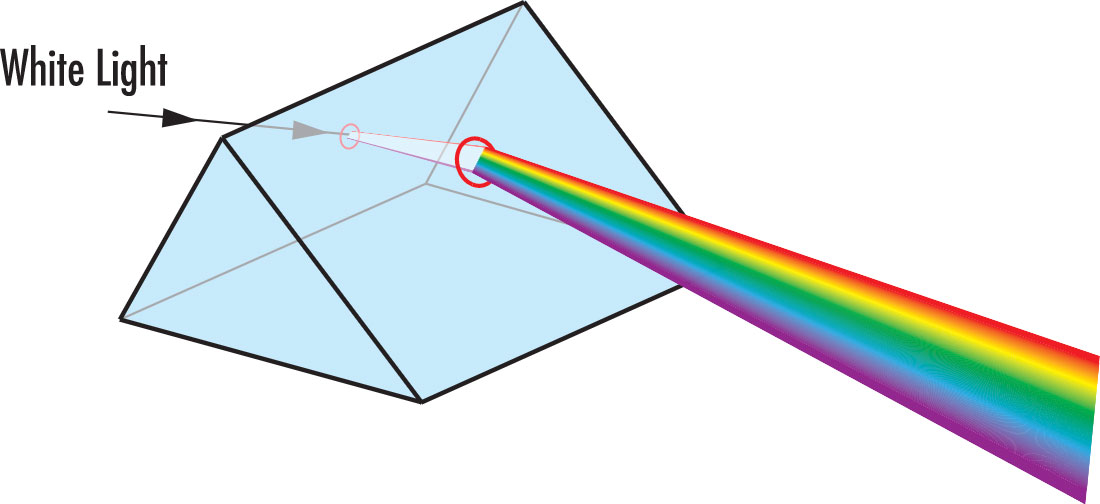
A prism is an optical device that, through normal dispersion of glass (that means, $n(\lambda)$, where $n$ is the index of refraction of glass and $\lambda$ is the wavelength of light, separates the components of white light due to the different optical paths that each wavelength travels through the material, resulting in the spectrum becoming clearly visible at the output window of the prism.
For your window, it is important to know a few things:
- Is the window really made of cut glass, or is that a film (as others pointed out) that has tinted sections? I personally think this is not the case, as the pattern looks rather structured (for rainbow films I have seen that the colors are more unevenly distributed).
- Does this only happen at night? Is the moonlight directly hitting the window?
- Does this also happen with sunlight?
The last 2 questions I don't think they are too important, it is just to understand better how the window itself is built.
Based on the picture only, I would assume that the cut glass is somehow circular in design (as it happens when, for example, in nature, the shape of raindrops is roughly spherical leading to the circular rainbow pattern). Therefore, I would broadly speculate that the cut glass is somehow thicker at the center causing the normal dispersion in glass, or maybe the light source plays a role.