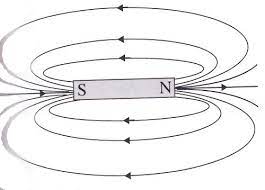
The equations satisfied by $\vec{H}$ are : $\vec{\nabla} \times \vec{H}=\vec{0}$ and $\vec{\nabla} \cdot \vec{H} = - \vec{\nabla} \cdot \vec{M} $
One might think that $\vec{\nabla} \cdot \vec{M} = 0$ because $\vec{M} $ is uniform. But it's wrong. We must not forget that $\vec{M} $ is discontinuous on the surface. Using the distribution's formalism, we can show that $\vec{\nabla} \cdot \vec{M} $ corresponds to two surface layers $\sigma = -M$ on the upper face and $-\sigma = + M$ on the underside (The "magnetic charges" at the poles of the magnet). Finally, the vector $\vec{H} $ has the same shape as the electrostatic field of a plane capacitor. But it is directed downwards: it is the "demagnetizing" field which tends to demagnetize an open magnet.
If the magnet is very long, we find that $\vec{H} \rightarrow \vec{0}$ except near the edges. The magnetic field $\vec{B} $ then tends towards $\mu_0 \vec{M} $ inside the magnet and towards $\vec{0} $ outside.
In electrical engineering, it is sometimes stated that the field $\vec{H}$ is controlled by free currents but this is only true if the demagnetizing field is zero. In particular, this is true for a torus or a very long cylinder. It is this type of geometry which is used to obtain the hysteresis cycle of a magnetic material and indeed, in this case, the vector $\vec{H}$ is directly controlled by the intensity which circulates in the winding of the primary. (If the secondary is traversed by a negligible current)
We could also obtain $\vec{B} $ directly by using the equivalent magnetization currents:
$\vec{j_m} = \vec{\nabla} \times \vec{M}$ .
We will have :
$\vec{\nabla} \times \vec{B}=\mu_0 \vec{j_m}$ and $\vec{\nabla} \cdot \vec{B} =0$
Again, one might think that $\vec{j_m} = \vec{\nabla} \times \vec{M} = \vec{0}$
But it's wrong. Again, we must not forget that $\vec{M} $ is discontinuous on the surface. Using the distribution's formalism, we can show that $\vec{j_m} = \vec{\nabla} \times \vec{M}$ corresponds to surface current $\vec{j_m} = \vec{M} \times \vec{n} = M \vec{e_\theta}$ . Clearly, the vector $\vec{B} $ has the same shape as the magnetic field of a solenoid.
One can note that with this equivalence, one proves "rigorously" that the magnetic field outside an "infinite" solenoid tends towards $0$. But it is a bit tortuous method!
Hope it can help and sorry for my poor english.