1

I understand Gauss's law. I also understand that by gauss's law, for the infinite plate of charge(uniformly distributed), Electric field is the same everywhere which means it doesn't depend on the distance.

While I truly understand the proof of gauss's law and also its usage and proof why E is the same everywhere for infinite plane of charge, I can't still make sense of it logically in a physical sense.

Imagine there's infinite length of plate. Then, from it, at distance P, we know E is σ/2ε. But now, if we imagine the point from plate at distance P+100, we can easily see that there's higher distance between P+100 and each charge than it was for the point P. So the electric field definitely must be smaller, but it's not since however we proved it for point P, the same proof will give us exactly the same for P+100.

What am I missing in terms of logical explanation(no need to include formulas, I understand them)?

UPDATE

@J.Murray | @Jacob Stuligross, I think there're lots of approximations being made here.

  1. we assume the ring can be rolled and used as a rectangle whose width is dx(the thickness of ring) and height as 2px(x is radius). x is definitely inner radius. Though, it quite won't be rectangle as if you say we got dx as thickness, then after rolling the ring, one height is x, second height is 2p(x+dx). So if you still treat it rectangle, we definitely lose some very small rectangle areas and are we sure it's so small charge won't be there ?

  2. from the above point to the ring's points, cone is assumed to be drawn. While I agree that from apex to each point of the outer ring's edge, they're the same height(important since if not we can't treat it as if area * E_change holds true. if they're the same height, then true, all points of rings are distanced away from P by the same value, but this assumption means that there should not be multiple charges in the shell area(outer - inner). If there're more than 1 charge there, distance from it to our reference point wouldn't be the same as the distance between apex and outer edge. Hence calculation won't be fully correct, but since you bring dx there, i assume it's small, but still holds charges. if it holds multiple charges, it's bad. Any thoughts ?

Giorgi
  • 535

2 Answers2

8

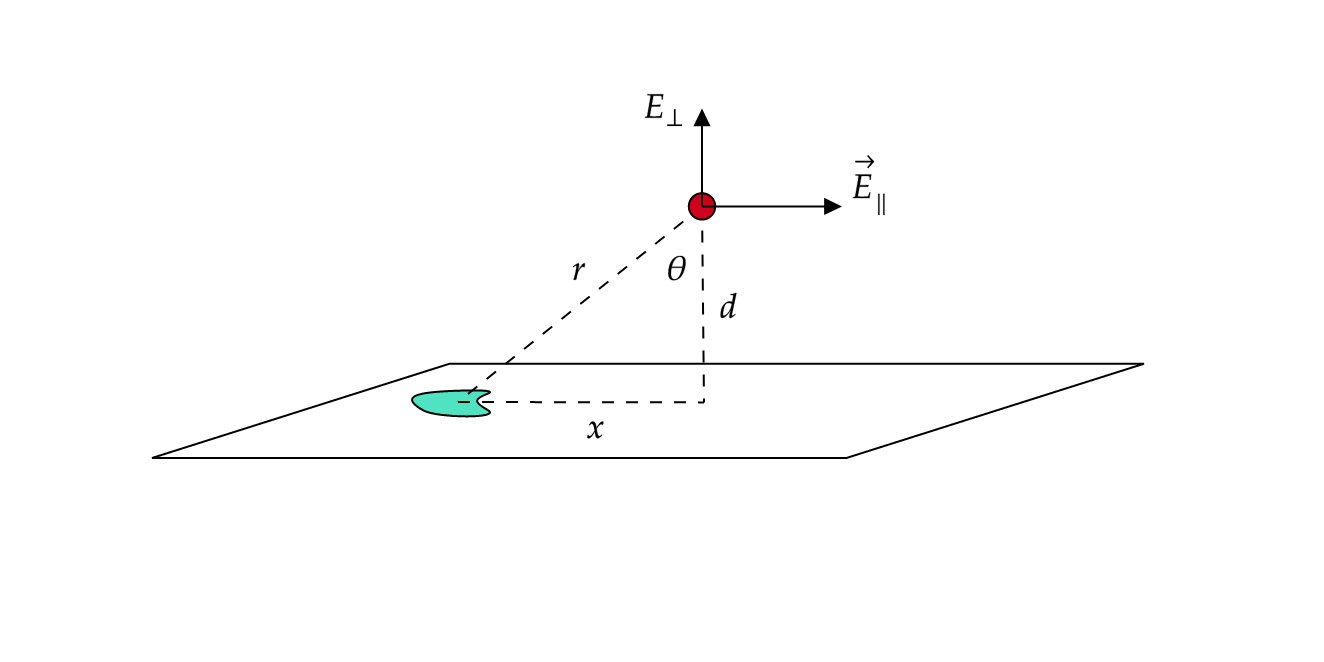
The contribution to the field due to any particular patch of charge on the plate has a component which is perpendicular to the plate and a component which is parallel to the plate. When you sum over the entire plate, the parallel components cancel each other out and the perpendicular components add together to give you your net field.

enter image description here

Since the $\vec E_\parallel$'s all cancel out due to symmetry, the relevant contribution is $E_\perp$, given by

$$E_\perp = \frac{dA}{r^2}\cos(\theta)=dA \frac{d}{(x^2+d^2)^{3/2}}$$

where I've ignored the Coulomb constant and charge density. When we make a tiny step $d\mapsto d+\delta d$, the change becomes $$\delta E_\perp = \frac{x^2-2d^2}{r^5} \delta d$$

Observe for $x>d\sqrt{2}$, $E_\perp$ actually increases when you take a step away. Even though the magnitude of the force goes down, the change in angle more than compensates. Defining polar coordinates $(x,\phi)$ on the plane, we can write the total contribution as

$$\int_0^{2\pi}\mathrm d\phi \int_0^\infty x\mathrm dx\ \delta E_\perp = 2\pi \delta d\left[\int_0^{d\sqrt{2}} \mathrm dx \ x\left(\frac{x^2-2d^2}{(x^2+d^2)^{5/2}}\right) + \int_{d\sqrt{2}}^\infty \mathrm dx \ x\left(\frac{x^2-2d^2}{(x^2+d^2)^{5/2}}\right)\right]$$ $$= 2\pi \delta d \left[-\frac{2}{3d\sqrt{3}} + \frac{2}{3d\sqrt{3}}\right] = 0$$

So the take-away is this: When you move away from the plate, the magnitude of the field from each patch decreases as you'd expect. However, for sufficiently far away patches, this results in an increase in the perpendicular component of the field due to the corresponding change in angle. When you sum over the whole plate, the positive changes to $E_\perp$ (which correspond to patches with $x>d\sqrt{2}$) precisely cancel the negative changes (corresponding to patches with $x<d/\sqrt{2}$) with the net effect being that the total field does not change.


Now that the intuition is (hopefully) there, we can see this more cleanly by noting that the total perpendicular force can be written

$$ E_\perp = \int_0^\infty \mathrm dx \frac{2\pi x d}{(x^2+d^2)^{3/2}}$$ If we define $u\equiv x/d$ and substitute, we see that the $d$-dependence completely drops out. Even more simply, observe that if we assume

$$E_\perp = k_C^a\sigma^b d^c$$ then dimensional analysis yields immediately that $c=0$.

Albatross
  • 72,909
2

This is because infinity is a very weird thing. In this case, it presents a scale invariance to our system. That is, an infinite plate doesn't appear to get any smaller as you move away from it.

If you consider any individual point, its contribution does weaken as you move further away, but if you then take the sum contribution of all of the points within some given solid angle, that number of points will increase as you move away and the contributions of the additional points offsets the loss due to distance.

We consider the infinite plate because it closely resembles what is experienced by a charged particle very close to a finite plate much larger than it. In such a system, while there isn't true scale invariance, it's very close.