7

enter image description here

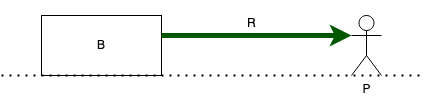
In the diagram above, person $P$ is pulling block $B$ by a massless rope $R$, and they are all accelerating in the indicated direction.

  • If the force that $P$ applies to $R$ is $F_{P,R}$, then to my mind the force $R$ applies to $B$, $F_{R,B}$ is such that $F_{P,R} = F_{R,B}$.

  • By Newton's Third Law, $F_{R,B} = - F_{B,R}$.

The sum of forces acting on $R$ is $$\sum{F_{,R}} = F_{P,R} - F_{B,R} = 0.$$

Why does $R$ accelerate?

Qmechanic
  • 220,844

3 Answers3

12

person P is pulling block B by a massless rope R … Why does R accelerate? (emphasis added)

The rope is taken to be massless, so no force is required to accelerate it. By $\vec F_{net}=m\vec a$, if $m=0$ then $\vec F_{net}=0$ for all $\vec a$. So you cannot use Newton’s 2nd law to determine the acceleration of a massless object. That information must come from something else.

In this case, the right end of the rope is attached to the person so the right end of the rope has the same velocity as the person. Furthermore, the left end of the rope is attached to the block so it has the same velocity as the block. Finally, the rope is inextensible which means that the left and right ends must have the same velocity. These constraints require the rope to accelerate to match the other objects (and require the other objects to accelerate together).

So it is the constraints that determine the acceleration of the rope, not Newton’s 2nd law. The acceleration is compatible with Newton’s 2nd law, but the law is not sufficient to determine the acceleration. This is generally true for massless objects.
Dale
  • 117,350
6

The problem has been idealized to make it easier to focus on the key point. This point is how a mass accelerates under forces. The rope is just a way to transmit force between a person and a mass or between two masses. Some of its real properties have been idealized away, such as mass, stretchiness, etc.

So if you ask reasonable questions about the rope, you may get nonsense answers.

Mostly people ignore the nonsense. But when asked, they try to make it reasonable by supposing the rope is really light or taking the limit as the rope's mass approaches $0$. In more advanced classes, you will be asked how a massive rope behaves.

mmesser314
  • 49,702
4

In a more realistic system, when $R$ is not massless, some amount of the resultant force on it will be present (informally: a part of the force applied by $P$ is expended on $R$, and another part on $B$), so $R$ will accelerate as expected.

When $R$'s mass $m_R=0$ and the resultant force on it is $F_R=0$, the equation $a=\frac{F_R}{m_R}$ isn't mathematically meaningful.