A small correction: massless objects have to travel at the speed of light. Massive objects can't move at the speed of light. So let's consider two massive observers, moving at a speed of say 99% the speed of light.
As a second note, the situation is completely symmetric with respect to the two observers (considering they are both massive). So the effects that I describe below appear the same for both observers. Consider two observers Alice and Bob. If Alice, from here perspective, sees Bob's clock ticking slower, then Bob will see Alice's clock ticking slower from his perspective.
There are four interesting effects that happen because of special relativity
- Length contraction
- Terrel rotation
- Doppler shift
- Time dilation
Length Contraction
Length contraction means that objects that are moving close to the speed of light in a certain frame will be shorter in the direction of movement. As an example of how 'real' this effect is, consider the ladder paradox (or barn-pole paradox). Imagine a barn with width $L$ which has two doors, one in the front and one in the back. A ladder moving close the speed of light is moving towards the barn, whose doors are open. The length of the ladder is chosen such that at rest it wouldn't fit in the barn, but when it is moving close to the speed it will fit in the barn. Right when the ladder is inside the barn, the two doors are briefly closed and then opened again. Because the ladder is length contracted this is perfectly possible. The paradox arises when we switch to the frame of the ladder. In the frame of the ladder, the ladder is no longer length contracted so it has its original size. Even worse, the barn is now length contracted and so it is smaller! If the doors close, will the ladder fit inside? The answer is yes, it turns out that in the ladders frame the doors close at different times and so the ladder will fit inside. For more details see the wiki link I provided.
Terrel Rotation
Terrel rotation is a purely visual effect. It means that objects viewed from the side appear rotated. This effect occurs because light from the left of the object reaches your eyes earlier, just like light from the front of the object compared to the back. What you see when you are right in front of the object is a combination of light from the left of the object and from the (now contracted) front of the object, which appears as a rotation to you. Straight lines also appear curved, which is again purely visual.
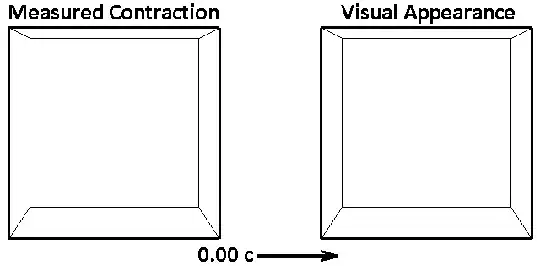
Image credit: By Stigmatella aurantiaca - Own work, CC BY-SA 4.0, https://commons.wikimedia.org/w/index.php?curid=58075763
Doppler Shift
Doppler shift means that object moving towards you appear blue-shifted, while objects moving away from you appear red-shifted. This is similar to how the pitch of an ambulance changes as it moves towards/away from you, but now for photons.
Time Dilation
Time dilation means that the clocks of objects which are moving fast in your reference frame appear to slow down. Like length contraction, this is a very real effect. As an example of this consider muons generated in cosmic rays (1). When cosmic rays hit the upper atmosphere of earth, they sometimes generate muons, which are particles similar to electrons. They have a very short lifetime: they have a half-life of about 2 microseconds. When we don't take relativity into account, we would basically no muons to ever hit earth. But, because from our perspective the clocks of muons are slowed (about 7 times!), more muons reach the earths surface than we would initially expect. In fact, this agrees with what we see.
(1) Relativistic Effect of Cosmogenic Muons Efrain Covarrubias,
B.S. Candidate, Department of Physics, California State University Stanislaus, 1 University Circle, Turlock, CA 95382


