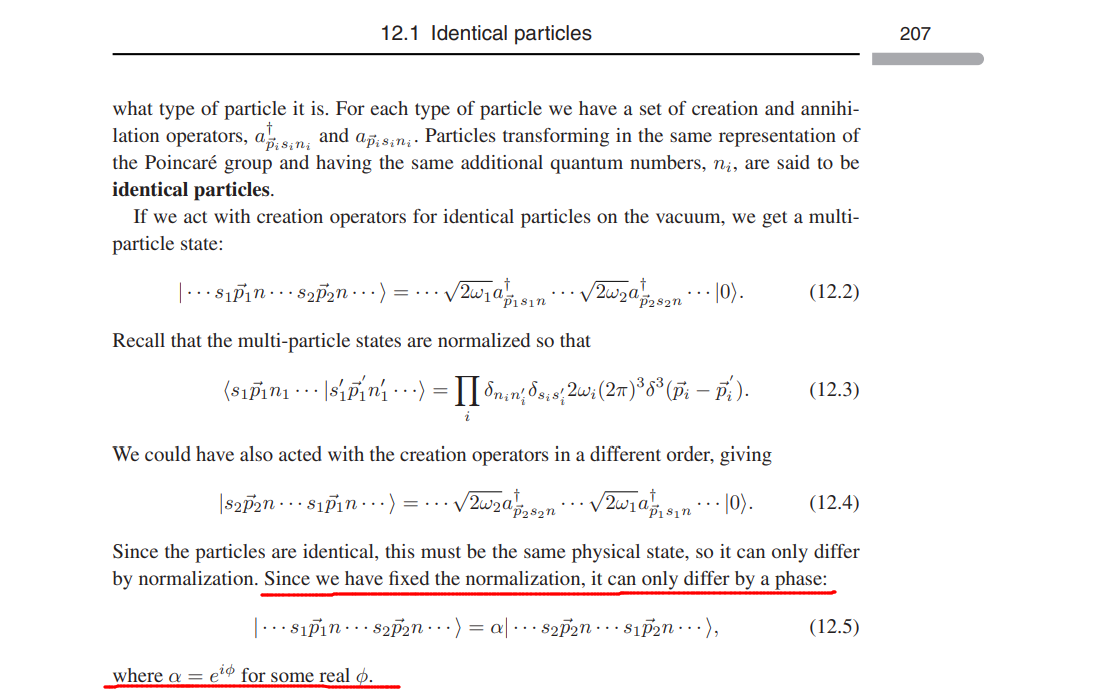
First, Schwartz is technically talking about indistinguishable rather than identical particles. Two electrons are identical but if one is on Mars and the other on Earth they are distinguishable: see this question.
If the particles are indistinguishable, then the labelling of the particles cannot affect the outcome of any measurement. Thus, interchanging any two particles $(i,j)$ in $\vert\psi\rangle$ will give $\vert\psi'\rangle$ so that
$$
\langle \psi\vert \hat{\cal O}\vert\psi\rangle= \langle \psi'\vert \hat{\cal O}\vert\psi'\rangle
$$
for any operator $\hat{\cal O}$. The only way for this to work is if $\vert\psi'\rangle=e^{i\phi}\vert\psi\rangle$.
In fact, Kaplan in
Kaplan, Inna G. "The exclusion principle and indistinguishability of identical particles in quantum mechanics." Soviet Physics Uspekhi 18, no. 12 (1975): 988
provides an example where $P_{ij}\vert\psi\rangle$ is not a multiple of $\vert\psi\rangle$ and shows that the resulting average value depends on the labelling of the particles. Basically the argument boils down to requiring the state of a collection of many indistinguishable particles to transform by a 1-dimensional representation of the permutation group.
Having argued that $\vert\psi'\rangle$ must be a multiple $\alpha$ of $\vert\psi\rangle$ if the states are to give the same average values for any operator, it follows that they can only differ by a phase: the multiple must be of the form $\alpha=e^{i\phi}$ so both states are properly normalized. Since $P_{ij}P_{ij}=1$ for any transposition, if follows that $\alpha^2=1$ and thus $\alpha=\pm 1$.
This (non-relativistic) argument relies on using permutation (rather than braiding transformations) to interchange particles, so the topology of the ambient space is largely irrelevant, although quasi-particles with fractional statistics (anyons) are possible in 2d.