1

Suppose you have a ball at rest on a floor with friction. After applying a force $F$, the ball rolls without slipping. Therefore, friction from the floor should equal $-F$. Then $F_{net}=\frac{dp}{dt}=F-F=0$, but obviously there is linear momentum (towards the right) because the ball is rolling forward.

What is the contradiction here? Is my understanding of rolling without slipping correct? Additionally, if there is no friction, will the ball roll?

Qmechanic
  • 220,844

5 Answers5

14

The friction on the floor does not equal $-F$. There are three unknowns in this problem: the linear acceleration $a$, the angular acceleration $\alpha$, and the friction force $F_f$. We can produce three equations: Newton's 2nd law, Newton's 2nd law for rotation, and the no-slip condition. Writing these three equations and solving for the three unknowns will give you a $F_f \ne -F$.

$$F-F_f = m a$$ $$r_F F + r F_f= I \alpha$$ $$ a=r\alpha$$

Dale
  • 117,350
3

Just to add to @Dale 's answer (which is excellent and concise), the third equation is key to the no slipping requirement. The angular acceleration and linear acceleration of the center of mass must match for the given radius for no slipping to occur.

Hope this helps.

Bob D
  • 81,786
1

Assume a ball rolls without slipping in a straight line on a horizontal surface. If the center of mass (CM) of the ball is moving at constant velocity, there is no net force in the horizontal direction and the force of friction is zero. If an external force is applied to the CM of the ball, the force of friction acts such as to impede acceleration of the CM and to increase the rotational velocity of the ball; the net horizontal force (applied minus friction) is positive and the CM of the ball accelerates. For pure rolling (no slip), the force of friction does no work: the decrease in translational kinetic energy of the CM due to friction is compensated exactly by the increase in rotational KE of the ball due to friction with respect to its CM. Once the external force is removed, the ball continues to move at constant velocity and the force of rolling friction is again zero.

If the ball slips when the external force is applied, the force of friction does work since the decrease in translational kinetic energy of the CM due to friction is less in magnitude than the increase in rotational KE of the ball due to friction with respect to its CM.

An automobile on a level surface has no external horizontal force except friction. The internal engine increases the rotational energy of the drive wheels, and the force of friction opposes that increase thus providing a force to accelerate the car forwards.

See Is work done by torque due to friction in pure rolling? and other related discussions of friction on this exchange.

With no friction, the ball will not roll if an external horizontal force is applied to its CM; the ball slides forward on the frictionless surface. Without friction the car using an internal engine will not move forward; the wheels will rotate faster and faster.

John Darby
  • 9,601
1

Therefore, friction from the floor should equal $-F$.

The static friction force would equal $-F$ in the case of something like a block on a floor with friction. In that case, where the only potential motion is sliding (or tipping) and no rolling, the static friction force matches and opposes the applied force up until the maximum possible static friction force is reached at which point the block slides. However, in the case of rolling motion the role of static friction is to contribute to, where needed, the necessary net torque to satisfy no slip conditions (discussed below)

If you simultaneously solve the equations given in the answer by @Dale for the no slip condition, you will find the magnitude of $F_F$ will always be less than the magnitude of $F$ if there is linear acceleration $a$, thus not violating Newton's 2nd law. It is also important to keep in mind that the maximum applied force $F$ is limited to that corresponding to the maximum possible static friction force of $F_{F}=\mu_{s}mg$, which would result in slipping while rolling.

Additionally, if there is no friction, will the ball roll?

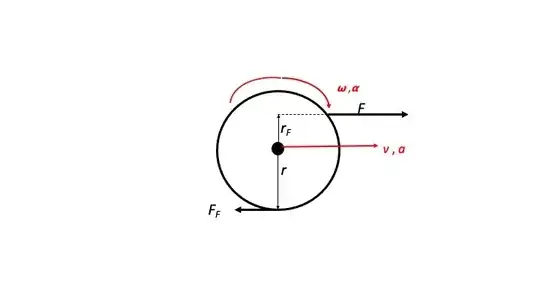
I assume you mean roll without slipping. The ball can roll without slipping in the absence of static friction if the no slip condition of $a=r\alpha$ can be satisfied with $F_{F}=0$ in the figure below.

Then, per Newton's 2nd law for linear motion we where $a$ is the linear acceleration of the ball, we have

$$F=ma\tag{1}$$

Per Newton's 2nd law for rotational motion we have

$$\tau=r_{F}F=I_{com}\alpha\tag{2}$$

Where $\tau$ = the torque applied by $F$, $I_{com}$ = the moment of inertia of ball about its center of mass and $\alpha$= the angular acceleration of ball.

The no slip condition is given by

$$a=r\alpha\tag{3}$$

Combining equations (1), (2) and (3) we obtain

$$r_{F}=\frac{I}{mr}\tag{4}$$

For a solid sphere

$$I_{com}=\frac{2}{5}mr^2\tag{5}$$

Substituting (5) into (4)

$$r_{F}=\frac{2}{5}r$$

So if the force $F$ is applied a distance of exactly $\frac{2}{5}r$ from the COM friction is not required for rolling without slipping.

However, I would argue since any deviation in the location of the applied force from the no static friction "sweet spot" would result in slipping while rolling in the absence of static friction, that the no friction condition represents an inherently unstable condition.

Hope this helps.
enter image description here

Bob D
  • 81,786
0

To get the ball rolling on a horizontal surface by the application of a horizontal force whose line of action passes through the centre of mass of the ball there must be a frictional force but once the ball is rolling with the centre of mass moving with a constant linear velocity and there is no slipping, the frictional force is zero.

If the ball starts from rest then there are two horizontal forces acting on it.
The external force $F$ and the frictional force $f$.

enter image description here

The system will try and move towards the no slipping condition, $v=R\omega$, and to that end you can think of the frictional force as trying to reduce the linear acceleration by opposing the external force, $F-f=ma$, whilst at the same time providing a torque about the centre of mass to increase the angular velocity, $fR=I_{\rm com}\alpha$.

If the external force is removed and the no slip condition is satisfied there os no frictional force on the ball and the net horizontal force on the ball is zero as is the torque about the centre of mass of the ball.

Farcher
  • 104,498