1

In my homework assignment there's the following question:

A general thermodynamic system is being compressed isentropically from pressure $P_i$ to $P_f$ while keeping the number of particles constant. write down the temperature change of the system using an integral. reduce the partial derivative in the integrand to the measurable quantities: $T,V,\alpha$, $C_p$.

The solution to the question is the following:
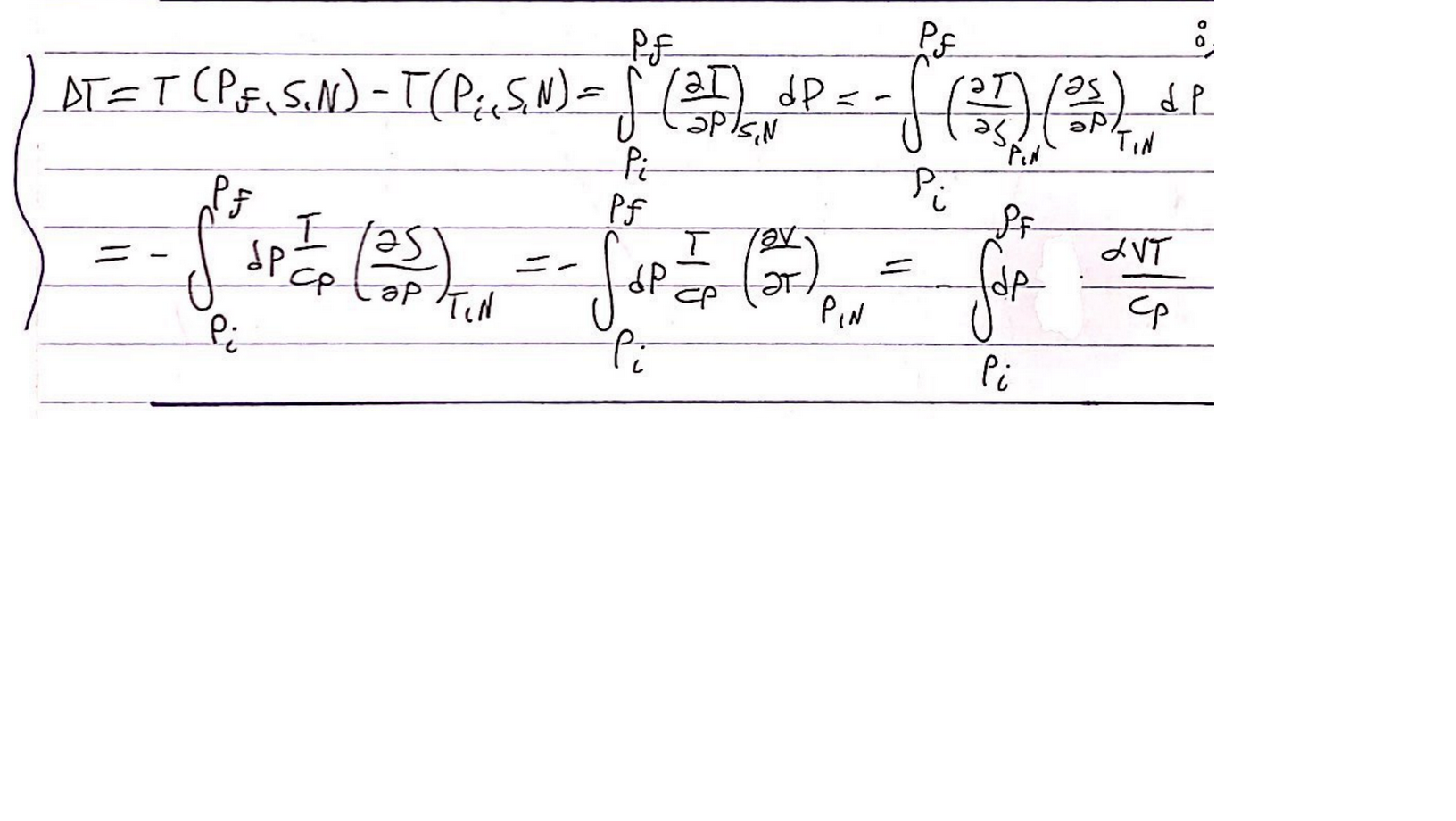
enter image description here

My question is: What was used in the transition from $\Delta T$ to the first integral over $dp$? how would one approach this question and get the correct result as seen above?

Qmechanic
  • 220,844
DAcheese
  • 127

2 Answers2

2

The first step is just the following model:

$$f(b)-f(a)=\int_a^b f'(x)\,dx=\int_a^b\frac{df}{dx}(x)\,dx$$

After that it's the triple product rule:

$$\left(\frac{\partial x}{\partial y}\right)\left(\frac{\partial y}{\partial z}\right)\left(\frac{\partial z}{\partial x}\right)=-1$$

That's a big trap compared to the 2D case.

Edit: the starting point is about which variables $H$ depends on.

Without going into too much details, let's start with internal energy $U$. Its differential form, for a system without chemical reaction or phase transition, is:

$$dU=T\,dS-P\,dV$$

Spotting the $dS$ and $dV$ terms, it means that $U$ is naturally a function of $S$ and $V$.

Then you define $H=U+PV$. Its differential form is:

$$dH=dU+P\,dV+V\,dP=T\,dS+V\,dP$$

which means that $H$ is naturally a function of $S$ and $P$.

So, to answer the question you added in your comment: mathematically speaking, you have to decide from the start which set of variables you're working with. Since you're studying $H$, those are $S$ and $P$, and $N$ (I didn't mention it before because $N$ is constant as long as there's no chemical reaction or phase transition).

Miyase
  • 6,342
1

This is not how I would have solved this problem. I would first have written: $$ds=\left(\frac{\partial s}{\partial T}\right)_PdT+\left(\frac{\partial s}{\partial P}\right)_TdP=0$$In addition, $$\left(\frac{\partial s}{\partial T}\right)_P=\frac{C_p}{T}$$and, from a Maxwell relationship, $$\left(\frac{\partial s}{\partial P}\right)_T=-\left(\frac{\partial v}{\partial T}\right)_P$$So, combining these equations gives: $$\left(\frac{\partial T}{\partial P}\right)_s=\frac{T}{C_p}\left(\frac{\partial v}{\partial T}\right)_P=\frac{\alpha vT}{C_P}$$

Chet Miller
  • 35,124