To understand why Young was able to realize his experiment with sunlight, we first need to understand a little bit more about the sunlight.
To say that sunlight is incoherent is the same to say that it has a low degree of coherence, but how much? And what kind of coherence measure we are talking about?
When we have a point source, any two points in its front waves, no matter how distant, could produce interference when averaged over time.
But we how there are no point sources in nature, just approximately dimensionless in some cases. It means that different points over the source will produce different wave fronts, not necessarily in phase with other points. The resultant profile of the wave front will not necessarily be all regular. The distance between two points in the wave front that could produce interference defines a diameter used to estimate the coherence area. We can use this measure to say how much the sunlight is coherent.
We should be aware about it to do an interference experiment, since our first slit width should not be greater than the diameter of the coherence area in order to observe diffraction from it. If the conditions of the experiment matches the coherence area previous mentioned, we can say that our light is coherent, at least for this experiment.
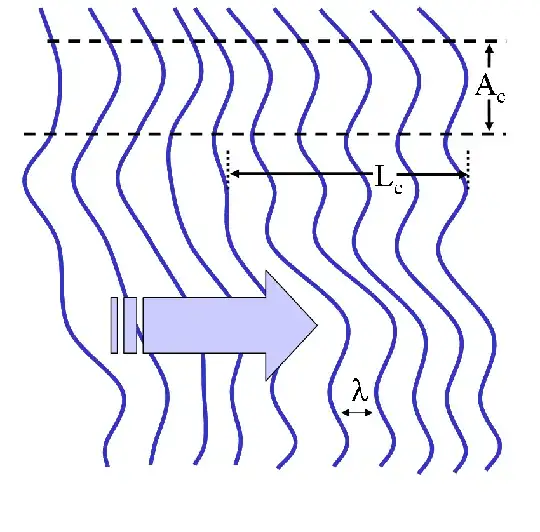
In this article we find the following formula for the coherence area
$$
A_c = {\lambda^2D^2\over A_S}
$$
where $D$ is the distance from the source, $\lambda$ is the wave length and $A_S$ is the area surface of the souce. For the Sun, considering that for visible light we have $\lambda \propto 10^{-6} m$ and $D\propto 10^{11} m$ and $A_S \propto 10^{18} m^2$, we get $A_c\propto 10^{-8} m^2$. So the slit should have a width at most $10^{-4} m = 0.1 mm$, with matches in order of magnitude the slit width usually considered in this experiment (I searched for the Young's original data, but apparently he didn't mention the quantitative details of his experiments in his documented lectures).
After the sunlight passes the first slit, it will behave approximately like a pointwise source and we can place the two slits a little bit farther than previous calculated diameter, since know the coherence area will be greater.
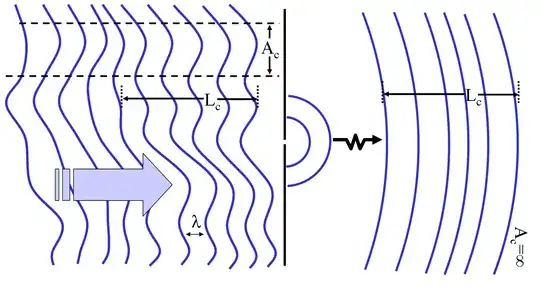
The only thing Young was not able to eliminate is the frequency length $\Delta \omega$ of the sunlight, which produced many superposed interference patterns for each different frequency. In this video, the YouTuber Veritasium made the Young's experiment with a box and test it by himself, and you can see how the pattern looks like.
The images was created by J S Lundeen and posted in English-language Wikipedia, in the aforementioned article. I just copied them here for convenience.


