38

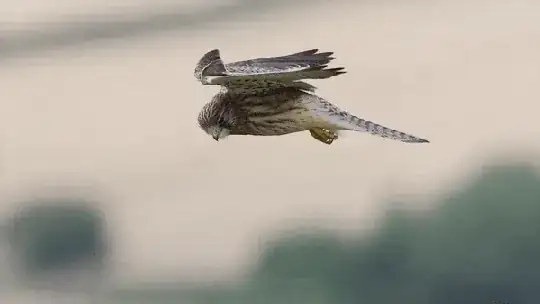
Kestrels are birds of prey commonly found in Europe, Asia, Africa, and the North America. They belong to the falcon family but have a unique ability to hover in the air. You can find a whole bunch of videos (See 1,2,3,4, for example) about these fascinating creatures if you search "Kestrel hunting."

(You can click the images below to see the videos)
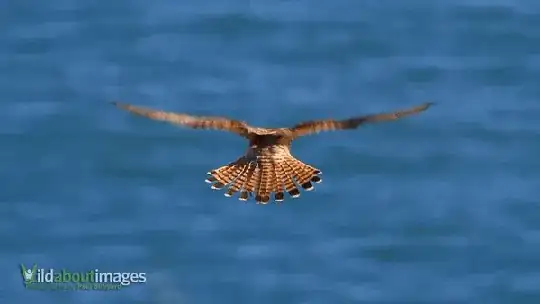

back_view

Rearview : Video from wildaboutimages (link here)
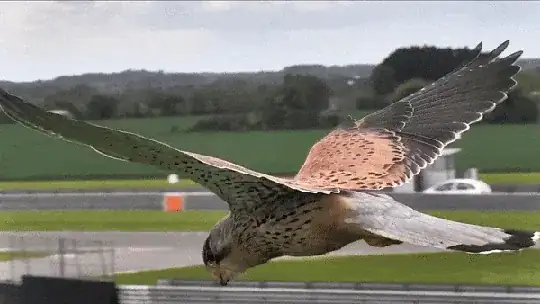

kestrel_hover

Video from viralhog (link here)


kestrel_slomo

Side view in slow motion: Video from wildaboutimages (link here)


While I admire how they stabilize their head, I am fascinated by their ability to remain still in the air. Note that the bird doesn't have any external support and doesn't flap its wings during this process. There is no horizontal displacement even though there is a reasonably strong wind flow (enough to support its weight).

Why doesn't the bird get thrown backward like, say, a paper plane would in the wind?

While it could be possible that the movement is so small for us to see, watching and rewatching the video makes me think otherwise. Did the birds finally manage to get rid of drag, or is this some very delicate balancing of forces?

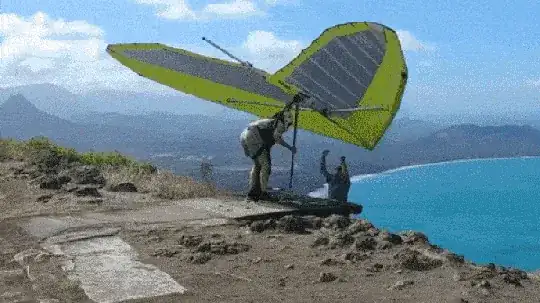
It should also be noted that this behavior is not limited to Kestrels or even birds. See this video of a barn owl hunting, for instance (not as impressive, but worth mentioning.), or this video where a hang glider gracefully hovers in the wind.
hangglider

AlphaLife
  • 13,439

6 Answers6

25

A free-body diagram for a fixed-wing airfoil takes into account four interactions: weight, thrust, lift, and drag. For an unpowered airfoil, the thrust is zero.

Glider free-body diagram [source]

These are approximately mutually perpendicular, but not quite:

  • The weight force always points down.
  • “Drag” is the part of the aerodynamic interaction that’s antiparallel to the motion through the air.
  • “Lift” is the aerodynamic interaction that’s perpendicular to the motion through the air.
  • The direction of thrust (in powered flight) depends on the orientation of your engine.

If the motion of the wing through the air is perfectly level, then the lift and drag forces are vertical and horizontal, and constant-velocity motion (including zero-velocity motion, like hovering) is impossible: there’s nothing to oppose the horizontal drag force, so the wing will accelerate in the direction of the drag. Likewise, if the motion of the wing through the air has an upward component, then the horizontal parts of the drag and the lift point in the same direction. But in the illustration, the motion through the air has a slight downward tilt, which means the lift vector has a forward-pointing horizontal component that can in principle cancel out the horizontal part of the drag.

The kestrel is “hovering” by gliding on a very slight updraft, so that its airspeed exactly cancels the wind’s velocity.

Seagulls also hover, and they do so in flocks. When you see a flock of seagulls hovering, they all do so facing the same direction, and tend to hover relatively close to each other. That’s the place where the updraft is the strongest.

rob
  • 96,301
11

The three main forces acting on the Kestrel are shown by the arrows below (left).

There is the vertical weight, the lift from the air flowing over the wings and the drag force of the wind, (the blue arrow going slightly upwards, as described in Rob's answer).

enter image description here

These three forces must have a resultant of zero, they make a 'triangle of forces', right diagram.

(seagulls do it too)

John Hunter
  • 13,830
9

Only if there is an up-draft

Yes, you are perfectly correct in that — had the wind been only horizontal along the ground — hovering would have been impossible (without the bird actively adding thrust on its own).

So in all these cases, the bird is using a very slight up-draft to find that motionless state.

The same goes for that glider. Note that they are starting at the edge of a beginning downslope. This means that — since they are facing a head-wind — that the wind is rushing up the slope, and therefore has a significant vertical component.

Hence, in relation to the moving air-mass, the bird and the glider are gliding down, but because of the air's upward motion — in relation to the ground — it can cancel out or — in the case of the glider — overcome the downward motion of the flyer.

After that it is merely a question of adapting horizontal drag such that the horizontal velocity component is also cancelled out, and that enables some birds to hover apparently motionless.

MichaelK
  • 1,130
  • 6
  • 11
3

By very accurat direct variation of lift and drag of its wings.

As Nasa and the other answers point out, three main forces act upon the bird. Lift, drag and its body weight. Forces on a glider The (controls) problem for the bird is now to balance these three forces, which is further complicated as it also has to keep its rotational attitude while the wind rapidly changes magnitude and direction.

The bird is only able to achieve this by directly modifying the lift and drag forces it is generating with its wing. You can actually see that on the video, the bird rotates its wing (in order to generate more lift) or it slight folds and unfolds its wings in order to vary its wingspan (in order to decrease lift and drag combined). The key is that it can directly affect how much lift and drag is generated. If were unable to do so, the bird would either rise up or down, or would get carried away horizontally in either direction. You can see this exact effect in your second edit, in which you reference a hang-glider, which climbs away.

As a side note: It also has to keep its rotation, which it achieves with its tailfeathers and differential lift components of its wing as well as differential drag of its wings. This goes to show that this is an increadible feat of the bird to control its lift and drag forces as well its rotation just such that its head is able to balance out the remaining motion. This is simply incredible.

P.S. perhaps this question would be a better fit for aviation.stackexchange...

U_flow
  • 179
1

Basically, the lift force generated by the air passing around their wings is not perfectly upwards perpendicular to the ground; instead, it is a bit tilted forward. The forward component of that force happens to be exactly the same as the backward component of the wind, while the upward component of the lift happens to be the same as the gravity force. All the forces cancel out, and the bird is hovering motionless.

1

The bird is using a relatively simple closed control loop to maintain its position. As shown in the diagrams of the forces acting on airfoils/airplanes, there are forces in all directions, and their concrete value depends on the geometry of the wing(s). The animal, in turn, has techniques to move in all directions by relatively minor movements, and "just" cancels out the wind movement.

If you look at your videos you see that the birds, while not quite flapping, do in fact move their wings and tail substantially. This constantly updates their position and velocity relativ to whatever target they want to meet, as the "microspeeds" of the wind around the birds change.

You see something similar in, say, wildwater kajaks surfing in standing waves. They stand still on absolutely ferocious water with very little effort (all the paddling you see going on there are to perform their tricks). With a bit of practice, you can stand very still in a wave (if it is less turbulent than in this example and you're not that hyperactive as these persons) with only minute weight shifting and a very occasional little touch of the paddle on the water surface for braking. In this case, the forward force cancelling out the water movement comes through the angle of the boat and gravity.

The same is true for the bird, and quite visible in the videos. If the bird needs to move forward relative to the wind (but not to the floor), it just does whatever a bird does to fly forward (i.e., angle its wings a little bit "down").

The real magic, for me, is, how that little thumbsized brain (if it is that large at all) manages all that processing in realtime. Nature on fire!

AnoE
  • 3,025