2

Based on the discussion with chemomechanics under his answer of this post, I post this new question on how the mechanical work to construct a system is $PV$.

From ChemoMechanics's answer:

Me:Why is the energy required to make space for the rabbit exactly given as pV? How would we prove that it is so from first principle?

Mechanical work is calculated as $dW=p\,dV$. The pressure is that of the atmosphere, which can be assumed to remain constant because it's much larger than the system. Integrate over the system volume $V$ to obtain $pV$

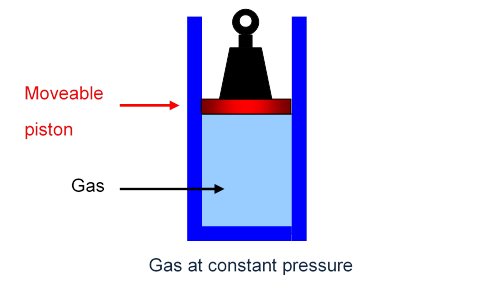
Suppose that instead of the rabbit we wanted to construct a ideal gas ensemble from out of thin air with the gas having state variables $(P,V,T)$ source

enter image description here

I am assuming the conjuration is not instantaneous, that is it takes some time to conjure up the system. In this case, the gas in system will reach a significant pressure state relative to the atm before the total process is complete. At this point, the piston pressure would equilibrate with the atmosphere and how much work that is done when reach the final state is dependent on what path we take. (maybe we go from the state we have to final adiabatically, or maybe isothermally etc).

Hence, how can it be that the work is always pV?

Qmechanic
  • 220,844

1 Answers1

1

Thank you for clarifying your earlier comment.

How much work that is done when reach the final state is dependent on what path we take.

This is not true, because (1) we know the initial state (very large atmospheric volume of $V_0$ and zero temperature, in this cartoon idealization) and the final state (atmospheric volume $V_0-V$, where $V$ is the system volume, and zero temperature) and (2) only mechanical work is involved in this decoupled step.

(Why is the temperature zero? Because we haven't allowed the surroundings to heat the system to ambient temperature $T$ yet, as specified in the cartoon.)

Thus, I can pick any path between these two states, with the same result. I'll pick the reversible path of quasistatic adiabatic expansion of $\Delta V=V_0-(V_0-V)=V$ against the constant atmospheric pressure $P$, yielding required work of $PV$.

You can envision this process as the magician moving the rabbit from a region of vacuum into a region at atmospheric pressure, say, by sliding it out through the wall of a vacuum container. Analyze it as you prefer, incorporating various processes as you desire (perhaps an initial expansion to $2V$, perhaps, followed by compression to a final $V$), as the net result between the two fixed states must be the same.