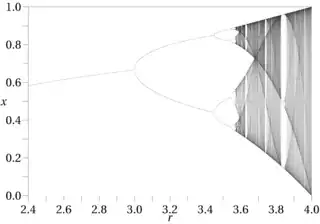
Yes you can estimate the dimension by box counting.
It is not quite hand waving but the idea has an advantage to be intuitive.
1) You consider the logistic map attractor like an analogy to a Cantor set whose dimension you can compute by box counting.
2) You remember that when the chaotic bands double, their sizes scale like $1/a$ and $1/a^2$ where $a$ is the second Feigenbaum constant, $a \approx 2.5029$. So the procedure looks like the Cantor set production because at each doubling you "remove" a part of the previous band. The difference being that the new smaller 2 parts have not the same size like in the Cantor set.
3) You suppose that at the Nth doubling you need $2^n$ boxes of size $R_n$ to cover the bands. Then at the $N+1$ stage you will need $2^{n+1}$ boxes of average size
$$
R_{n+1} = \frac{R_n}{2}\left(\frac{1}{a} + \frac{1}{a²}\right).
$$
The hand waving part is the arithmetical average because there is no rigorous reason to use it but one sees the idea of approximation.
4) The box counting dimension is then
$$D_b = - \frac{\log 2}{\log(1/2(1/a + 1/a²))} = 0.544$$
You will admit that the hand waving was not so bad because one is not far from the much more rigorously derived value of $0.538$.
As a particular remark, the box counting is not very practical when the attractor is not strictly self similar like f.ex the Cantor set because the results depend then on the particularities of the covering method chosen