8

Today, the obliquity of the earth is about 23.4°. 6500 years ago, it was about 24.1°

enter image description here

Imagine the blue square is the constellation of Orion, and the yellow star is the sun. Viewpoint B is you, on earth, today, when the obliquity is 23.4°. When you look at Orion, you see it as below the ecliptic. But with a change in obliquity, your viewpoint moves to Viewpoint A. Now when you you look at Orion, it appears to be on the ecliptic.

Am I correct, or have I got it wholly wrong?

I realise the diagram greatly exaggerates the angles, as well as condenses the distances, but the principle is there. The question is, does the principle apply in the case of Orion?

I'm exploring a hypothesis that at some time in the past (I chose the date of 6500 years ago, because the Vernal Equinox was closest to Orion at that time), Orion seemed to be closer to the sun's path than it does today. However, it has been suggested to me that it may actually have been further away.

So, would the change in obliquity have any effect on the view of Orion, or not?

EDIT after first 2 answers

Here's an image that better expresses what I mean:
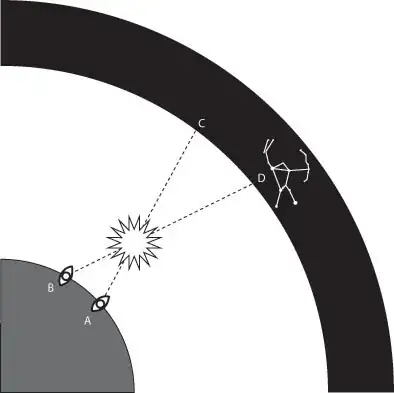
parallax

Your viewpoint A is where you are on earth today, when the earth is at 23° axial tilt. Looking at the sun, you see no stars on the celestial sphere behind it. But when the earth was tilted 24°, when you look at the sun you see Orion behind it. (Obviously, this is imaginary, as you don't see the sun and stars in the sky at the same time, but it illustrates the principle of where the ecliptic is.)

Because the celestial sphere is much further away from the earth than the sun the distance C-D seems much greater than the distance A-B, even though the angles are the same. So the optical effect is that Orion appears on the ecliptic, or not, depending on what angle the earth is tilted at. Yes or no?

2nd edit

Without wishing to sidetrack, it might help if I explained why I'm so interested in this. I'm studying Egyptology. Among the few certainties we have are that a) their religion/myth was astronomically based, and b) their god Osiris was the constellation of Orion. Now, Osiris' name is written with the hieroglyphs of an eye and a throne. Because the eye is a common symbol for the sun, Egyptologists such as Lefebure and Brugsch, and others, have suggested that the name simply means "the seat, or throne, of the sun (god)". This is disputed by others, of course.

Now I'm re-examining the problem, without having a vested interest, one way or the other, in the outcome. My reasoning goes like this; a phrase such as "the seat of the sun" or sometimes "house of the sun" is well-documented in many ancient cultures as referring to a stage in the sun's path; that most often seems to refer to the equinoxes or solstices, but can also refer to the zodiacal constellations. The implication is that Orion was given this name because of some sort of relationship between him and the sun. 6500 years ago, the Vernal Equinox was directly above Orion: above, but not in, because Orion is not on the ecliptic.

However, Egyptian myth tells us that Osiris was murdered by being struck down (or in a variant text, drowned). This implies a downward movement. The name "the seat of the sun" makes absolutely no sense whatsoever, unless the Vernal Equinox was actually in Orion, and not several degrees above it. And so, I'm wondering if the myth of Orion/Osiris being struck down or drowned is somehow an attempt to describe the visual effect of an axial shift; I'm hypothesising that perhaps 6500 years ago, from the viewpoint of an observer on earth, the sun did appear to be closer to Orion than it currently is, close enough to be described as in rather than above.

We cannot be absolutely sure precisely which stars of Orion represented Osiris for the Egyptians; we only have a general idea. But it's a fairly safe bet that the principal 7 or 8 stars of the 'hourglass' shape were included. Also, as Orion was frequently depicted in astronomical texts with one arm raised, much like the constellation is today, it's very probable that Chi 1 and Chi 2 Orionis were also included.

So, in order to demonstrate that, at the time of the Vernal Equinox, the sun was in Orion, I would need to somehow show that the sun appeared slightly lower in the sky, not necessarily low enough to cross Orion's Belt (which would be more than I could possibly hope for!), but low enough to even cross his raised arm. That would probably be enough. Look at the map: it's only a few degrees from the ecliptic to the arm... is there no way this could be possible?

It's not exactly a world-shattering event, but it would settle a long-running debate between Egyptologists once and for all.

Rob
  • 81
  • 5

3 Answers3

4

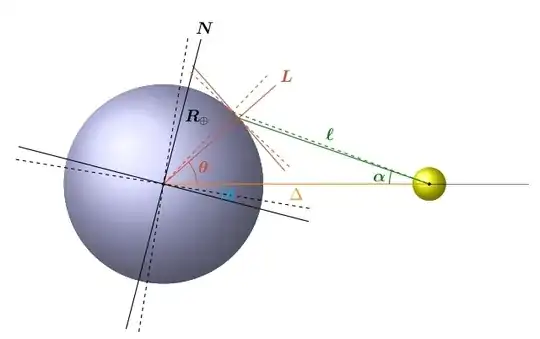
The effect that you're describing is extremely small. Have a look at the following figure:

enter image description here

Here you see the position of the Sun from a location $L$ on Earth. Let's call $R_\oplus$ the radius of the Earth, $\Delta$ the distance between the Earth and the Sun, and $\varepsilon$ the obliquity of the Earth. The angle $\delta$ is the declination of the Sun at a particular day, i.e. the angle between the Sun and the equator. $\delta$ varies between $-\varepsilon$ (at the winter solstice) and $\varepsilon$ (at the summer solstice), with $\delta=0^\circ$ at the equinoxes. More specifically, $$ \sin\delta = \sin\varepsilon\sin\lambda, $$ where $\lambda$ is the ecliptic longitude of the Sun at that day. If $\varphi$ is the latitude of the location, then $$ \theta = \varphi - \delta $$ at the given day. Now suppose that the obliquity changes from $\varepsilon$ to $\varepsilon'$. Then for the same location and the same day, the solid lines change into the dashed lines, with $$ \begin{align} \sin\delta' &= \sin\varepsilon'\sin\lambda,\\ \theta' &= \varphi - \delta'. \end{align} $$ The change in position of the Sun, with respect to the distant stars, will be $$ p = \alpha' - \alpha. $$ These angles can be calculated with basic trigonometry: $$ \begin{align} \ell\sin\alpha &= R_\oplus\sin\theta,\\ \ell^2 &= R_\oplus^2 + \Delta^2 - 2R_\oplus\Delta\cos\theta, \end{align} $$ thus $$ \sin\alpha = \frac{R_\oplus\sin(\varphi - \delta)}{\sqrt{R_\oplus^2 + \Delta^2 - 2R_\oplus\Delta\cos(\varphi - \delta)}}, $$ and analogously $$ \sin\alpha' = \frac{R_\oplus\sin(\varphi - \delta')}{\sqrt{R_\oplus^2 + \Delta^2 - 2R_\oplus\Delta\cos(\varphi - \delta')}}. $$ The dominant term in the denominator is $\Delta^2$, and it is clear that both $\alpha$ and $\alpha'$ are small angles; since $\sin x\approx x$ for small $x$ (in radians), we get $$ p^\text{(rad)}\approx \frac{R_\oplus}{\Delta}\!\left[\sin(\varphi - \delta') - \sin(\varphi - \delta)\right]. $$ Since $R_\oplus/\Delta\approx 0.000043$, the resulting parallax is extremely small.


Edit

The value of $p$ will be maximal when

  1. the change in $\delta$ is maximal, i.e. at the solstices. At the summer solstice, we have $\delta=\varepsilon$ and $\delta'=\varepsilon'$.
  2. the angles $\varphi-\delta$ and $\varphi-\delta'$ are minimal (because the change in the sine function is maximal for small angles). For instance, we can take the latitude $\varphi=\delta$.

With these assumptions, we get $$ p^\text{(rad)}\approx \frac{R_\oplus}{\Delta}\!\left[\sin(\varepsilon - \varepsilon')\right]. $$

If we take $\varepsilon=23^\circ$ and $\varepsilon'=24^\circ$, then $$ \begin{align} p^\text{(rad)}&\approx -\frac{R_\oplus}{\Delta}\!\sin(1^\circ)\\ &\approx 7.5\times 10^{-7}, \end{align} $$

which corresponds with $0.15''$, i.e. about a tenth of an arcsecond. For comparison, let's look at the angular size of Orion:

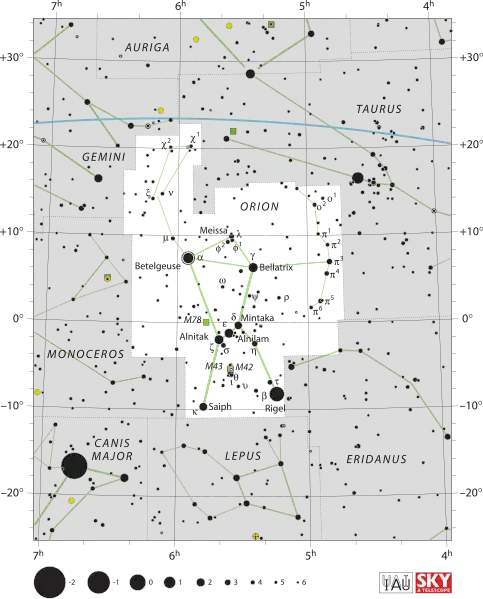
enter image description here

In equatorial coordinates, its borders lie between about $4^\text{h}43^\text{m}$ and $6^\text{h}25^\text{m}$ in right ascension, and between $23^\circ$ and $-11^\circ$ in declination, which is about $25^\circ\times 33^\circ$. In other words, Orion is many orders of magnitude larger than the change in solar position.

Pulsar
  • 14,970
3

There would be no effect on the image of Orion due to the obliquity of Earth. Keep in mind that the obliquity you've mentioned here is the angle of Earth's axial tilt with respect to the ecliptic. The angle of the ecliptic is relatively unchanging.

While it may be true that certain locations on Earth we may see Orion shifted above or below our equatorial line, since Earth hasn't actually moved (that is its orbit wrt the rest of the solar system) and since it is approximately a sphere, we can always move to another location on the surface in order to see the exact same thing as before.

Consider the following artistic masterpiece that I just made:

enter image description here

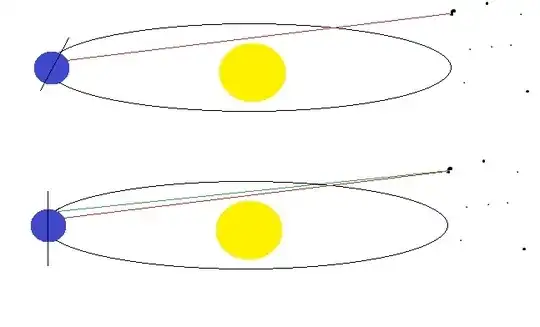
The top image shows our approximate obliquity. The red line indicates the line of sight of an observer to Orion. The bottom image shows the difference if I were to change the obliquity to $0^o$. Here the green line represents the line of sight for an observer at the same point, notice it is different. But also notice that there exists a different point on the surface where I could move to and find the exact same line of sight as before (that's the red line).

In fact, changing the obliquity does not introduce any new viewpoints. So we would not have a new perspective of Orion. The reason when you turn your head, everything shifts around is because your eyes cannot move to another location on your head.

So it may be true that a non-moving observer would eventually have a different perspective of Orion at the exact same time in the sidereal year if you change Earth's obliquity. But their old perspective still exists at another location. So as a society, we would still recognize Orion as being in the same place.

Edit
I did some approximating and some hand waving. But over the past 6500 years, at a latitude of ~ $25^o$ at winter solstice (vernal equinox experiences no change). The maximum shift in position a stationary observer would see is that the Sun would now appear to be a total of ~ 0.07 arcseconds closer to Orion. That is 51.3 km at the distance of the Sun and just over 2 AU at Orion (averaged over all stars).

Jim
  • 24,676
0

If I understand the original question correctly, it can be formulated as follows:

Does ecliptic latitude of a star (its angular distance from ecliptic) change with time?

The short answer (known already to Tycho Brahe) is yes, it does.

Contrary to what previous comments and answers suggest, ecliptic plane does (significantly) change its position in space (relative to distant stars or quasars). Historically, discrepancy between expected and recorded ecliptical latitudes of a few bright stars (like Sirius) led Halley to discovery of proper motion of stars.

I will expand on this later.

Leos Ondra
  • 2,265