10

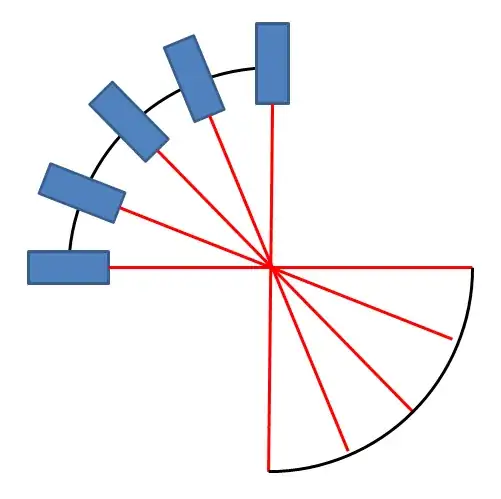
I want to arrange some red lasers along a 90 degree arc of a circle, aimed towards the center of the circle. When their beams hit the opposite side of the circle, will I notice any interference effects? What if I use dozens of lasers?

Laser arc

If they do interfere, how do I calculate the interference pattern?

Neal Ehardt
  • 233
  • 1
  • 2
  • 8

3 Answers3

11

No, there will not be an interference pattern. You can find interference patterns at the point where two lasers meet. After the laser beams crossed, you will not observe any effects of the crossing since there are no elemental photon-photon interactions.

So if you move the screen into the crossing point you will probably see interference, but it is hard to calculate because you don't know the phase difference exactley since you use different lasers and not split one beam.

In different words: If two light beams cross each other, they don't interact.

anna v
  • 236,935
Noldig
  • 1,469
4

The answer by Noldig is sufficient for your question. Red lasers and the setup you describe are not sufficient to show any higher order processes in photon physics. There exists though a calculation where an effect is expected to be seen:

An expression for the number of generated photons is derived, and using state-of-the-art laser data it is found that the number of photons can reach detectable levels. In particular, the prospect of using the high-repetition Astra Gemini system at the Rutherford Appleton Laboratory is discussed. The problem of noise sources is reviewed, and it is found that the noise level can be reduced well below the signal level. Thus, detection of elastic photon-photon scattering may for the first time be achieved.

The proposed laser setup is way out of the possibilities of red lasers in your design, and it is a research project that is being proposed in the publication.

anna v
  • 236,935
0

Maxwell's equations, which describe electromagnetic fields including light beams in full generality as long as you don't ask about photons, are linear. The air in for all practical purposes linear. The laser beams will pass right through each other without noticing.

However, according to quantum theory, electromagnetic fields are described by QED. This entails photons sometimes appearing briefly as electron-positron pairs (and muon-antimuon, etc.) although very rarely for any practical apparatus if your budget is less than several million dollars.

High-power intersecting laser beams is one way to ignite hydrogen fusion at the Nation Ignition Facility at Lawrence Livermore. I suppose they have to worry about interference. Of course, the beams do interact at the fuel pellet,

Search terms to try: "photon-photon scattering", "QED box diagrams"

There is also the fact that all transparent materials exhibit nonlinearities at sufficiently high intensities. For air, it takes quite a lot.

Here's the abstract of a paper on measuring nonlinear optical effect in air at near infrared frequency using a 100GW laser: http://www.opticsinfobase.org/oe/abstract.cfm?uri=oe-14-13-6194
DarenW
  • 5,947