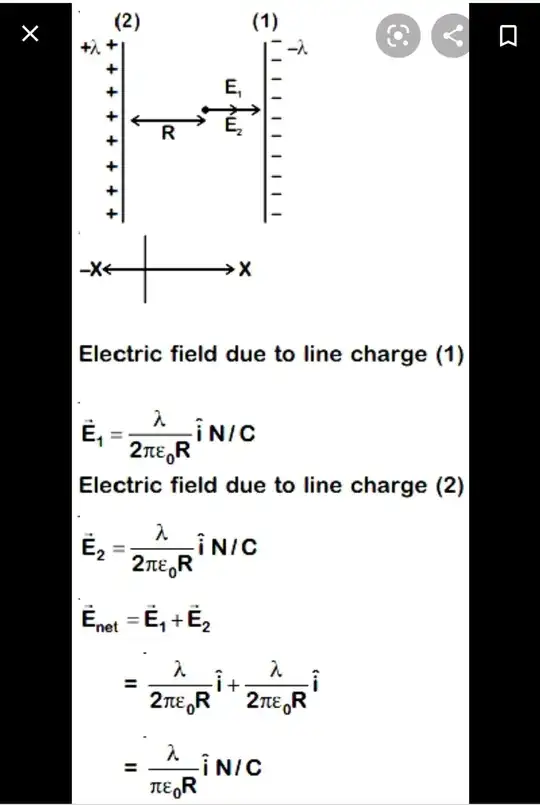
I had a doubt about why inside a capacitor having equal and opposite charges on both plates have a electric field $Q/A€$ and not $2Q/A€$ (where $€$ stands for permittivity).
But a question at stack exchange answer this by saying that superposition will not apply for when electric field terminate at the negative charge
https://physics.stackexchange.com/a/65194/291481
i want to know why not the same concept is applied in this case of infinitely long line charges having opposite charges
why we are using superposition to find electric field at a point between the two line charges