29

I find the term "microgravity" to be misleading, how was it coined?

NASA provide this definition:

Microgravity is the condition in which people or objects appear to be weightless. The effects of microgravity can be seen when astronauts and objects float in space.

Presumably the word "micro" is not being used in its mathematical sense, and is being used to express something that is small. However, the above article goes on to state that:

The International Space Station orbits Earth at an altitude between 200 and 250 miles. At that altitude, Earth's gravity is about 90 percent of what it is on the planet's surface.

I would not describe 90% as small.

It seems a poorly constructed term.

8 Answers8

97

Microgravity is used because zero gravity is inaccurate. The ISS, at 400 km, experiences an average atmospheric density of 4 nanograms per cubic meter. It's frontal area varies from 700-2300 square meters. At 1000 m$^2$, the drag force is $ \frac 1 4$N. With a mass around 250,000 kg, that's $10^{-6}$ m/s$^2$, or 0.1 $\mu$g.

Hence: microgravity, literally.

If you leave an object at the back of the space station, it will fall forward, falling 100 m (the length scale of ISS) in 4 hours, with an impact speed of $\sqrt 2$ cm/s.

JEB
  • 42,131
18

Microgravity doesn't mean that the gravitational field is negligible, just that the system in question does not feel its effects due to being in free-fall. The interior of a freely-falling elevator is a microgravity environment - at least until it hits the ground.

Albatross
  • 72,909
11

You are not the only person who has problems with the term microgravity. I doubt there is any record of how or why the term was coined.

My guess is that NASA introduced the term microgravity because it sounds more scientific that "zero gravity" (which is just plain wrong) but less scary than "free fall", which is accurate but might suggest to the man in the street the ISS was about to fall out of the sky.

This article suggests that due to active stabilisation the environment on the ISS is actually closer to "nanogravity" than microgravity.

gandalf61
  • 63,999
4

The ISS is subject to vibration from many sources.

  • astronauts moving around, exercising etc.
  • mechanical equipment (motors running etc)
  • thermal effects (as the station moves in and out of Earth's shadow(
  • visiting spacecraft docking, undocking.
  • reboosting
  • aerodynamic drag

The gravity environment on the ISS is monitored by the Principal Investigator Microgravity Services.

The requirements for the gravity environment on the ISS are:

for 0.01 ≤ f ≤ 0.1Hz: a ≤ 1.6 µg
for 0.1< f ≤ 100 Hz: a ≤ f x 16 µg
for 100< f ≤ 300 Hz: a ≤ 1600 µg

That document also has measurement results. A few highlights:

  • the gravity environment is not the same across the entire station. Experiment cabinets can be isolated from the station, leading to lower vibration in the cabinet
  • Events like reboosts, dockings cause lots of vibration, mostly at times predictable enough that they can be planned around.

Regular reports show the environment in practice:
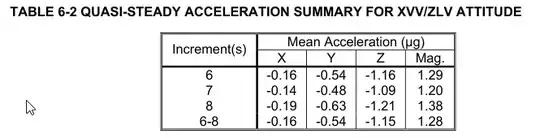
enter image description here

The quasi-steady state regime is the lowest frequencies (≤ 0.01 Hz).

These low-frequency accelerations are associated with phenomena related to the orbital rate, primarily aerodynamic drag. However, gravity gradient and rotational effects may dominate in this regime, depending on various conditions and an experiment’s location relative to the vehicle's center of mass (CM).

You can see the term 'microgravity' is appropriate. Most of the accelerations in these reports are in the 1-1000 micro-g range.

There have been plans for unmanned space stations with a better quality vibration environment (MTFF), but these were not proceeded with.

Hobbes
  • 450
3

The Space Station is in orbit, i.e., in free fall. In free fall, gravity is not felt. If you are unfortunately in a falling elevator and you let go of an object it will remain where you left it and not fall to the floor. In the elevator frame of reference there is no force of gravity because it is in free fall. Of course, to an observer in the building there is gravity.

Not_Einstein
  • 2,816
3

There is gravity, there is just no Normal force that would exist if you were on a surface on Earth. You're constantly falling so there little upward resistance; you experience weightlessness because of this.

3

The greater the distance from Earth's surface, the less the gravitational force. As the space station is in orbit, not stationary, the 90% g is the centripetal force on it. This is equaled by the centrifugal force of its rotation around the Earth. At the stations center of gravity these forces are equal so there is no net gravity from Earth. Above or below (relative to Earth) the center of gravity there are net microgravity effects, which could be termed tidal effects. For the small distances involved these are usually negligible. Other causes of microgravity effects on the station could be from the small amount of air resistance, and small net gravitational pulls from the Sun, Moon, and other objects.

1

Any point-body in free fall in a vacuum would experience zero gravity. The ISS differs from this in all defining aspects:

  • It is not in permanent free fall due to corrective manoeuvres every now and then
  • It is not in vacuum because there is still enough atmosphere to cause a tiny amount of drag
  • It is more than 100m larger than a point so that the inhomogeneity of the gravitational field comes into play.