23

The question clearer: Is the infinitesimal cube the absolute smallest infinitesimal volume?

(Sorry if people thought that it meant: "Is it possible and is it done in daily life to use anything other than the Cartesian volume element?" : I know the answer to this is of course yes and I know it's usefulness. But please note that the question title has not been changed at all! It stands.)

After the many discussions, now the questions stand at comparing infinitesimal volumes.

A holistic answer that addresses this will be appreciated. This involves a phrasing of what infinitesimals are, how an infinitesimal volume arises, and what happens when such volumes are compared from two different coordinate systems. Is it OK to address the infinitesimal volumes as smaller versions of finite shapes? If it is fine, what is wrong in this Gedanken?:

  • An infinitesimal is by definition a length that is really, really small. If then I multiply this length with the same but in two perpendicular directions, I get a cube. This is the infinitesimal volume in Cartesian coordinates.I.e., an infinitesimal volume should have all it's edges as infinitesimal lengths, right? Is any other infinitesimal volume theoretically correct? (I have trouble accepting cuboid-shaped "infinitesimals" as well.)

I would highly appreciate people from a physics background to answer this question in an intuitive, "Feynman lectures" way, for lack of better words. Everyone's time is appreciated!

My argument for the comparison of volume elements across different coordinates systems:

In any coordinate system, I can define an interval whose unit length I can define, right eg. $|ds|=\sqrt{dx^2+dy^2+dz^2} $. So, the infinitesimal volumes from any coordinate system can be compared. Given this and that infinitesimal volumes occur, as a result, I would start off with 3 infinitesimal lengths with no possibility of a curved surface. I should end up with a cube only.

Deschele Schilder
  • 1
  • 5
  • 45
  • 105
Sidarth
  • 1,007

18 Answers18

43

Infinitesimal volume elements do not have to be cubes.

Some familiar examples come from typical solids of revolution problems from calculus 1/2. Typically one discusses using either the "disk/washer" or "cylindrical shells" methods for finding the volume of the solid. As you can guess, the former method uses infinitesimally thin disks/washers as volume elements, and the latter uses cylindrical shells with infinitesimal thickness.

Volumes that are finite in one or two dimension(s) and that are infinitesimal in a third dimension are still infinitesimal because an infinitesimal value multiplied by a finite value is still infinitesimal. You can also build up "non-cube" volume elements by integrating over certain variables from your "cube" volume elements. For example, you can get spherical shell volume elements by integrating over the azimuthal and polar coordinates: $$\text dV=\text dr\cdot\int_0^\pi\int_0^{2\pi} r^2\sin\phi\,\text d\phi\,\text d\theta=4\pi r^2\,\text dr$$

which as you can tell is the volume of a spherical shell of radius $r$ and thickness $\text dr$.

BioPhysicist
  • 59,060
21

Your comments (and to a lesser extent, your Question) indicate a severe confusion about ever having an infinitesimal volume. You never construct an infinitesimal volume. Infinitesimal volumes appear at the end of a limiting process.

Where do the infinitesmial rectangular parallelepipeds you are discussing appear? They appear in the limit of an iterated triple integral. An iterated triple integral involves nested orthogonal partitions to construct Riemann sums. In the limit as the diameters of all the partitions decrease to zero, the resulting volume elements are the infinitesimal rectangular parallelepipeds you first describe.

Can there be other infinitesimal volumes? Of course; use a different coordinate system. If you have arranged your triple integral to be in spherical coordinates, then you (may, if your region of integration includes it,) have an infinitesimal sphere at the center and the rest will be volumes bounded by two radii, two longitudes (which bound a spherical wedge) and two latitudes (which bound a spherical segment). In the limit as all the partition diameters go to zero, you obtain infinitesimal versions of these volumes.

Notice that at no point during the taking of the limit do you ever have an infinitesimal volume. These infinitesimals only appear once the partition diameters finish going to zero. I'm not going to get in the philosophical difficulties of completed infinities and whether the results of infinite processes exist. The point is that we use non-infinitesimals to infer what would happen if we really could use infinitesimals.

As another example of a different infinitesimal volume, consider cylindrical coordinates. Here, we have cylinders on the longitudinal axis, and, everywhere else, volumes bounded by two (infinitely long) cylinders of constant radii, two planes of constant angle, and two planes of constant longitude. Let's give those last volumes a name: "fred"s. The cylinders and freds are not rectangular parallelepipeds. In the limit as the partition diameters go to zero, we end up with infinitesimal cylinders and infinitesimal freds.

There is a different idea -- using non-rectangular regions in the usual 1-dimensional Riemann sum. For instance, graph the function over the interval of interest, then pack the area between the curve and the $x$-axis with disks. Sum the areas of the disks. Then repeat the process in the limit as the radius of the disks goes to zero. What you find is that you do not get the same value as the usual integral. If you are careful in specifying your packing method, you will actually have a limit as the radii go to zero and the resulting total disk area will underestimate the actual integral due to the "gaps" between the disks.

In short, the method described in the first few paragraphs where we partition all of the space of integration into pieces is necessary -- don't leave gaps.

Eric Towers
  • 1,797
9

Different coordinate systems have different kinds of volume elements; The volume elements are a consequence of how the grid lines of the coordinate system are set. Volume element can be generated by nudging the parameters which describe points in the space by infinitesimal amounts and figuring out the volume of the region generated as a consequence. This is especially useful in multi-variable volume integrals and in the application of some vector-calculus results such as the divergence theorem.


On some more thought, I'd like to add one more point. Yes, you are correct that infinitesimals are small quantities, however you're missing a crucial point. Depending under what constraint you put while your quantity small, the actual structure of this 'small quantity' would be different. This would be understandable using the references I have given in the bottom.

As a more direct example, suppose you have a large cube and you keep scaling down the dimension till you get some sort of infinitesimal volume cube, and now for contrast, consider a large sphere and imagine scaling it down till you get a tiny infinitesimal sphere. These two things are infinitesimal volume elements but the volume each contains is different due to the actual object which you are shrinking being different.


Deriving Volume Element for spherical co-ordinates

Lecture series which shows the concept described above using 3-d animations

For Understanding the ideas of linear transformation noted in the previous lecture better


Answer V2.0 based on op's new details of the question:

  1. and 2.) You can relate the volume elements between different co-ordinate systems using the determinant of jacobian. In a way, the Jacobean is the ratio of n-volume in one system to the n-volume in another. Also do not forget that some transformations do not behave the same globally, for example it is easy to understand that the 'natural unit' vector of polar co-ordinates scales up as you move further away from the origin (*)

  2. I'm not sure on this on what exactly you mean by 'smallest'. You need an absolute measuring scale to measure the concept of smallest. If I were to guess, the smallest volume element would be a singular linear transformation which squishes space into a point and hence literally have zero volume.

  3. and 4.) Not gonna comment on hyperreal numbers as I have not done much of it and this concept was dealt with in Dave's answer in much detail already.

  1. Yes, the properties of a shape other than n-volume measures should be invariant under uniform scaling. For example, consider similar triangles.
Nat
  • 4,720
6

An infinitesimal is by definition a length that is really, really small.

I think that your question arises due to a misunderstanding of what infinitesimals are. Infinitesimals are not easy to understand, they can be understood either as a limit as a quantity goes to zero or in terms of the hyperreal numbers. As the hyperreal concept is relatively new compared to the limit, it is not often taught, but it does have some clarity which I find helpful.

The hyperreal line is the real line augmented with infinities whose absolute values are larger than any real numbers and their reciprocals, the infinitesimals, whose absolute values are smaller than any positive real number.

The thing about the infinitesimals is that as individual numbers (not as sets) they can be manipulated with all of the same operations as reals. You can multiply an infinitesimal by a real number and get another infinitesimal. The infinitesimals can themselves be ordered, meaning that if $dx$ is an infinitesimal then $2 dx$ is larger than $dx$, but still smaller than any positive real and therefore still a perfectly valid infinitesimal.

So using “...” to denote an infinite sequence we can order the hyperreal numbers like this: $$1>\frac{1}{2}> \frac{1}{3}> ... > dx > \frac{dx}{2} > \frac{dx}{3} > ... > dx^2 > ... > 0$$ or more colloquially we can consider $\epsilon =0.000...1$ to be a sort of unit infinitesimal which can still be divided by 2 to make something even smaller and so on. There is no absolute smallest infinitesimal number. As an exercise, consider $dx$ and $\epsilon$. Which is smaller$^*$? Is $dx<\epsilon$ or $\epsilon < dx$?

This is important because infinitesimals can preserve their relationships to each other. They are all smaller than any positive real, even if some infinitesimals are larger than other infinitesimals. So $dx \ dy \ dz$ is half the volume of $dx \ dy \ (2 dz)$, but they are both infinitesimal.

In fact even if $x$ and $y$ are finite real numbers $ x \ y \ dz$ can be an infinitesimal volume. An infinitesimal volume merely needs to be smaller than any positive real volume, not smaller than other infinitesimal volumes. For that a single infinitesimal in the product suffices. A spherical shell from radius $r$ to $r+dr$ is a completely legitimate and valid infinitesimal volume $4 \pi r^2 dr$ even though its surface area is finite $8 \pi r^2$. This all follows from the properties of hyperreal numbers.

Infinitesimals can be formed into a hyperreal plane and into vectors, and those vectors can have norms and dot products, so you can have arbitrary infinitesimal shapes. You can have right angles, but you can also have arbitrary other angles. There is nothing magical about right angles that allows them and forbids other angles. You can have straight lines, but you can also have arbitrary curved lines. There is no restriction to right angles and straight lines.

Since you realize that infinitesimals can be orthogonal to each other, it should not be surprising that there is no limitation to other angles and thence to arbitrary shapes. The same rules that allow you to construct orthogonal infinitesimals allow you to construct other shapes. Again, all of this follows from the hyperreals.

Is not the infinitesimal cube the absolute smallest infinitesimal volume?

Responding to this most recent aspect of the question. There is no absolute smallest infinitesimal volume. You can always make a volume smaller.

For instance if $dx \ dy \ dz$ is an infinitesimal cube then we can define $dx = 2 dX$ and then $dX \ dy \ dz$ is a smaller volume and is not a cube. Similarly, we can define $dx = 2 dr$ and then $4\pi/3 \ dr^3$ is an infinitesimal sphere which is smaller than the cube. And simply by using a bigger number than 2 we could make volumes smaller than those. There is no absolute smallest infinitesimal volume.


Since many people are not familiar with hyperreals, here are some introductory sites (by no means complete or optimal):

https://www.youtube.com/watch?v=FTXRnEKEn4k

https://en.wikipedia.org/wiki/Hyperreal_number

https://www.youtube.com/watch?v=ArAjEq8uFvA

https://web.archive.org/web/20171231211005/http://mathforum.org/dr.math/faq/analysis_hyperreals.html

http://homepage.divms.uiowa.edu/~stroyan/InfsmlCalculus/FoundInfsmlCalc.pdf


$^*$ In this case $\epsilon < dx$. Notice that $dx$ is defined by: $$ 1 > \frac{1}{2} > \frac{1}{3} > ... > dx$$ and $\epsilon$ is implicitly defined by: $$ 1 > \frac{1}{10} > \frac{1}{100} > ... > \epsilon$$ Since every term in the second sequence is smaller than the corresponding term in the first sequence $\epsilon < dx$

Glorfindel
  • 1,424
  • 4
  • 17
  • 21
Dale
  • 117,350
5

It’s not so much a question of what is theoretically correct, more a question of which shape of region allows us most easily to pass to the limit and derive a differential equation or an integral (which is usually the goal of this step).

The choice of region often depends on the symmetry of the problem. In problems with cylindrical symmetry it is common to use a cylindrical shell. In problems with spherical symmetry a spherical shell is often used.

gandalf61
  • 63,999
5

To take an entirely different approach to the various integration-related approaches of other answers...


You appear to be perfectly comfortable defining "an infinitesimal cube", as a cube with sides of infinitesimal length.

Let's go one step further ... let's say:

"the infinitesimal cube with a vertex at the origin, and lying within the positive octant of 3-dimensional space w.r.t. the origin, comprises all points whose x-, y- and z- co-ordinates lie within an infinitesimal distance from 0."

That seems a perfectly reasonable definition of an infinitesimal shape, and I can't really imagine any other definition of a shape that you can "have", "get" or "take", that doesn't amount to essentially the same thing.

Ok, so we're happy with the infinitesimal cube.

Consider this definition:

"all points whose Cartesian distance from the origin lies within an infinitesimal distance from 0."

Voila ... an infinitesimal sphere :) i.e. a sphere with infinitesimal radius.


Obviously all of this gets lost when you start to think of things in terms of mathematical limits. But this presents an answer w.r.t. the initial question, as asked.

Brondahl
  • 670
1

Yes, it absolutely does sometimes make sense to have infinitesimals be shapes other than cubes. Particularly when the metric space being used is not necessarily Euclidean.

In Walter Rudin's Principles of Mathematical Analysis, in the early part of his formulation of the general form of Stoke's Theorem (i.e., for arbitrary finite dimensional metric spaces), he builds a general integral calculus for an arbitrary metric spaces using parallelepipeds. I'd say, in mathematical circles at least, that's a fairly famous case of non-cubic infinitesimals.

You might get much better answers by posting this question on Math.SE. For anyone wondering what areas of physics might use arbitrary non-Euclidean metric spaces, I'm personally not sure, but I know manifolds are used in Physics, and I believe General Relativity is at least sometimes studied or modeled with non-Euclidean coordinates.

Related to this part of your question:

Some one can come and ask then why are you not making the length in the third dimension also the same

A parallelepiped can have all the lengths of its edges be equal. What makes it not a cube is that its angles are not necessarily equal.

Regarding:

How can I just assume that this is going to give me the smallest possible volume?

Infinitesimals need not be "the smallest possible volume" at all. While I'm not an excellent mathematician, I'm pretty sure the requirements for an infinitesimal for use in integral calculus is that they be composed of a volume that is both fixed and arbitrary. The questions you need to be able to answer about an infinitesimal are, "can you calculate the volume of it?" and "can you choose the volume of it?"

The common rigorous way to answer the two questions I posed in the previous paragraph is to define a linear transformation that "chooses the volume" and ensure there exists another linear transformation that "calculates the volume", the latter transformation usually being a well-known formula for calculating volume.

1

The two most important properties of an infinitesimal volume used for integration are

a) its side is shorter than that of any other volume you care to specify

b) the value of the property that is a function of its dimensions, this is the thing you're integrating over a volume, is the same on any edge or vertex of the volume. That means it doesn't matter whether you sum f(x), f(x+dx) or f(x=dx/2), they are all the same as far as the integration, or the summation in the limit of dx->0, are concerned.

It doesn't matter what coordinate system you choose, cartesian, spherical or cyclindrical polar, a 'small' volume in any coordinate system will have those properties.

Neil_UK
  • 843
1

Some important points I have gathered from discussions, that might help someone to completely dispel my doubts. Thanks to all!

  1. One does not set out to construct a volume element, rather, it occurs as a result of the grid system we are using, through a limiting process. Naturally, the shape of the volume element will depend on the system. A question on this: Is it ok to compare volume elements (magnitude) from different systems? (they are related by the determinant and will obviously be different, so, asking which is smaller is mathematically possible and my OP question still remains.)Related

Volumes that are finite in one or two dimension(s) and that are infinitesimal in a third dimension are still infinitesimal because an infinitesimal value multiplied by a finite value is still infinitesimal.

Fine, but what if I want to compare those different infinitesimal volume elements? This has been the question from the beginning.

  1. The infinitesimal volume element in a particular coordinate system will turn out to be the smallest volume possible in that grid system.

  2. "Infinitesimals" is a special construct in mathematics and should not be taken to mean "smallest" and need not correspond with my intuitive thoughts e.g. one the idea that one particular volume element being the absolutely smallest possible volume across all coordinate grid systems. (even though it seems to be a very plausible thing!)

  3. Infinitesimals behave like real numbers, with ordering as well but are actually hyper-real. The definition of an infinitesimal volume is such that one infinitesimal in the product is sufficient to call it an infinitesimal - this completely makes my edit#2 and edit #3 insignificant(and even the first two points above) but does not answer straightforwardly: it's not really the minimum possible infinitesimal length. Still, however, the product is going to be smaller than any real number, only that we are now comparing real and hyper-real numbers (this is new to me since it feels like coming up with a definition to justify something.)

  4. The point is that we use non-infinitesimals to infer what would happen if we really could use infinitesimals.

This greatly relates to me. From the beginning, I have been thinking about the properties of big shapes and have assumed it as the properties of their infinitesimal versions. ( Is this wrong and if so, why?). The quote below also tells that this supposition of mine is wrong:

How small (or large) an infinitesimal can be made to be does not depend on its shape. We can make all kinds of shapes arbitrarily small.

(I apologize if some of the points above are redundant/repetitive)

Deschele Schilder
  • 1
  • 5
  • 45
  • 105
Sidarth
  • 1,007
1

Since infinitesimal volumes are primarily used in the context of integration, I will answer from that perspective.

The infinitesimal volume elements used in Riemann integration are always generalized rectangles in their respective coordinate systems since the Riemann integral is only defined over generalized rectangles.$^*$ For example, a volume element that looks like a wedge when represented in Cartesian coordinates could actually be a prism when represented in spherical coordinates (of course you would still need the determinant of the Jacobian to get the volume correct). This is because a generalized rectangle is just a Cartesian product of intervals, i.e. $\prod_i [a_i, b_i]$, in some coordinate system.

However, why should we restrict ourselves to just Riemann integration? The Lebesgue integral does not concern itself with unnecessary structures like coordinate systems or a notion of shapes, but instead, looks only at the value the integrand takes on measurable sets and the measures of those sets. In this case, it is the measure that gives us a notion of volume. Thus, we can see that mathematically it makes sense to use infinitesimal volume elements of arbitrary shape, but what about physically? Since matter is actually discrete, one might wonder if it even makes sense to discuss any infinitesimal volume of a physical object, but we know that physical objects can be modeled as being continuous in $\mathbb R^n$, so it makes sense that we can use the mathematics associated with $\mathbb R^n$ to describe said objects.


$^*$There is a way to extend the Riemann integral to more general Jordan domains, but that is still done by integrating over a generalized rectangle. A Jordan domain is a set whose boundary has Jordan content zero.

Deschele Schilder
  • 1
  • 5
  • 45
  • 105
Sandejo
  • 5,496
1

We can generalize the concept of integration thusly: given a space $S$ with a measure $m$ and given a function $S \rightarrow \mathbb R$, for each natural number $n$, separate $S$ into disjoint subsets, none of which has measure greater than $2^{-n}$. For each subset, take the supremum of $f$ over that subset, multiply it by the measure of the subset, and then sum the results over all subsets. Now take the limit as $N goes to infinity. Then do the same thing, except with the infinum rather than supremum. If those two limits are the same, then that is the integral.

If $S$ has a projection into n-dimensional Euclidean space (i.e. has n-dimensional coordinates), we can take these subsets as being the Cartesian product of intervals of these coordinates (the concept of infinitesimals, to simplify it a bit, is taking the limit as the length of those intervals goes to zero). If $S$ actually is a Euclidean space, and the measure is the normal Euclidean one, then the measure of each subset is simply the product of the length of the intervals. Otherwise, we need to include a term representing this measure. In the limit, this reduces to the Jacobian.

Deschele Schilder
  • 1
  • 5
  • 45
  • 105
1

This involves a phrasing of what infinitesimals are, how an infinitesimal volume arises, and what happens when such volumes are compared from two different coordinate systems.

The infinitesimal of a volume (a volume element) is defined (as you probably know):

$$\Delta{V}=\Delta{x}\Delta{y}\Delta{z},$$

after we take the limit $$\Delta{x}\rightarrow dx$$ $$\Delta{y} \rightarrow{dy}$$ $$\Delta{z}\rightarrow{dz},$$
where $dx$, $dy$, and $dz$ approach zero.

So, finally:

$$dV=dxdydz,$$

the infinitesimal cubic volume element.

The general definition of a volume element is:

general volume element

where $u_1 , u_2$, and $u_3$ (e.g. $\rho$, $\theta$, and $\phi)$ are the new coordinates. Each point in (Euclidean) space can be reached by them.

When worked out this gives for the new volume element:

enter image description here

The determinant is called the Jacobian.

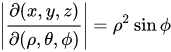
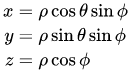
For spherical coordinates the Jacobian equals:

J S C),

derived from:

xyz expressed in spherical coordinates.

Depending on the problem you want to solve you can use different volume elements for integration. For problems involving spherically symmetric quantities, the easiest way to integrate these quantities is to use the spherical volume element as mentioned above.

Is it OK to address the infinitesimal volumes as smaller versions of finite shapes?

I guess you mean making from an arbitrary shape (like a three-dimensional seven-point star) shape with a volume approaching zero. The question, in this case, is of course: Does the Jacobian exists for such a form? Like it obviously does for a solid sphere or cylinder. I.e., how do $u_1$, $u_2$, and $u_3$ look like?
Only in special cases $u_1$, $u_2$, and $u_3$ can be defined. There are few (to my knowledge none) problems which require an arbitrary volume element. That's because there are few (to my knowledge none, but if someone an example, feel free to comment) arbitrarily in space distributed quantities. I think the volume has to be a "nice" one, like a 3d hexagon. Or the combination of a cube and half-spheres: on each side of the cube we place a half-sphere. Though I doubt the last volume element is of practical use. Maybe it fits a problem with spatial boundary conditions that, on a macroscopic scale, has the form of such a cube with half spheres.

There are speculations that the smallest (measurable) distance is the Planck length (see this Wikipedia article) which is approaching zero. In this case, the physical minimum of $dV$ would be finite, so $\Delta{V}$.

Final comment:

Is not the infinitesimal cube the absolute smallest infinitesimal volume?

Don't you think a tetrahedron (a pyramid with a square as its base) has a smaller infinitesimal volume (i.e., a smaller volume element?). Or half of a cube? Or equal parts of a cube that together form a whole (infinitesimal) cube? If you think this you're wrong.
All volume elements are equal insofar the volume is concerned. Why should it be the cube? Because you can put them together to fill up space without empty space between them? Volume elements are not used to fill up space. They are used for integration in different coordinates. This is the reason, I guess that you think the cube volume element has the absolute smallest infinitesimal volume.
The spherical volume element has the least surface area with the most volume in it. The cube volume element has an area surface that is bigger when the same volume is contained in it. But the infinitesimal volumes are all equal (even though they are a limit) when compared to each other. It is the surfaces that can have a minimum (or a maximum), not the volumes.

To answer the question in the question box: yes, it makes sense.

I hope this satisfies a "Feynman lecture" criterium.

Deschele Schilder
  • 1
  • 5
  • 45
  • 105
0

Let's think about considering your question in the context of an abstract Riemannian manifold $(M,g)$. In local curvilinear coordinates $(x_1,x_2,\cdots,x_n)$ we have $dV=\sqrt{\vert g\vert}dx_1dx_2\cdots dx_n$.

Differential geometers like to say that the volume form on a manifold has no local structure. This is the gist of a famous theorem of J. Moser, published in 1965. In non-technical phrasing, we can find a change of coordinates (local diffeomorphism) so that $dV$ is identical to that of the volume form on $\mathbb{R}^n.$ So after a change in coordinates, the volume form looks like the standard one based on infinitesimal cubes.

Keeping this all in the arena of Euclidean space as you are doing, if you did use some other geometrical underpinning for your infinitesimal volume form, then after a change in coordinates, you can bend this infinitesimal geometry to look like infinitesimal cubes.

So long story short--by Moser, locally any two infinitesimal geometries that you might use to define volume are equivalent, from the viewpoint of a differential geometer.

user52817
  • 359
0

The question is changed and has more focus on: "The question clearer: Is not the infinitesimal cube the absolute smallest infinitesimal volume? "

There is no such thing as a "smallest volume". Those "smallest" volumes mentioned in the texts at school or the internet are thought to be "limits", not absolute values.

To simplify, look not at cubes (or any deformations of) but to a single interval $[0,\epsilon)$.

$$\lim_{\epsilon\to 0}f(\epsilon)=a\iff\forall_{\delta>0}\exists_{\epsilon>0}\mid f(\epsilon)-a\mid<\delta$$

Instead of having one fixed $\epsilon$, you are looking at all $\epsilon>0$ satisfying the inequation.

This is maths, not quantum mechanics. How to reconcile those two, I'm myself out of wit, but that would be another bunch of Q&Ss.

When someone claims to have the least number $\epsilon>0$ then anyone can claim that $\frac\epsilon{2}$ is even lesser.

Just forget physics for a moment and look up any per-calculus sources about limits in maths.

Deschele Schilder
  • 1
  • 5
  • 45
  • 105
0

Let me give you a kind of off-the-wall answer and maybe it helps. To do this I am going to drop down one dimension, from volume to area, and I am going to give you kind of what calculus “is” in my way of looking at it.

A curiosity about circles

So when I was a kid, I was forced to memorize that we define $\pi$ as the ratio of a circle’s circumference to its diameter. (It was not absolutely obvious to me at that time that this should be a fixed numerical ratio. This is also a problem that can be solved with calculus-thinking. But I just had to take it on adults’ authority that somehow all lengths, even curved ones, in a figure must scale with the scaling parameter. So when you zoom in by a factor of 2 the diameter and circumference both double and the ratio remains fixed. The home that calculus is needed to prove it furnishes some nice counterexamples in fractals.) So I could accept that we called it $\pi$ and it was measured as approximately 3.14159.

But if that was maybe mildly surprising, far more outrageous was it that the area of the circle was $\pi r^2.$ Like, I memorized this very quickly. It is very memorable. But, why is it the same $\pi$? Why not, say, $\pi^2$? Okay, well, maybe not $\pi^2,$ because $\pi^2$ is obviously too large. I was able to see that the circle was inscribed within a square of side-length $2 r$ and therefore it must be less than $4.$ With some cleverness I could inscribe a dodecagon to find that $A>3r^2$, furthermore I could stretch the dodecacon out to find after a lot of work that $A< 6 (\sqrt{3} - 1)^2,$ so it had to be less than 3.2154 and if I guessed halfway between those I would get 3.11 or so. This was already enough to exclude, say, $\pi^2/3$.

But still, that question of “how can I see that this is exactly $\pi$” was missing for me until I learned calculus, and I learned that it has two distinct proofs in calculus, one which we call “integral” calculus and one which we call “differential calculus.” Curiously, they have both to do with Italy’s most famous foods.

Proof by pizza

Slice the circle with a perfect blade into $N$ slices, pizza-like. Then rearrange them, stacking $N/2$ of those slices pointed “up” with the other $N/2$ pointed down, to “sicilianize” the pizza into a sort of almost-parallelogram shape. As $N$ gets very very large we would be creating these infinitesimally thin almost-triangles of pizza! (There is your counterexample, infinitesimal triangles instead of infinitesimal squares.) And the “crust” of the pizza needs to be distributed exactly over the top and the bottom of the parallelogram whereas the larger $N$ gets the more this needs to look like a rectangle. So we have a rectangle of side length $\pi r$ and height $r$ and so it must have area $\pi r^2.$ Proof by pizza.

You actually don't have to rearrange them, just the fact that there are $N$ triangles with areas $\frac12~r~(\2\pi r/N)$ already gives you $\pi r^2$ when you add them all together. The “Sicilianize them” step is just a nice touch that I am stealing from a quantum complexity theorist named Scott Aaronson, heh.

This we call the “integral calculus”, it is about trying to cut up a complex shape into a lot of tiny “infinitesimal” simple shapes, and then rearrange them or sum them back up. In this case the shapes are simple because they are, in the limit of large $N$, triangles. The core idea of calculus is that when I zoom in on this circle’s edge enough, the circle looks like a straight line, so if I take very small chunks of it I can pretend they are not pizza slices but triangles.

Proof by pasta

Here's a very different sort of proof that calculus also offers. It says that I can make a circle which is slightly larger, by wrapping a thin piece of spaghetti around an existing circle. This thin piece of spaghetti can then be unwrapped: it has length $2\pi r,$ roughly, and width $\delta r$. Meanwhile since we know the area scales quadratically with our zoom factor, we know the area is $A = \alpha r^2$ for some $\alpha$, and this says that $$\alpha (r + \delta r)^2 \approx \alpha r^2 + 2 \pi r~\delta r.$$ Ignoring the $\delta r^2$ term (which is a tiny little triangle chunk of spaghetti at the end, the spaghetti was actually a sort of trapezoid with one edge being $2\pi(r + \delta r)$ and the other being only $2\pi r$: ignore the little chunk), we FOIL out the product on the left and find out that $$\alpha r^2 + 2 \alpha r~\delta r \approx \alpha r^2 + 2 \pi r~\delta r$$ and we conclude that $\alpha$ must have been $\pi$ all along.

More esoteric proof constructions

You can also use both of these the other way!

You can do the integral proof with spaghetti: create the circle as $N$ nested circles of spaghetti of width $r/N$. The length varies, but the $k^\text{th}$ one corresponds to the circle of radius $k r/N$, so when we unroll all of these we get a sort of rough triangle with height $r$ and base $2\pi r$ and so it must have area $\pi r^2$ after we compute the triangle’s $A = \frac12 b h.$

Or the differential proof with pizza: cut a radius in the circle and try to stretch it open a little bit, an opening $\delta C$ in terms of circumference length. We want to say that we can reshape that dough into a slightly larger circle with the same area, so the old area was $\alpha r^2$, this has been redistributed into a chunk of a circle of new radius $r + \delta r$, that chunk we can measure as being $(C - \delta C)/C$ of the new circle. So the new radius must be given by $$ \alpha (r + \delta r)^2 \left(1 - \frac{\delta C}{C}\right) \approx \alpha r^2,\\ \delta r \approx \frac{\delta C}{4\pi}.\\ $$ Once you have this you can finish the argument that $\alpha (r + \delta r)^2 \approx \alpha r^2 + \frac12 r~\delta C = \alpha r^2 + 2\pi r~\delta r,$ because we add the missing pizza slice with area $\frac12 r~\delta C.$ It's a weirder argument but you can certainly make it.

What this says about infinitesimals

I said above that the key point about calculus is that when you zoom way way in on a circle it looks like a straight line, and we have now added an infinitesimal pizza slice to an existing circle, and we have cut it into infinitesimal pizza slices so we could rearrange those slices into a breadtangle of pizza: both of these are based on this insight that the pizza slices become like triangles. But we also see something similar with the spaghetti: we are either adding an infinitesimal bit of spaghetti around the edge of a circle and then unrolling it, or else we are building the whole think out of concentric circles of spaghetti: but what we have in common is that because locally the circle looks like a straight line, the noodles become floppy and can be easily unrolled into being flat.

Now, infinitesimals are this helpful mental tool for a way of talking about this sort of argument. The claim is that if the spaghetti is thin enough then who cares about a tiny little chunk off the end of the spaghetti; if the pizza slice is thin enough then who cares about a tiny little curve of its crust?

One way to make this rigorous is to think, “If I made the spaghetti half as thin, then the little chunk on the end would occupy only a quarter of the area compared to the spaghetti itself having half the area, so this argument that ignores this chunk gets twice as precise. So I can do this halving however many times I need to do, in order to make this argument as close to correct as I need to.” This is roughly what the definition of limits gives you. It does not define “infinitesimal” directly, it just says that the “infinitesimal” argument is the “limit” of macroscopic arguments and is arguing about certain terms disappearing faster than other ones.

You have also by now seen the hyper-real numbers of “nonstandard analysis.” This is a different mental toolkit to make the same thinking rigorous. In this mental toolkit we “imagine that there are numbers which are so big that you are never going to run into them, you don’t even have the matter in the universe to write them down with some of your finest of chained-arrow notations: super-large numbers. I am not even going to tell you what $N$ is but just to say that after some unspecified number $N$ the numbers become too large for us to care about. Surely this should happen eventually, as numbers become so big that we can’t compute them or think about them.” So that is how we start to formalize the new number system. We can then also have a category of numbers formed by 1/(super-large) that are super-small. These are how we think of infinitesimals.

Part of the hyper-reals is that there’s always half of an infinitesimal, and half of that: just like there's always twice of a super-large number and twice that. And we can fudge $N$ to say that most of these numbers are not near $N$ so that within some bounds of reason there is always twice a super-small number, and half of a super-large one (we just assume that it's way way larger than $N$), as long as we don’t start doing some very suspicious things with them like many-repeated divisions. So we really just invent a number system which has infinitesimal numbers and then we use infinitesimals directly, rather than thinking about how certain expressions with our ordinary numbers limit to various other expressions as we make our arguments smaller and smaller.

There are probably other ways to make this reasoning rigorous, too. But all of that is about justifying these arguments about zooming way in on a problem and approximating the solution with simpler shapes. They don’t have to be squares, they may be triangles or spaghetti.

Coming back to your question

So now you’re me and you’re asked this strange question about whether the infinitesimal square is the smallest infinitesimal area. And the answer is, this misses all of the squishiness of infinitesimals. Like, the category of question is wrong because it assumes $\mathrm dx~\mathrm dy$ is somehow some real objective thing, $\mathrm dx$ being the smallest possible increment in $x$ or so. But the arguments above are all about saying that when I am looking at some finite $\delta x$, I can always look at $\delta x/100$ to get a better approximation. If I am looking at some square $\delta x~\delta y$, I can always cut it diagonally into two triangles if that is preferable. If I am cutting into a million slices of pizza and summing them up and somehow that’s not right and my pizza crust is still too curved, then I will cut into a billion slices of pizza. Or a googol. Or a googolplex. Or Graham's number. Or something that puts Graham's number in the dust.

If I wanted to do discrete calculus, I can also do that, by the way. There is a discrete calculus where we have infinite sequences $x_0, x_1, \dots$ and we define operators like $$(\Delta x)_i = \begin{cases}x_0,& \text{if } i = 0,\\ x_i - x_{i-1}, & \text{otherwise}\end{cases},\\ (\Sigma x)_i = \begin{cases} x_0,& \text{if } i = 0,\\ x_i + (\Sigma x)_{i - 1}, &\text{otherwise}\end{cases}.$$ So for example we can start from the sequence $N = [1, 2, 3, 4, \dots ]$ and form the sequence of odd numbers $N_\text{odd}= 2N - 1 = [1, 3, 5, 7, \dots ]$ and then we can perform $\Delta N_\text{odd} = [1, 2, 2, 2, \dots].$ Or we can perform $\Sigma N_\text{odd} = [1, 4, 9, 16, ...] = N^2.$ There is this discrete calculus with a fundamental theorem that plus undoes minus and minus undoes plus: $$\Delta \Sigma x = \Sigma \Delta x = x.$$ And then we do have your idea of a smallest possible increment, because sequences $x_n$ are like functions $x(n)$ where the smallest possible increment is this rigid $\mathrm dn = 1$. Similarly I have seen $\mathrm dn$ be a rigid “one bit-flip” in the exciting field of differential cryptography which fundamentally changed a lot of how we design security primitives.

So like there exist these other interesting fields. But in this context of normal real analysis, the key thing about differentials is that they are squishy and I can consider long skinny differentials that I wrap around shapes or skinny pizza differentials that I shove into existing pizzas. That squishiness is why I love them. The idea of a rigid unsquishy $\mathrm dx ~\mathrm dy$ underneath that is just unappealing to me.

CR Drost
  • 39,588
0

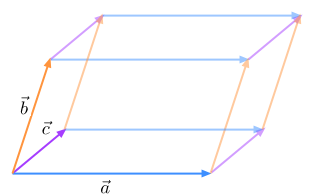
This is a arbitrary volume element

enter image description here

thus: the infinitesimal the volume is :

$$dV=(\vec a\times \vec b)\cdot \vec{c}\,da\,db\,dc$$

for a cube the is the $dV=dx\,dy,\,dz$

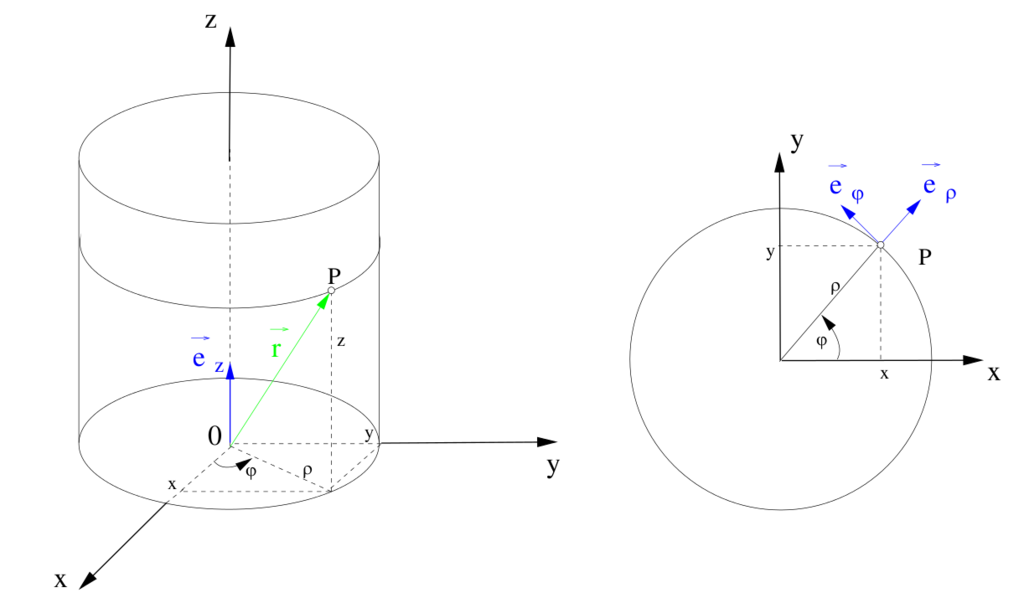
Example: cylinder volume element

enter image description here

with :

$$\vec{r}_p= \left[ \begin {array}{c} \rho\,\cos \left( \varphi \right) \\ \rho\,\sin \left( \varphi \right) \\ z\end {array} \right] $$

$$\vec a=\frac{\partial \vec r_p}{\partial \rho}=\left[ \begin {array}{c} \cos \left( \varphi \right) \\ \sin \left( \varphi \right) \\ 0\end {array} \right] ~,\vec b=\frac{\partial \vec r_p}{\partial \varphi}=\left[ \begin {array}{c} -\rho\,\sin \left( \varphi \right) \\ \rho\,\cos \left( \varphi \right) \\ 0\end {array} \right] ~,\vec c=\frac{\partial \vec r_p}{\partial z}=\left[ \begin {array}{c} 0\\ 0\\ 1\end {array} \right] $$

thus:

$$dV=\rho\,d\rho\,d\varphi\,dz$$

only for a cube is the the $dV=dx\,dy\,dz$

Eli
  • 13,829
0

Since you asked for a "Feynman Lecture" explanation, here is a very informal discussion that may shed a bit of light on infinitesimals. Infinitesimal are small quantities. In physics, they are used often to divide something (a line, an area, a volume, ...) into a lot of very small quantities. This is done because when the "something" gets small, things get simpler. For example, any "reasonable" function can be expanded around a point using a Taylor's series, and when distances from this point get very small, only the linear term of the series can be kept.

Very small lengths are useful for at least two things: getting derivatives and integrating. In the first one, we divide by this small length. In the second one, we add a lot of the small lengths together, often with the length multiplied by some function.

If your goal is integration, you should choose your infinitesimals such that they cover the whole line/plane/volume. In all cases, it makes sense to choose the infinitesimal segments/areas/volumes that match your coordinate system and make your life easy. Cubes are convenient, but there is no problem in using other shapes, as long as the function you integrate stays about constant inside your infinitesimal volume. For example, integrating spherical shells to get the mass of a body having a density that only vary with the radius is OK. Doing the same if the density also varies with latitude or longitude is not OK. You then have to use other infinitesimal elements. However, if the volume element is infinitesimally small in all dimensions, there is no problem with choosing any element. In fact, mathematics teaches us how to do adapt our calculations, with the Jacobian.

The Cartesian coordinate system is very convenient as the coordinate axes are perpendicular to each other, don't change direction in space and don't "interact" with each other when calculating volumes and areas. By this, I mean that, for example, a small arc segment of angular size dphi and radial extension dr will have an area that depends on where it is in the plane (r dphi dr). There is no such effect with the Cartesian system. However, in some cases, it makes much more sense to work in Cylindrical coordinates than in Cartesian ones, even if we have to take these variations into account.

Now, your question "is the Cartesian dx dy dz volume the smallest" is not well defined. You can always make a coordinate change such that the value obtained by multiplying dx dy dz is smaller. To give a numerical example, let's day dx=dy=dz = .1, then dx dy dz is .001. Now, make the coordinate change x'=x/2, y'=y/2, z'= z/2, which is still Cartesian, and dx' dy' dz' = .001/8, which is smaller than 0.1. Even within Cartesian systems, the smallest volume is not defined.

0

If you by infinitesimal element men coordinate system then it can make a difference. An integral can be convergent in one system and non convergent in the other. This is the case for potentials in some metals.