I think in some media, light can be significantly slowed down; but even if only slightly, where would the momentum go when the light slows down and where does it get the extra momentum when it leaves that medium? An example is a water.
Asked
Active
Viewed 4,175 times

3 Answers
91
This question is a very long-standing one, and is sometimes known as the Abraham-Minkowski controversy.
Both Abraham and Minkowski derived expressions for the energy-momentum tensor of electromagnetic waves in matter. Each author’s tensor is based on sound theoretical arguments. Unfortunately, they disagree. Abraham’s tensor shows that the momentum decreases, as you suggest, but Minkowski’s actually shows that it increases in matter.
These two views were resolved in this paper: https://arxiv.org/abs/0710.0461 where it is shown that the key is to pay attention to the corresponding energy momentum tensor of the matter also. The sum of the EM and the matter tensor is the same for both. Any extra momentum comes from the matter and any missing momentum goes to the matter.
Also, all experimental predictions are identical for both tensors. So the choice of how to partition the total momentum into an EM and a matter tensor is arbitrary. An EM wave propagating through matter cannot be uniquely identified or separated from the matter through which it propagates.

Dale
- 117,350
7
Additional to @Dale's answer, probably I have a picture which demonstrates that the momentum change should create a recoil pressure on the matter.
Imagine the prism refraction as in the picture:
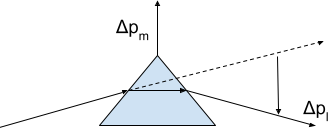
Here, the exiting light is turned compared the entering, so its momentum changes as it passes the prism. So, the prism should experience an oppositely directed recoil force. That force would just come from the points where light enters and exits the matter.

BioPhysicist
- 59,060

max630
- 171
-5
Light (photons) always travel with the speed of...guess...light! To put it lightly. When photons travel through a medium, the effective speed associated with the effective momentum of light can be less than c. How do photons interact with the medium? See for example the comment made to the answer above in which it is stated that photons in a dielectric become entangled with the electrons in it and form massive polaritons, which means that the photon's effective speed is less than c). At the moment I'm not aware of other means of photon propagation through media (for more info see this article, this one, or this one.
The photon's momentum, in empty space, is the light-like (how else can it be) four-vector $(E,p_x, p_y, p_x)$ ($E=||\vec p||$). Upon entering a medium, some of the photon's energy is absorbed by the medium. Effectively the 4-momentum is changed to $(E', p'_x, p'_y, p'_z)$, where $E'\lt E$ and $||\vec p||\lt || \vec {p'} ||$ (but still $E'=||\vec{p'}||$).
Depending on the medium the photons enter, they will react with it. If the medium is transparent the photons will maintain their direction (the photons now possess an effective momentum $(p_x, p_y, p_z)$, i.e. the same direction as when they entered the medium.
So to answer your question: the momentum of the photon changes upon entering the medium as well when it exits. Energy will be lost to the medium, so only if the medium's thickness is small enough the photons will make it to the other side, depending on the absorption coefficient of the medium.
It's only the effective speed, associated with the 3d momentum $(p_x,p_y,p_z)$, that gets smaller then c.
More or less (literally ).
Just now I realized what your question is about. Obviously this depends on the form of the object and the angles at which the light enters and exits. Upon entering the photons momentum gives the substance a push in the refracted direction of the light, while when leaving the substance the reverse happens. In almost all cases, this gives the substance a momentum, except for certain angles of incidence and exit.

Deschele Schilder
- 1
- 5
- 45
- 105