In my book, I read that we can choose any level as Zero Gravitational
P.E. and measure height of objects above it and call its energy 'mgh'.
This works because we're almost always only interested changes in potential energy, rather than absolute values.
Let me show below that the reference point is of no importance in that case.
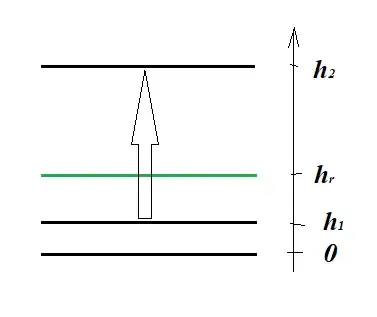
Let $h_r$ be a reference point where $U=U_r$. You can assume $U_r$ to be unknown. Now we look at an object of mass $m$ that is moved from $h_1$ to $h_2$ and want to know its change in potential energy.
We know that:
$$U_1=U_r+(h_1-h_r)mg$$
$$U_2=U_r+(h_2-h_r)mg$$
The change $\Delta U$ is:
$$\Delta U=U_2-U_1=U_r+(h_2-h_r)mg-[U_r+(h_1-h_r)mg]$$
$$\Delta U=mg(h_2-h_1)$$
So choosing an arbitrary, non-zero reference point gives the same, correct change in potential energy.
Another, more 'absolute' way of looking at it is by looking at the potential energy in a gravitational field
$^\dagger$, far away from Earth's surface:
$$U=-\frac{GMm}{r}$$
Here obviously for $r\to +\infty$ then $U=0$. So here $r= +\infty$ is a good zero reference point.
$^\dagger$ http://hyperphysics.phy-astr.gsu.edu/hbase/gpot.html


