1

Assume I have two disks, $p_1$ and $p_2$, of radius $r$, with their own velocities (preferably in $(x,y)$ form, but $(m, \theta)$ works too) and masses (unit-less, but same unit) collide in two dimensions, how can I compute their resulting velocities?

I was looking around on the internet and it seems like every calculation assumes that one of them is at rest, but both of mine will be moving.

Wikipedia has this bit, but it assumes that I know how to calculate the angle of deflection of the system, $\theta$, but that's even more confusing.

I'm pretty lost. What do I do?

Qmechanic
  • 220,844

1 Answers1

1

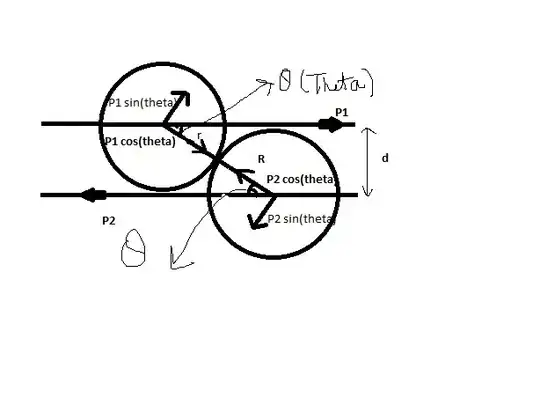
At the time of collision join the centres of the to disk by a line now resolve the momentum of each disk in parallel and perpendicular to the line and apply the conservation of momentum. And in this case sin(theta)= d/(r+R) where d is the distance between parallel line drawn from the center of two discs. Value of d or theta would be given in the question if not wait for some time i will find and post the way to find theta without d.enter image description here

it should help you P1 and P2 are the momentum of the two disc

Deiknymi
  • 2,271