In Kepler's first law, the earth moves around the sun in a elliptical path. The sun is at one of the focuses. Now, would this suggest that sun is always at the focus? i.e: it's position is fixed?
Asked
Active
Viewed 208 times


2 Answers
4
These laws assume the sun has to be in one of the focal points. This workes because the sun is so much heavier than any of the planets. In truth all bodies revolve around the barycenter of the composite planetary system, including the sun itself.
In astronomy, the barycenter (or barycentre; from the Ancient Greek βαρύς heavy + κέντρον center1) is the center of mass of two or more bodies that orbit one another and is the point about which the bodies orbit. It is an important concept in fields such as astronomy and astrophysics. The distance from a body's center of mass to the barycenter can be calculated as a two-body problem.
If one of the two orbiting bodies is much more massive than the other and the bodies are relatively close to one another, the barycenter will typically be located within the more massive object
The present day heliocentric orbits are about the barycenter.
A heliocentric orbit (also called circumsolar orbit) is an orbit around the barycenter of the Solar System, which is usually located within or very near the surface of the Sun. All planets, comets, and asteroids in the Solar System, and the Sun itself are in such orbits, as are many artificial probes and pieces of debris
Kepler's orbits were agood approximation for that time and accuracy of observations.


3
Yes, Kepler assumed that the centre of the Sun is exactly at a focus of the planet's elliptical orbit. However, Newton showed that that's not quite correct, and in a two body system both bodies execute elliptical motion, with the centre of mass of the system at a focus of each of the ellipses.
For more details, please see the two-body problem and the gravitational two-body problem.
Of course, in our solar system there are many bodies, which all have some effect on each other's orbits. The dominant masses are of course the Sun, Jupiter and Saturn. Here is a diagram from Wikipedia of the motion of the barycentre (centre of mass) of the solar system, relative to the Sun. Jupiter's orbital period is around 12 years, Saturn's is around 29 years. You can see that Jupiter has quite a strong influence on the barycentre.
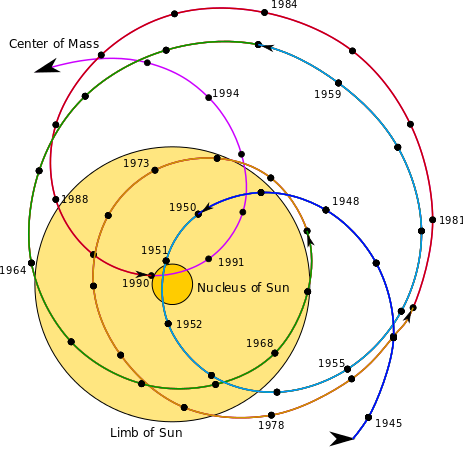
Please see https://astronomy.stackexchange.com/a/28036/16685 and https://astronomy.stackexchange.com/a/44903/16685 for more information, graphs, and diagrams related to the solar system barycentre, including an interactive 3D diagram.

PM 2Ring
- 13,541