1

The neutrino mass hierarchies are made of two hypotheses/scenarios:

  • the normal hierarchy: $m1<m2<m3$
  • the inverted hierarchy: $m3<m1<m2$

Why neutrino mass hierarchy scenario do not include also the cases:

  • $m2<m1<m3$?

  • $m3<m2<m1$?

I have seen the post: Neutrino mass hierarchy

but two people are in contradiction and there was no conclusion on who is right. @SRS is saying in this thread that it is a convention to have $m_1<m_2$. Is he right? wrong? Is there a proof of the convention from a statement in a document?

2 Answers2

2

We know that $m_1$ is less than $m_2$ from solar neutrino measurements of the MSW effect. Here's a quote from a paper that addresses this

Solar neutrinos allow to fix the sign of $\Delta m^2_{21}$for the standard value of $V_e$. The sign determines the resonance channel (neutrino or antineutrino) and the mixing in matter. The facts that due to smallness of the 1-3 mixing the problem is reduced approximately to the $2\nu$-problem and that suppression of signal averaged over the oscillations at high energies is stronger than 1/2, selects $\Delta m^{2}_{21} > 0 $.

-- Solar neutrinos and neutrino physics, Maltoni & Smirnov.

Put simply we measure the survival probability of solar neutrinos to be (more or less) like this... survival probability Image from Wikipedia.
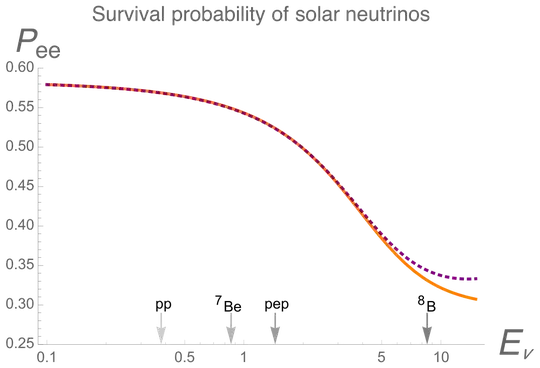
Where the probability at low energies is ~60% and at high energies is about 30%. If $\Delta m^{2}_{21}$ were negative you would see at high energies the survival probability dip to some value of ~50% at ~1MeV then go back up to ~60% at higher energies. (Caveat, most of the numbers above are made up, take them with a grain of salt).

mze
  • 36
1

I was also trying to find a concrete answer to this question and just came across this quote from https://arxiv.org/abs/1801.04946;

Note that the observation of matter effects in the Sun constrains the product $\Delta m_{21}^2 \cos 2θ_{12}$ to be positive. Therefore, depending on the convention chosen to describe solar neutrino oscillations, matter effects either fix the sign of the solar mass splitting $\Delta m_{21}^2$ or the octant of the solar angle $θ_{12}$, with $\Delta m_{21}^2$ positive by definition.

So the answer appears to be both. Though I have seen more documents fixing the octant of the angle than the sign of the splitting.