0

Centre of mass gives the location where the 'weighted average' of all the elemental mass of a body acts. Considering that weighted average is one of the many statistical tools used to find the spread of a data, isn't centre of mass a rough idea ? Are there any proofs that show that any result obtained using the centre of mass is equivalent to the one obtained by using the sum of all the elemental masses of the whole body ?

For example, let us consider that a cuboid is tilted in such a way that its centre of mass is no longer supported.Would the torque obtained by availing centre of mass be same as that of what is obtained by availing individual point masses/elemental masses ?

Qmechanic
  • 220,844
Zam
  • 851

3 Answers3

3

This is just a footnote to user8718165's answer. What I'm going to do is address the question in your final paragraph:

For example, let us consider that a cuboid is tilted in such a way that its centre of mass is no longer supported. Would the torque obtained by availing centre of mass be same as that of what is obtained by availing individual point masses/elemental masses?

and show that the torque obtained by availing centre of mass is the same as that of what is obtained by availing individual point masses/elemental masses. We'll do this by showing the two ways of calculating the torque give the same result. Start with the diagram sowing the forces on the tilted cube:
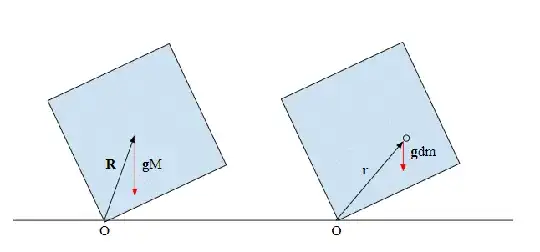
Tilted cube

On the left we do the calculation using the centre of mass. The torque due to a force $\mathbf F$ at a position given by the vector $\mathbf R$ is:

$$ \tau = \mathbf R \times \mathbf F $$

where $\times$ is the cross product. On the left the force acting at the centre of mass is just $\mathbf g M$. We take the corner of the cube $O$ as our origin so the psition of the centre of mass is given by the vector $\mathbf R$ and the torque is:

$$ \tau = \mathbf R \times \mathbf g M \tag{1} $$

Now look at the right diagram. This time we'll take some infinitesimal mass $dm$ at some position $\mathbf r$. The force due to $dm$ is $\mathbf g dm$ so the torque is:

$$ d\tau = \mathbf r \times \mathbf g dm $$

And the total torque is given by integrating:

$$ \tau = \int \mathbf r \times \mathbf g dm \tag{2} $$

So to answer your question we have to show that the torque calculated in the two ways, i.e. using the equations (1) and (2), is the same. And this is really easy. We start with the definition of the centre of mass position:

$$ \mathbf R = \frac{1}{M} \int \mathbf r dm \tag{3} $$

Take equation (1) and substitute for $\mathbf R$ using eqution (3) to give:

$$ \tau = \left( \frac{1}{M} \int \mathbf r dm \right) \times \mathbf g M = \left( \int \mathbf r dm \right) \times \mathbf g $$

And you need to know that for the vectors $\mathbf a$, $\mathbf b$ and $\mathbf c$ we have the identity:

$$ (\mathbf a + \mathbf b) \times \mathbf c = \mathbf a \times c + \mathbf b \times c $$

and that means we can bring the cross product with $\mathbf g$ inside the integral to get:

$$ \tau = \left( \frac{1}{M} \int \mathbf r dm \right) \times \mathbf g M = \left( \int \mathbf r dm \right) \times \mathbf g = \int \mathbf r \times \mathbf g dm $$

And this is just our equation (2). So we've shown that equations (1) and (2) are the same i.e. they give the same torque.

John Rennie
  • 367,598
2

We use the concept of center of mass whenever we want to determine the overall behavior of motion of the body.

Remember that it's possible for all other particles to change their position without changing the center of mass's position but the opposite isn't always true.

Most of the times, (not necessarily every-time) all the points in the body have to change their positions if the COM changes its position.

For a counter example as suggested by user JMAC in the comments, let's consider the cube resting on an edge or a corner, it is possible for the COM of the cube to move around without losing contact with the floor at that point.

In your example, gravitational force is uniformly acting on the body if the body is considered to be small. That means all points in the body are experiencing the same force due to gravity and hence we prefer to use the concept of COM.

enter image description here

The box will tumble and fall to the right due to net torque which is

$$\tau=(mg\sin\theta)r$$

Here we can see that the torque is developed due to two different forces acting at two different points and they don't cancel out.

We can still use the fact that all points are feeling the same force so we can sum them up but that's very tedious here. In fact the derivation for a system of $n$ particles is given in any introductory physics book.

We can't use the concept of COM in places where the force acts asymmetrically on a body since different points in the body will experience different forces.

We only use this concept whenever all the points in the body have the same velocity.

user8718165
  • 1,566
0

The basic idea is that tracking the center of mass simplifies the equations motion (or balance in case of statics).

In dynamics of rigid bodies, the concept of center of mass is arises from the derivation of linear and angular momentum from collection of moving particles.

Without loss of generality consider a collection of particles that rotates about an axis passing through the origin. A rotation about an axis is the only allowable motion that preserves the distances between particles. Use the vector $\boldsymbol{\omega}$ to describe the rotational velocity.

  • In this co-moving inertial reference frame the velocity of each particle is $$ \boldsymbol{v}_i = \boldsymbol{\omega} \times \boldsymbol{r}_i \tag{1}$$

  • What is the total momentum of all the particles? $$\boldsymbol{p} = \sum_i m_i \boldsymbol{v}_i = \sum_i m_i ( \boldsymbol{\omega} \times \boldsymbol{r}_i) = \boldsymbol{\omega} \times \sum_i m_i \boldsymbol{r}_i \tag{2}$$

  • The idea of the center of mass, is finding a special point in space $\boldsymbol{r}_C$ that makes $$ \sum_i m_i \boldsymbol{r}_i = \boldsymbol{r}_C \sum_i m_i \label{cm} \tag{3}$$

  • Of course the answer is trivial, with solution $$ \boldsymbol{r}_C = \tfrac{1}{m} \sum_i m_i \boldsymbol{r}_i \tag{4}$$

  • Note also that $$m = \sum_i m_i \tag{5}$$

  • So the total momentum is now $$ \boldsymbol{p} = m ( \boldsymbol{\omega} \times \boldsymbol{r}_C ) \tag{6}$$

  • But the thing inside the parentheses is the velocity of the center of mass since you can take the time derivative of \eqref{cm}

    $$ \boldsymbol{p} = \sum_i m_i \boldsymbol{v}_i= \sum_i m_i \tfrac{\rm d}{{\rm d}t} \left( \boldsymbol{r}_i \right) = \left( \tfrac{\rm d}{{\rm d}t} \right) \boldsymbol{r}_C \sum_i m_i = m \boldsymbol{v}_C \tag{7}$$

  • So the simplest form of total momentum comes by the derivation of the center of mass

    $$\left. \boldsymbol{r}_C = \frac{1}{m} \sum_i \boldsymbol{r}_i \,\right\} \boldsymbol{p} = m \boldsymbol{v}_C \tag{8}$$

  • Similarly (but with more complex algebra) you can find angular momentum about the origin as $$ \boldsymbol{L} = \sum_i \boldsymbol{r}_i \times ( m_i \boldsymbol{v}_i ) = \boldsymbol{r}_C \times \boldsymbol{p} + \mathbf{I}_C \,\boldsymbol{\omega} \tag{9}$$

  • Angular momentum about the center of mass is much simpler as the above reduces to $$ \boldsymbol{L}_C = \mathbf{I}_C \,\boldsymbol{\omega} \tag{10}$$

  • Finally the equations of motion are derived from the time derivative of momentum

    $$ \begin{aligned} \boldsymbol{F} & = \frac{{\rm d}}{{\rm d}t} \boldsymbol{p} \\ \boldsymbol{\tau}_C & = \frac{\rm d}{{\rm d}t} \boldsymbol{L}_C \end{aligned} \tag{11} $$ or in word form

    • The sum of forces on a body equals the rate of change of linear momentum
    • The sum of torques about the center of mass equals the rate of change of angular momentum about the center of mass.
John Alexiou
  • 40,139