18

When continuous rudder is applied in a typical light aircraft during straight and level flight at "normal" flying speeds and altitudes, the primary effect is that the aircraft will yaw to the left - so it's flying "sideways" to some extent.

It is commonly understood amongst pilots that the secondary effect in most aircraft, is that the aircraft will also start rolling in the direction of yaw (i.e. applying left rudder causes left yaw, and left roll).

What causes this roll? And does the Dihedral angle have anything to do with it?

Johan
  • 281

3 Answers3

13

Rody and Mike almost got it right. :)

Most aircraft are designed with swept wings. That is the primary mechanism that gives the roll effect to an airplane that may only receive a yaw input. if you look at this picture:
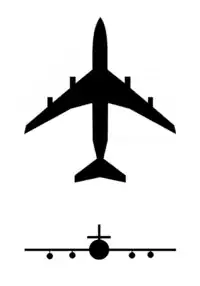
A typical swept wing aircraft from Wikipedia commons

You can see that both wings have a backwards sweep to them. Now, if you introduce a yaw to the aircraft, one wing will extend out more directly into the wind-stream, while the other wing will be even more swept. This effectively makes one wing longer, and the other wing shorter. Like in this image (this image is actually displaying a more extreme case that also involves boundary layer separations, but that is beyond this answer):
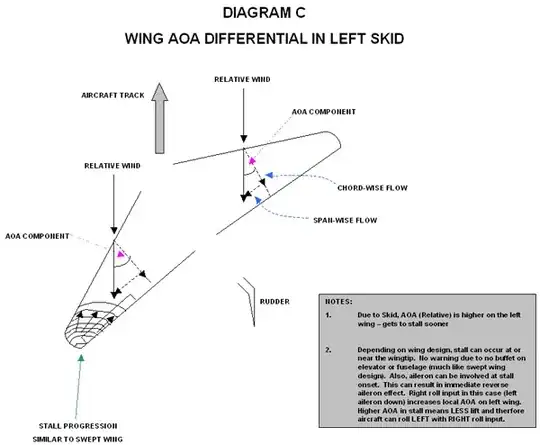
Wing AoA in a Yaw from a public training site

Actually, this picture displays it exactly as I was taught in USAF flight school::
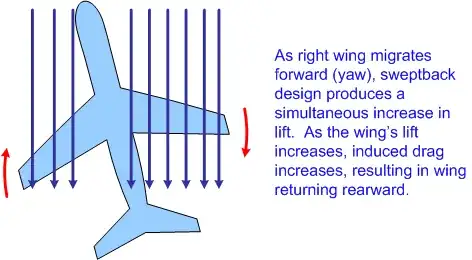
Yaw effects on lift of swept wing aircraft from Langley Flight School, standard textbook image

The longer wing will generate more lift, and the shorter one will generate less lift. And since there is unequal lift around the roll axis, the airplane will roll, and continue to roll.

Of course, with more lift comes more drag, so that will counter the lift and pull the wing back (Causing an effect known as "Dutch Roll"). Many aircraft have a device called a "yaw damper" to counter this (or else you will feel quite queasy flying). Dutch roll is demonstrated by this GIF:
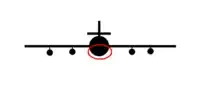
Wikipedia Commons Dutch Roll GIF

The reason that Mike's answer is not totally correct is from Figure 2 in his wiki link. Note that the words "non-zero" are included in this diagram:
Wikipedia Commons Dihedral Roll causation diagram

That means that theoretically, if one were able to yaw an aircraft with dihedral perfectly, the aerodynamic forces would not be the causal factor. Also, most aircraft that have a dihedral or anahedral configuration also have a wing sweep, so that is the overall factor that is at play.

11

I want to replace my former answer with this one.

The on-line book by John S. Denker has a very good chapter on this subject.

He outlines a number of reasons why there is slip-roll coupling:

  • dihedral effect

  • wing-sweep effect

  • updraft/downdraft at wing roots caused by off-center flow

  • "wind shadow" caused by off-center flow

  • torque about roll axis from rudder displacement and other surfaces exposed to asymmetric wind

  • propwash (which actually causes some adverse roll moment)

Mike Dunlavey
  • 17,328
6

There's quite a few factors at play here, and granted, it's been a while since my last flight dynamics class :)

After a few iterations with the other answerers below, here is a (still not yet complete) list of reasons the effect will occur:

  1. While yawing, the left and right wings will have slightly different speeds. This difference in wing speed causes slightly more lift on one wing than on the other, thus inducing a rolling moment (more lift usually also means more drag, so this effect dampens the yawing motion). In a spirally unstable aircraft, any non-zero initial roll will grow due to said effect, in principle without bounds (the aptly named "graveyard spiral").

  2. Rudder deflection causes an aerodynamic moment in the yaw direction, but as rudders on many aircraft are built into the vertical vertical tail section, this moment also has a small arm w.r.t. the roll axis, thus causing a rolling moment.

  3. Large yaw angles could create an asymmetrical interference between the fuselage and both wings; one wing will be directly in the airflow, while the other is in the "wind shadow" of the fuselage. This causes a difference in lift (and larger induced drag on the shadowed wing), causing a rolling moment.

  4. An aircraft's design may employ a dihedral angle, which is mostly there to stabilize the spiral mode. However, after applying a(n) (impulsive) yaw angle, the aircraft will side slip, causing a different angle of attack on the two wings. This will again cause a difference in lift between the two wings, therefore causing a rolling moment (which will eventually stabilize).

  5. An aircraft's design may employ wing sweep to mitigate adverse effects in the transsonic and supersonic regimes. When an aircraft with swept wings is side-slipping after applying a yaw, the relative wind on the outward wing will be more aligned with the chord line of the wing's cross section than the inward wing. The net effect is the same as if the wind speed would be faster on the outward wing then on the inward wing, therefore, a rolling moment is caused. Note that this is only true for backward-sweep angles; the adverse is true for forward-swept angles (which is part of the reason not many aircraft have a forward sweep angle).

  6. More to come.