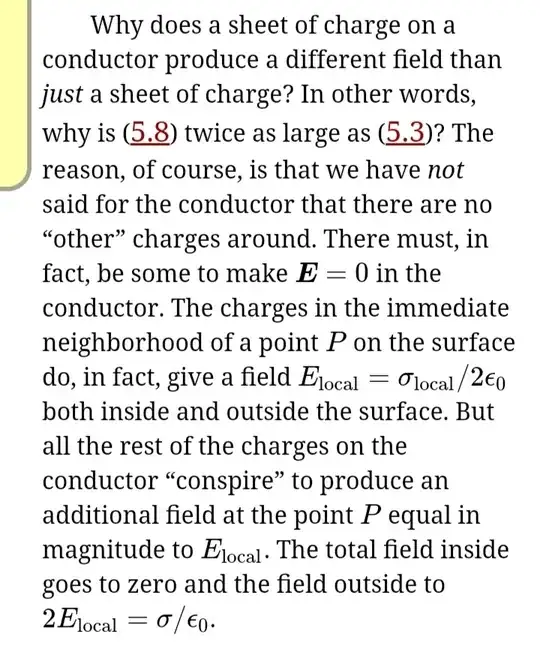
I will admit that the language he is using is slightly confusing at first, but if you read on, it makes more sense. The "other" charges he is talking about are the charges outside the tiny Gaussian surface.
In the middle of a charged sheet, by symmetry, the charge distribution produces an equal and outward (for positive charge density) E-field on either side of the sheet.
For a small Gaussian surface at the boundary of a charged conductor, this symmetry argument no longer applies. The E-field only due to the charges inside the Gaussian surface would still point outward on either side of the boundary, by symmetry, as in the case of the charged sheet. However, the E-field within the conductor must be zero, meaning the "other" charges produce a field that cancels the E-field inside the conductor that is due to the charge inside the Gaussian surface. At the same time, this E-field reinforces the E-field just outside the conductor due to the charge within the Gaussian surface, which is why the total E-field here is twice that found outside a charged plane.