56

Noether's theorem is one of those surprisingly clear results of mathematical calculations, for which I am inclined to think that some kind of intuitive understanding should or must be possible. However I don't know of any, do you?

*Independence of time $\leftrightarrow$ energy conservation.
*Independence of position $\leftrightarrow$ momentum conservation.
*Independence of direction $\leftrightarrow$ angular momentum conservation.

I know that the mathematics leads in the direction of Lie-algebra and such but I would like to discuss whether this theorem can be understood from a non-mathematical point of view also.

Gerard
  • 7,189

7 Answers7

22

It's intuitively clear that the energy most accurately describes how much the state of the system is changing with time. So if the laws of physics don't depend on time, then the amount how much the state of the system changes with time has to be conserved because it's still changing in the same way.

In the same way, and perhaps even more intuitively, if the laws don't depend on position, you may hit the objects, and hit them a little bit more, and so on. The momentum measures how much the objects depend on space, so if the laws themselves don't depend on the position on space, the momentum has to be conserved.

The angular momentum with respect to an axis is determining how much the state changes if you rotate it around the axis - how much it depends on the angle (therefore "angular" in the name). So the symmetry is linked to the conservation law once again.

If your intuition doesn't find the comments intuitive enough, maybe you should train your intuition because your current intuition apparently misses the most important properties of time, space, angles, energy, momentum, and angular momentum. ;-)

Luboš Motl
  • 182,599
16

The intuitive argument for Noether's theorem, which is also the best completely precise argument for Noether's theorem, appears in Feynman's popular book "The Character of Physical Law". I will reproduce the argument which relies on the following diagram:

enter image description here

In this diagram the two parallel squiggles with a line connecting them at the top and at the bottom represent a particle path and a displaced particle path.

The action is stationary on the particle path, so the square squiggle which translates over, goes up parallel, and comes back has the same action as the original path. The original path, however, has the same action as just the squiggle part of the other path, therefore the two horizontal lines at top and bottom have equal action.

You can use this argument to find the exact form of the Noether current by replacing Feynmans horizontal lines with quick kicks by the momentum over a time $\epsilon$. His argument is an honest to goodness proof, it is by far the best proof, and it is the only case in all the history of publishing where a result is best presented in a popular book.

If you make the kicks continuous in time, so that they come here and there, you can still see that the kicks integrate by parts. This argument appears in the introduction to one of Hawking's 1970s papers, and is essentially equivalent to Feynman's "Character of Physical Law" argument, except it appears more than ten years later.

9

Well, I don't know about any intuitive explanation besides intuition gained by understanding the underlying math (mainly differential geometry, Hamiltonian mechanics and group theory). So with the risk of not giving you quite what you want, I'll try to approach the problem mathematically.

If you know Hamiltonian mechanics then the statement of the theorem is exceedingly simple. Assume we have a Hamiltonian $H$. To this there is associated a unique Hamiltonian flow (i.e. a one-parameter family of symplectomorphisms -- which is just a fancy name for diffeomorphisms preserving the symplectic structure) $\Phi_H(t)$ on the manifold. From the point of view of Lie theory, the flow is a group action and there exists its generator (which is a vector field) $V_H$ (this can also be obtained from $\omega(\cdot, V_H) = dH$ with $\omega$ being the symplectic form). Now, the completely same stuff can be written for some other function $A$, with generator $V_A$ and flow $\Phi_A(s)$. Think of this $A$ as some conserved quantity and of $\Phi_A(s)$ as a continuous family of symmetries.

Now, starting from Hamiltonian equation ${{\rm d} A \over {\rm d} t} = \left\{A,H\right\}$ we see that if $A$ Poisson-commutes with $H$ it is conserved. Now, this is not the end of the story. From the second paragraph it should be clear that $A$ and $H$ don't differ that much. Actually, what if we swapped them? Then we'd get ${{\rm d} H \over {\rm d} s} = \left\{H,A\right\}$. So we see that $A$ is constant along Hamiltonian flow (i.e. conserved) if and only if $H$ is constant along the symmetry flow (i.e. the physical laws are symmetric).

So much for why the stuff works. Now, how do we get from symmetries to conserved quantities? This actually isn't hard at all but requires some knowledge of differential geometry. Let's start with most simple example.

Translation

This is a symmetry such that $x \to x^\prime = x + a$. You can imagine that we move our coordinates along the $x$ direction. With $a$ being a parameter, this is a symmetry flow. If we differentiate with respect to this parameter, we'll get a vector field. Here it'll be $\partial_x$ (i.e. constant vector field aiming in the direction $x$). Now, what function on the symplectic manifold does it correspond to? Easy, it must be $p$ because by differentiating this we'll get a constant 1-form field $dp$ and then we have to use $\omega$ to get a vector field $\partial_x$.

Other way to see that it must be $p$: suppose you have a wave $\exp(ipx)$. Then $\partial_x \exp(ipx) = ip \exp(ipx)$ so momentum and partial derivatives are morally the same thing. Here we're of course exploiting the similarity between Fourier transform (which connects $x$ and $p$ images) and symplectic structure (which combines $x$ and $p$).

Rotation

Now onto something a bit harder. Suppose we have a flow $$\pmatrix{x \cr y} \to \pmatrix{x' \cr y'}= \pmatrix{\cos(\phi) & \sin(\phi) \cr - \sin(\phi) & \cos(\phi)} \pmatrix {x \cr y} $$ This is of course a rotational flow. Here we'll get a field $y {\rm d}x - x {\rm d} y$ and the conserved quantity of the form $y p_x - x p_y$ which can in three dimensions be thought of as a third component of angular momentum $L_z$.

Note that the above was done mainly for illustrative purposes as we could have worked in polar coordinates and then it would be actually the same problem as the first one because we'd get the field $\partial_{\phi}$ and conserved quantity $p_{\phi}$ (which is angular momentum).

Marek
  • 23,981
8

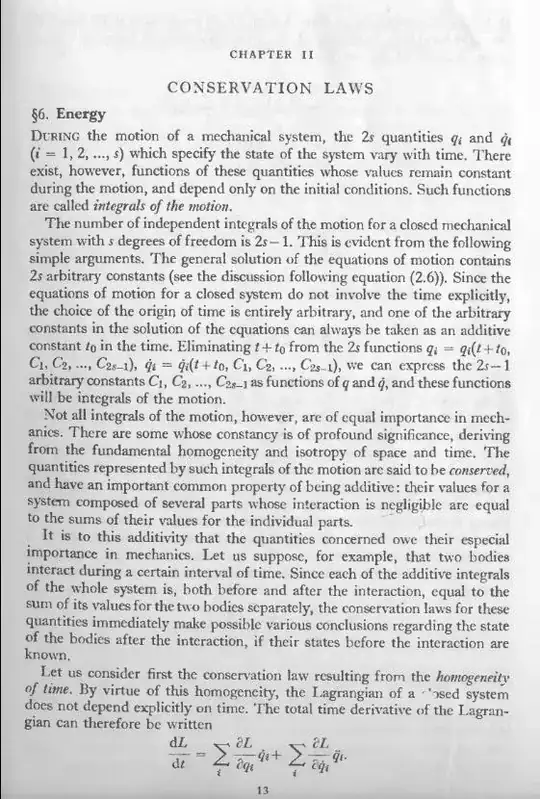
I can only tell that those conserved quantities you have listed above are additive in particles: $P = \sum p_i(t)$, for example. But there are those that are not additive! They do not have special names.

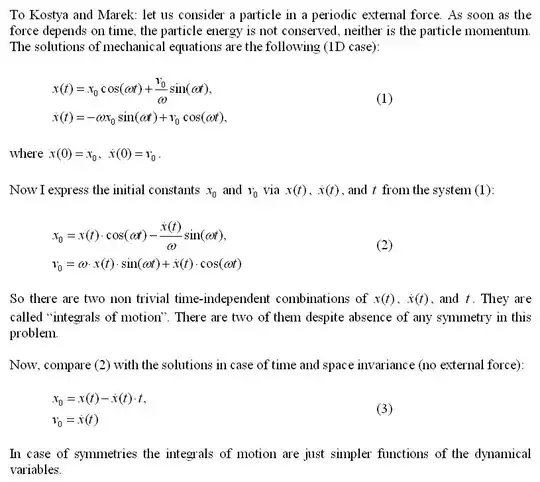
For N differential equations there are as many integrals of motion as the initial conditions or so. Some of them can be casted sometimes in the additive form but generally (when there are no symmetries) the total number of integrals of motion remains the same. They all are simply non additive (more messy, if you like). So I would answer that symmetries help combine some integrals of motion as conserved quantities additive in all particles.

EDIT 1: Maybe Noether's theorem shows explicitly what the conserved quantities are whereas from equations it may be not so evident to derive?

EDIT 2: I got -4. Is my reasoning really that bad?

EDIT 3: a page from Landau:

Conservation Laws

EDIT 4: An example of integrals of motion:

1D Integrals of motion

6

Here are my two cents. Read the proof it will help you understand and build intuition because it is constructive. It explicitly shows you what the conserved quantity is, given the group of symmetries. If it is too hard to follow and you can't see the forest because of the trees, try a few examples it should help. Also here is a link that may help a bit.

http://math.ucr.edu/home/baez/noether.html

MBN
  • 3,875
1

Since it is a mathematical theorem whose physical content you know already, it is difficult to discuss it without mathematics. But still I will try to present it in a simple way. It may help if we understand how it is derived.

Generally we look for an invariance of the action under a symmetry transformation with a time independent parameter. This is then a trivial mathematical identity. Now it is observed that if the dynamical variables obey the equations of motions then action becomes stationary even if the parameter is time dependent. We observe that the variation of the action - which must be zero since the action is stationary - can only depend on the integration of the time derivatives of the parameter. Now integrate by parts to take all the time derivatives off it and keep the rest in the integrand. Since the parameter is arbitrary, its co efficient in the integral must be zero. Now this coefficient is time derivative of something whose time derivative is zero. Therefore this "something" is constant or conserved in time.

0

Just had a quick look at the answers and I think a point is being systematically missed.

Noether's theorem is a definition of the conserved quantity associated to a symmetry, plus a proof that the equations of motion indeed imply conservation of said quantity under time evolution. (This is conceptually similar to how Newton's first law of motion is a definition of inertial frames.)

OP writes

*Independence of time ↔ energy conservation

which should be understood as

*Independence of time ↔ there exists a conserved quantity E, which we have agreed to call "energy".


The "Noether trick" approach to the theorem (actually relevant for calculations) also appears to be absent. For completeness, I will illustrate it for $$ S=\int dt\; \tfrac{1}{2} \dot q(t)^2. $$ Say you want the conserved quantity associated to time translations $q(t)\to q(t+\varepsilon \Delta t)$ for $\varepsilon \in[0,1)$ and $\Delta t$ an arbitrary time interval (being absolutely precise here). Since $$ \exp(\varepsilon \Delta t\;\partial/\partial t) q(t)=q(t+\varepsilon (\Delta t)) $$ we understand the infinitesimal generator is the operator $$ \delta_\varepsilon=\varepsilon \Delta t\frac{\partial}{\partial t} $$ (This is essentially Taylor's theorem.) This is a variation, so $$ \label{blah} \delta_\varepsilon S=\int dt\; \dot{q}\delta_\varepsilon \dot q= \int dt\;\dot q \frac{\partial}{\partial t}(\varepsilon \Delta t \dot q)\,, \quad (\star) $$ This is obviously the integral of a total $\partial/\partial t$ derivative, so $\delta_\varepsilon S=0$.

The Noether trick is to calculate $(\star)$ with the replacement $$\varepsilon\to\varepsilon(t)$$ (satisfying correct boundary conditions etc.). I find $$\delta_{\varepsilon(t)} S=\int dt\;\dot q \frac{\partial}{\partial t}(\varepsilon \Delta t \dot q) =-\Delta t\int dt\; \ddot q \dot q \varepsilon=-\Delta t\int dt\;\frac{\partial}{\partial t}\Big(\frac{\dot q^2}{2}\Big) \varepsilon. $$ Since $\delta_{\varepsilon(t)} q$ preserves the boundary conditions, $\delta_{\varepsilon(t)} S$ must vanish whenever the equations of motion hold. Therefore $$ \frac{\partial}{\partial t}\Big(\frac{\dot q^2}{2}\Big)=0 $$ when the equations of motion hold.

We read off the conserved quantity "kinetic energy" $$ T=\Big(\frac{\dot q^2}{2}\Big). $$

The role of time independence is to arrange that after you remove all derivatives from $\varepsilon$ via integration by parts, its coefficient turns into a total time derivative.

See Townsend (from whom I learned this) for more details.