1

How deeply is cosmic inflation required for the laws of physics? Is inflation required for a universe remotely like ours, or is it simply a contingent on the starting conditions of the universe?

For example, is time as we experience it a byproduct of inflation, something that could not exist without it?

The (limited) research I've done seems to suggest that inflation is deeply embedded in the laws of physics, but I don't really understand that. If it is so, how can our part of the universe not expand (within a galaxy), yet the laws of physics still apply here?

Qmechanic
  • 220,844
APCoding
  • 155

2 Answers2

6

Time has nothing to do with inflation. Clocks would tick even if the universe had not inflated.

Inflation is not “deeply embedded” in the laws of physics. You can have the Standard Model and a Big Bang based on General Relativity without having inflation.

Inflation is an ad hoc add-on to cosmological models to explain certain features of our universe — such as its homogeneity, isotropy, flatness, lack of magnetic monopoles, etc. — that would be hard to understand without it. Most inflationary models uses a so-far-unobserved scalar “inflaton” field to cause a brief period of inflationary expansion. We know that scalar fields exist (the Higgs field is scalar) and they can have the negative pressure that is required for inflation. Thus many physicists see inflation as fitting comfortably and plausibly into existing ideas about particle physics and cosmology, but inflation is not required by them.

Addendum for @safesphere: A scalar Higgs field is a critical part of the Standard Model of particle physics. With this field, the model is in impressive agreement with all observations of electromagnetic, weak, and strong interactions between various particles at, say, the Large Hadron Collider. Without it, the model utterly fails. For mainstream physicists, this evidence more than suffices to consider the Higgs field to “exist”. Whenever a physicist says “X exists”, she means “A model with X in it works really well to explain what we observe”.

G. Smith
  • 52,489
0

In the beginning there was the original Big Bang model, that explained the expansion of the universe using general relativity ( which described successfully gravity at the scale of the universe), and the known particle physics interactions.

But then, when the cosmic wave background radiation was measured, it showed a uniformity in any direction at the level of $10^{-5}$ .

This is also the horizon problem and it is inextricably tied with the fact that General Relativity is the theory of the Big Bang , with special relativity for flat spaces.

The horizon problem (also known as the homogeneity problem) is a cosmological fine-tuning problem within the Big Bang model of the universe. It arises due to the difficulty in explaining the observed homogeneity of causally disconnected regions of space in the absence of a mechanism that sets the same initial conditions everywhere

For a general uniformity in temperature to exist in the universe at the time of the photon decoupling at 380.000 years after the Big Bang the particles in the various regions of space should be able to interact and come to a thermodynamic equilibrium. This cannot happen at the time before the photon decoupling because of relativity, there are regions of the universe which do not interact with each other, due to the light cone geometry, so the uniformity is not explainable with thermodynamics.

The theory of inflation by introducing an effective quantum mechanical theory, allows for the uniformity observed, as it is explained in the link.
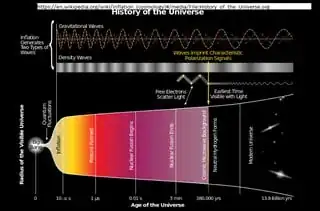
bigbang

This is a model that explains observations, though there is not as yet a definitive quantization of gravity.

anna v
  • 236,935