When we walk, is the magnitude of the earth's force on us greater than if we were standing still?
Asked
Active
Viewed 3,330 times

2 Answers
5
It bobs around as you go through your stride, but it's greater on average.
Newton's second law, F = ma, tells us that Earth exerts more or less force on you depending on whether you are accelerating. When you're walking, you oscillate up and down. If you're accelerating up (which happens when your body is at the lower parts of your gait), the Earth exerts more force on you. If you're accelerating down, it exerts less. The average vertical force is the same as if you were standing still.
That accounts for vertical forces. There are also some horizontal forces from the Earth, but these are generally small unless you're starting/stopping very abruptly. Since they're perpendicular to the normal force Earth exerts on you, they always increase the total force. As you walk, the horizontal (i.e. friction) force from Earth on you will change directions, depending if you're momentarily speeding up or slowing down. If you could walk very smoothly, you could minimize these forces.
One way that you could have the Earth exert less force on you on average while walking would be to walk in the direction of a strong wind. When you're standing still in a strong wind, the Earth exerts a friction force to keep you steady. But if you walk with the wind, its apparent strength is decreased, and the frictional force needed to keep you from sliding away can go down.

Mark Eichenlaub
- 53,961
3
Just to quantify Mark Eichenlaub's answer, the typical profile of the ground reaction force while walking looks something like the following image taken from here:
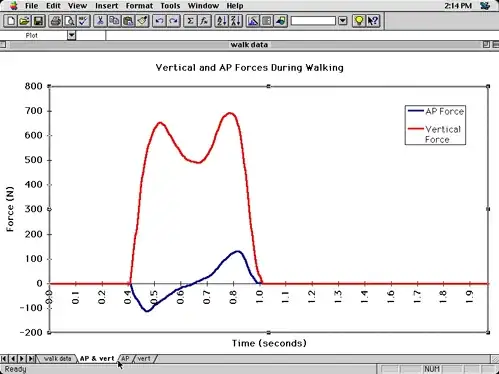
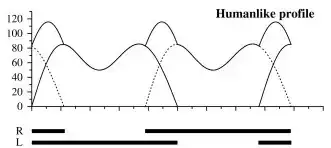
Vertical (red) and horizontal (blue) forces are for a single leg. Because there is simultaneous contact of both feet during walking, the actual total vertical force of the ground on the body looks like this graph taken from here:

Jaime
- 3,958