1

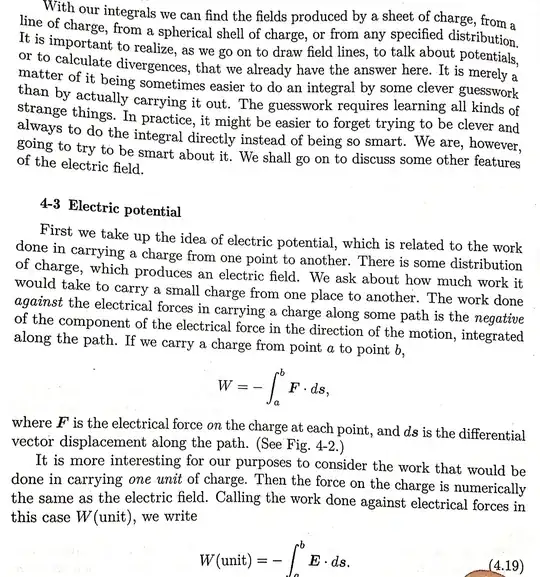
$$W = - \int _ { a } ^ { b } \vec { F } \cdot d \vec { r }$$
( from The Feynman lectures on physics vol. 2, new millennium edition, page 4-4)

In this formula why there is a negative sign in the formula? I am not asking the sign of the total workdone at the end of the calculation (which is already answered in this question which is similar to mine) but the sign in the formula that is before calculation. from where the sign comes from?does it have anything to do with the co-ordinate system,if yes then can the sign be changed if we take a different quadrant?.enter image description here

Hawkingo
  • 287

4 Answers4

3

The key is this:

The work done against the electrical forces in carrying a charge along some path is the negative of the component of the electrical force in the direction of motion. [emphasis added]

Generally, if we apply a force $\vec{G}$ to some object and move it along a path, the work done on the object is $$W = \int_a^b\vec{G}\cdot d\vec{s}$$

In this case, the force we must apply to the charged particle to move it quasistatically is opposite to the force $\vec{F}$ being applied to it by the electric field,

$$\vec{G}=-\vec{F}$$

so

$$W = -\int_a^b\vec{F}\cdot d\vec{s}.$$

To restate it, in the description in Feynman, $\vec{F}$ isn't the force we apply to the particle, it's the force applied by the electric field that we have to work against.

The Photon
  • 29,651
0

The force on a particle can also be described in terms of a scalar potential function $U(x)$, it has nothing to do with coordinate frames.

$\begin{align} F(x)=-\frac{dU}{dx};\hspace{5mm} \vec{F}(\vec{r})=-\vec{\nabla}U(\vec{r}) \end{align}$

The potential energy $U$ means the amount of work needed to move an object from some point to another, the force applied needs to be equal but opposite, thats why there is a negative sign.

The force exerted by the force field always tends toward lower energy and will act to reduce the potential energy.

The negative sign on the derivative shows that if the potential U increases with increasing x, the force will tend to move it toward smaller x to decrease the potential energy.

0

Well not only in electrostatics but in whole classical mechanics "The change in potential energy of the system is defined as the negative of work done by internal conservative forces of the system".

0

I agree with @The Photon answer.

First, as @The Photon noted, the force $F$ in the formula is the force that the electric field exerts on the charge. Consequently the negative sign in the formula is for the work done by an electric field where the force of the field on the charge is opposite to the direction of movement of the charge. This means the electric field is doing negative work on the charge taking energy from the charge and storing it as electrostatic potential energy (increasing its electrical potential). The charge gets that energy from an external electrostatic force that does an equal amount of positive work on the charge. The gravity analogy is taking a mass at rest off the ground and placing it at rest a height $h$ above the ground. You do positive work $mgh$ to move the mass. Gravity does an equal amount of negative work $-mgh$ taking the energy you supplied and storing it as gravitational potential energy

Note, however, that if instead the electrostatic force in the same direction as the movement of the charge, the field would be doing positive work decreasing the electrostatic potential energy of the charge and giving it kinetic energy. The gravity analogy is the positive work done by gravity on a falling object.

So to a certain extent the selection of the sign is arbitrary. However in electrostatics the potential at an infinite distance from a fixed positive point charge is arbitrarily assigned zero potential. This is logical since the strength of the field of the point charge approaches zero an infinite distance away. Now if another “test” charge at that infinite distance is to be moved toward the fixed positive charge its potential will either increase or decrease depending on the polarity of the test charge. If the test charge is negative, in moving it towards the fixed positive charge the field will do positive work and the potential of the charge will decrease. If the test charge is positive, the field will do negative work and increase its potential. The latter is the basis of the formula.

Hope this along with the other answers helps.
Bob D
  • 81,786