Why isn't it possible to focus a laser beam to an infinitely small point in space? I am familiar with the shape of a gaussian beam, but why can't my $w_0$ be equal to zero?
Asked
Active
Viewed 621 times

4 Answers
4
An ideal Gaußian beam is diffraction-limited - its wavefront inevitably spreads out due to Huygens' principle. An infinitesimally small beam would diffract infinitely strongly, i.e. not resemble a beam at all: By Huygens' principle a single point (i.e. a "beam source" with zero radius) as a source simply emits a single, spherical wave, not a beam.

ACuriousMind
- 132,081
2
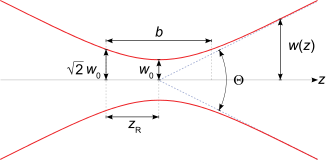
According to Wikipedia:Gaussian beam the beam waist ($w_0$) and the total angular spread of the beam ($\Theta$) are related by
$$ \pi w_0 \tan \frac \Theta 2 = \lambda $$
From this formula you see: The wave-nature of light (via its wavelength $\lambda$) is responsible for the non-zero waist.
That means you would have a beam waist $w_0 = 0$ only for these cases:
- wavelength $\lambda = 0$ (so that there is no diffraction)
- total angular spread $\Theta = 180°$ (meaning we have a spherical wave from a point source)

Thomas Fritsch
- 42,352
0
The Gaussian beam is not a precise solution of the Maxwell equation, it can only derived in the paraxial approximation, and this approximation is not applicable for small $w_0$.

akhmeteli
- 27,962
-1
Ok, I'm not happy with the answers so far so here's my 2 cents.
Yes $\omega_0$ can be zero. If you have a perfectly spherical mirror with a single particle lasing source inside, then by classical optics it will focus light to a infinitely narrow point at the centre.
The real reason then why it is not truly infinitely narrow (manufacturing defects aside) is that even if we are to ignore entanglement re: the photon and assume it to not ne governed by the exclusion principle, the emitter will be, and cannot be isolated to a infinitely narrow non-moving position.

Paul Childs
- 909