Furthermore, these black holes could not be totally black since all the matter of the original stars do not pass the horizon. So it would be possible for them to emit a bit of light no?
Have a look at this:Visible Light from a Black Hole Spotted by Telescope, a First
For the first time, astronomers have seen dim flickers of visible light from near a black hole, researchers with an international science team said. In fact, the light could be visible to anyone with a moderate-size telescope.
......
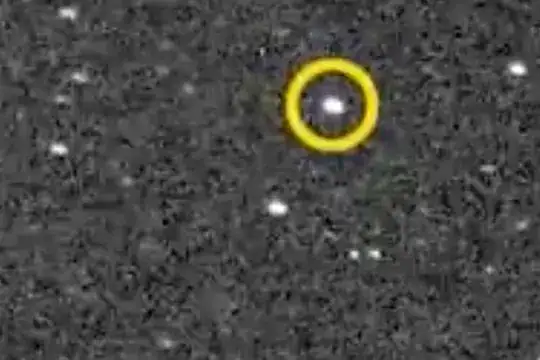
Anything falling into black holes cannot escape, not even light, earning black holes their name. However, as disks of gas and dust fall or accrete onto black holes — say, as black holes rip apart nearby stars — friction within these accretion disks can superheat them to 18 million degrees Fahrenheit (10 million degrees Celsius) or more, making them glow extraordinarily brightly.
Scientists discovered accreting black holes in the Milky Way more than 40 years ago. Previous research suggested that the accretion disks of black holes can have dramatic effects on galaxies. For instance, streams of plasma known as relativistic jets that spew out from accreting black holes at near the speed of light can travel across an entire galaxy, potentially shaping its evolution. However, much remains unknown about how accretion works, since matter can behave in very complex ways as it spirals into black holes, said study lead author Mariko Kimura, an astronomer at Kyoto University in Japan, and her colleagues.
So in the process of being consumed by the black hole,electromagnetic radiation is emitted and as seen above also visible light . In the process of falling the accelerations induce electromagnetic emmissions.
For electromagnetic emissions from the horizon Hawking radiation should be mentioned, but as the peak energy is related inversely to the mass, not in the visible.


