The acceleration in earth's gravity is $9.807 m/s^2$ at my location. But is this value uniform in the entire earth? For example in the inner core or outer core. What is the acceleration in the center of the earth?
Asked
Active
Viewed 2,683 times


3 Answers
4
he acceleration in earth's gravity is $9.807m/s^2$. But is this value uniform in the entire earth?
It's not even uniform over the surface of the Earth. The value of 9.80665 m/s2 is (roughly) an average value at the surface of the Earth. Gravitation at the surface varies slightly from that average value, with the highest acceleration at the surface being at the North Pole and the lowest atop a mountain near the equator. Inside the Earth, the gravitational acceleration increases slightly with increasing depth1 until one reaches the core-mantle boundary. At that point, it begins dropping with increasing depth, eventually reaching zero at the center of the core.
1 That's a bit of an oversimplification. Nonetheless, gravitational acceleration inside the Earth remains above the Earth surface value all the way down to the core-mantle boundary. It peaks sharply at the core-mantle boundary, above 10 m/s2, but also peaks slightly near the Moho discontinuity. Gravitation in the mantle initially decreases very, very slightly with increasing depth, but then increases toward the global maximum at the core-mantle boundary. There is no place in the mantle where gravitational acceleration is less than that at the surface.

David Hammen
- 42,721
- 8
- 81
- 129
3
From the surface and outwards, gravity decreases quadratically according to Newton's law of gravitation:
$$g=G\frac m {d^2}$$
From the surface and inwards, gravity decreases linearly (assuming constant density), according to:
$$g=\frac34 \pi G \rho d$$
$G$ is the gravitational constant, $g$ gravitational acceleration, $\rho$ Earth's density and $d$ distance from the centre.
This corresponds to the green linear curve on this picture (from Wikipedia ):
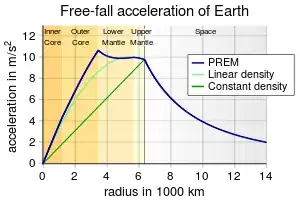
Linearity is only the case for constant density, though, which isn't entirely the case throughout our planet Earth. The real case is shown as the more bumpy curve.
And why is that?
The explanation is that as you descend into the depth of the Earth, you suddenly have some soil above your head. Naturally, the gravitational force from this amount of mass pulls upwards. Only the mass below you still pulls downwards.
Assuming constant density (and perfect sphere-shape) it turns out due to symmetry that the ring (or shell) of mass above your head cancels itself out when considered all around the planet. The only non-balanced force left is that from the sphere below you - as if you were standing on the surface of a smaller planet.
You can calculate how this mass changes with depth, by considering the volume formula of a sphere. Inserting that into Newton's law of gravitation gives us the linear version of the formula shown above.
When moving farther away from the surface of Earth, the amount of mass below us remains the same. Therefor all parameters in the law remains constant, except for distance, and the perfect quadratic decrease is seen in real life as well.

Steeven
- 53,191
1
The number $9.807 m/s^2$ is the acceleration on the surface of the earth. If you get closer to the middle of the earth, let's say at a distance $r$ from the center, this value decreases to $\frac{r}{R_E} \times 9.807 m/s^2$, where $R_E$ is the radious of the earth. The point is that the part of the earth oustide of you does not contribute to the acceleration. Therefore, right in the center of the earth, you effectively feel no gravitation. (Remark: Do not go there to check it out, you will not feel too well in the inner core, it's hot.)
A further remark: Look at this picture from Wikipedia. You see that the earth has the shape of a potato and not a perfect sphere. Therefore, even on the surface of the earth, there are some variations to the acceleration, although they are very slight.

Luke
- 1,569