The existence of Weyl fermions appears to be dependent on the repeating structure of the crystal lattice, specifically translation symmetry. Based on paragraph three of this paper, it looks like the Weyl points will even accommodate defects in Weyl semimetals.
Equal positive and negative chirality Weyl points are imposed on a Weyl semimetal as a way to ensure that it does not spontaneously accumulate chiral charge from Fermi arcs. Anything you do to slow the Fermi velocity of one chirality will prompt other translationally symmetrical 'cells' to interact with the disrupted pair in order to regain charge/momentum balance.
According to the talk (at 13:00) given here by Carlo Beenakker, individual Weyl cones can appear to have a unidirectional current. Charge is conserved by the interaction of left and right-handed cones across the bulk. In the situation you discuss, perhaps there are an even number of left handed and right-handed cones in the bulk, but they are not distributed evenly – this creates a ‘Chiral Chemical Potential Difference’.
The idea is that the uneven charge allows uneven current to appear over short distances. Changes in current produce a measurable magnetic field termed a ‘Chiral Magnetic Effect’, which is discussed (at 17:00). Experimental evidence for CME from CCPD does not appear to exist. However, computer simulations and indirect measurements suggest CCPD theory is valid.
Given that Weyl Fermions of both chirality are massless, will travel at the same speed through electric gradient or changing magnetic field. The speaker proposes a experiment which can produce evidence of CME (at 23:10) which needs a seed magnetic field to influence direction that left and right-handed fermi arcs bend.
It does not appear possible to preferentially accelerate a chiral current without using a CCPD, which is experimentally unconfirmed. The proposed magnetic field seeding will affect Weyl fermions equally because they have the same (zero) mass.
Contrast this with electrons and holes, where mobility is different for each ‘particles’.
Saved from discussion below:
Consider the following simplified example:
"We have 1 'coulomb' of right-chirality weyl fermions and 2 'coulombs' left-chirality weyl fermions available to a subgroup of atoms in a weyl semimetal, which is chirality balanced in bulk.
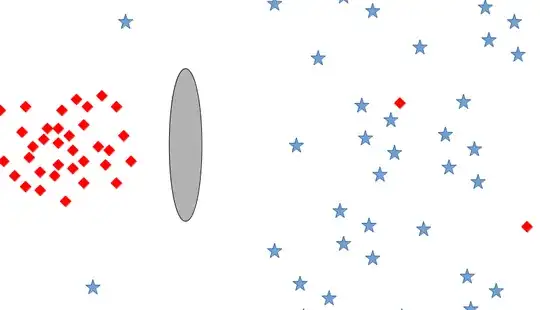
Chiral Chemical Potential Difference with cross-section.
A: The 'chiralstatic?' repulsion produced by their respective concentration gradients causes a current of 1 'ampere' of right-chiral fermions to travel (faster) across a $10mm^2$ cross section of the weyl semimetal as 1 'ampere' of left-chiral fermions travel (slower) in the opposite direction for a short period of time.
B: This happens until the chiralities are still imbalanced (.50 'coulombs right', .50 'coulombs left') but have non-equal concentration gradients such that all subsequent flow has $I_{NET}$=.25
'ampere' left-chiral fermions."
This example simplifies the current flow from what would obviously be a changing number to a constant number, but there are still two distinct periods. A has equal current, so by $Magfield=\frac{\mu_o∗I}{2∗pi∗d}$ the current carrying cross section has no magnetic field. B has a non-equal current, producing a temporary magnetic field. B would be an observable physical consequence, but it does originate from the faster speed of the right-chiral current. It originates from the net current of .25 left-chiral 'amperes' during stage B.
Stage A has a net magnetic field of zero because the dense left-chiral current appears magnetically opposite to the fewer contracted reference frame right-chiral fermions that are going faster.


