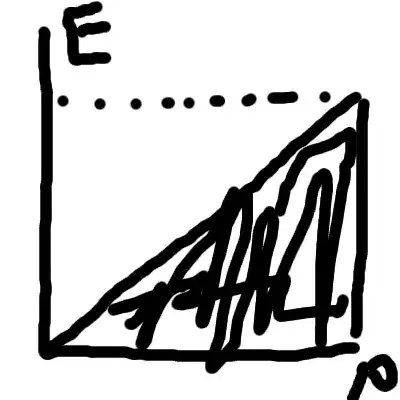
The force on a dipole placed in an electrical field is given by $\mathbf{F} = (\mathbf{p}\cdot \nabla)\mathbf{E}$ (see, e.g., Griffiths, 3rd edition, eq. 4.5). Recall that,
$$
\nabla(\mathbf{p}\cdot\mathbf{E}) = \mathbf{p}\times (\nabla\times \mathbf{E}) + \mathbf{E}\times(\nabla\times \mathbf{p})+(\mathbf{p}\cdot\nabla)\mathbf{E} + (\mathbf{E}\cdot\nabla)\mathbf{p}
$$
Assume $\nabla\times \mathbf{E} = 0$ (I'll justify this at the end, trust me for now). If the dipole moment is a permanent one, $\mathbf{p} = \mathrm{const}.$, the second and fourth terms above are zero, and the expression for the force can be rewritten,
$$
\mathbf{F}=\nabla(\mathbf{p}\cdot\mathbf{E})\quad\Rightarrow\quad U=-\int_{r_a}^{r_b} \mathbf{F}\cdot d\mathbf{r} = -\mathbf{p}\cdot \mathbf{E} |_{r_a}^{r_b}
$$
However, if $\mathbf{p}$ is not a constant, but rather $\mathbf{p} = \alpha\mathbf{E}$, where $\alpha$ is the polarizability, the fourth term is not zero, and
$$\begin{split}
\nabla(\mathbf{p}\cdot\mathbf{E}) &= 2\alpha\mathbf{E}\times (\nabla\times \mathbf{E}) + 2\alpha(\mathbf{E}\cdot\nabla)\mathbf{E}\\
&= 0+2(\mathbf{p}\cdot\nabla)\mathbf{E}
\end{split}
$$
Therefore,
$$
U=-\int_{r_a}^{r_b} \mathbf{F}\cdot d\mathbf{r} = -\int_{r_a}^{r_b}\frac{1}{2}\nabla(\mathbf{p}\cdot\mathbf{E})=-\frac{1}{2} \mathbf{p}\cdot\mathbf{E} |_{r_a}^{r_b}
$$
The only outstanding issue is justifying the assumption $\nabla\times\mathbf{E}=0$. From the relevant Maxwell equation, $\nabla\times\mathbf{E}= - \frac{\partial \mathbf{B}}{\partial t}$. If your fields are static, $\frac{\partial \mathbf{B}}{\partial t} = 0$, and we're done.
In an optical trap, the application discussed in the paper above, the field is not static and we have to be a bit more careful. An optical trap is arranged by counterpropagating two identical laser beams. Assuming beam fronts are approximately planar,
$$
\mathbf{E} = \mathbf{E_1} + \mathbf{E_2}\\
\mathbf{B} = \mathbf{B_1} + \mathbf{B_2} = (\frac{1}{c}\mathbf{\hat{k}}\times\mathbf{E_1}) + (\frac{1}{c}(\mathbf{-\hat{k}})\times\mathbf{E_2})
$$
If the beams are arranged so that they're in phase ($\mathbf{E_1} = \mathbf{E_2}$), we have $\mathbf{B} = 0$ at all times and so $\nabla\times\mathbf{E}=0$.
That's the math, then, but what's the intuition? To first order, there are two contributions to any change in the quantity $-\mathbf{p}\cdot \mathbf{E}$: the change in $\mathbf{p}$ at constant $\mathbf{E}$ and the change in $\mathbf{E}$ at constant $\mathbf{p}$. But there is actually no force opposing the first of these changes: strictly speaking, the energy of the dipole should just be the integral of the second of them. For a permanent dipole, the first change is zero, so we get away with writing the energy as $-\mathbf{p}\cdot \mathbf{E}$. But for an induced dipole, this is no longer the case. Linear polarizability gave us a factor of $1/2$, but more general relations between $\mathbf{p}$ and $\mathbf{E}$ may give you more complicated answers.