Today's Phys. Rev Letter GW170104: Observation of a 50-Solar-Mass Binary Black Hole Coalescence at Redshift 0.2 shows the analysis of the third confirmed detection of a black hole merger by the LIGO collaboration. According to the paper this even may differ from the previous two:
The black hole spins are best constrained through measurement of the effective inspiral spin parameter, a mass-weighted combination of the spin components perpendicular to the orbital plane, $\chi_{eff} = -0.12^{+0.21}_{-0.30}$. This result implies that spin configurations with both component spins positively aligned with the orbital angular momentum are disfavored.
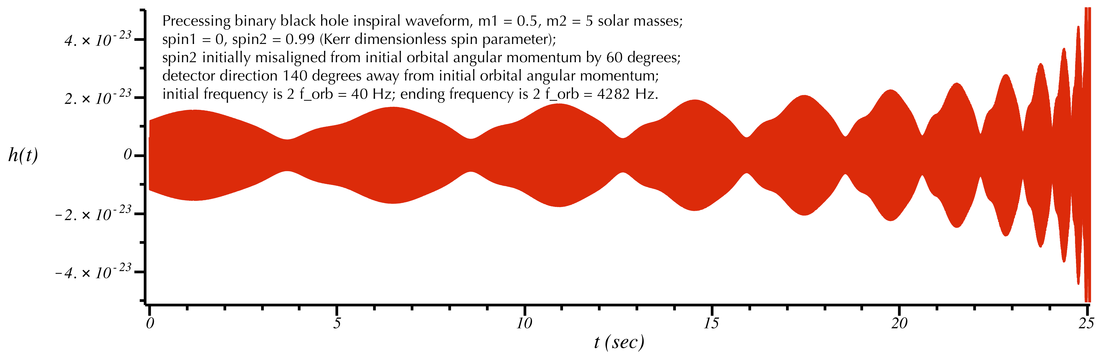
You can see a simulation in this LIGO/Caltech video (which I found here), showing what I believe is precession of the tilted spin axis of one of the objects. https://youtu.be/S2vp7iVWrkE
If I understand correctly, while there is significant pre-processing in frequency space, the final data for each site is really only the one-dimensional strain versus time plot, and all extracted parameters from the event come from the maximum-likelihood fitting of theoretically generated strain waveforms to these two plots for the two LIGO sites. See the several good answers to How were the solar masses and distance of the GW150914 merger event calculated from the signal? for further information.
A great deal of work has gone in to the statistical analysis of these events, both for low latency detection (alerts to the community for possible coincident optical detection) and more careful analysis later. The fact that $\chi_{eff}$ is so many error bars away from unity suggest there is a good chance the spins were not aligned to the orbit. In Section IV. at the bottom of the first column on page 221101-4 it says for example:
Considering the two spins together, the probability that both tilt angles are less than 90° is 0.05
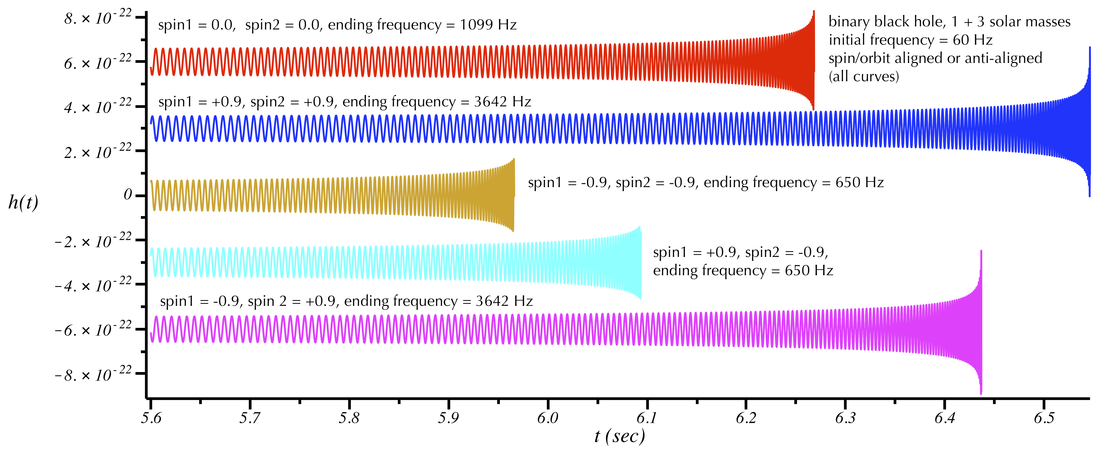
Question (Edited): How does the alignment of the spins manifest itself in the waveform shown in the LIGO data? Is it a subtle shift in phase near the end, or a modulation of amplitude?
Are there any examples of a simulated waveform for very different values of $\chi_{eff}$ that show the difference?
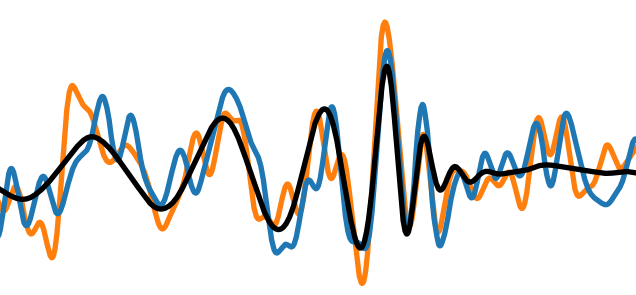
above: Enlarged, cropped section of Figure 1, shown below.
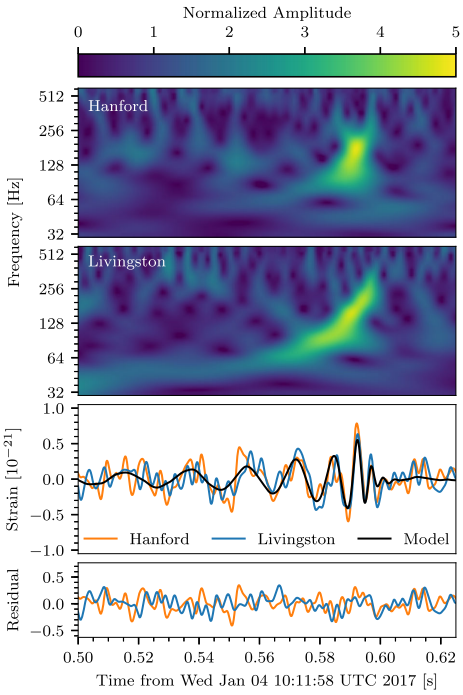
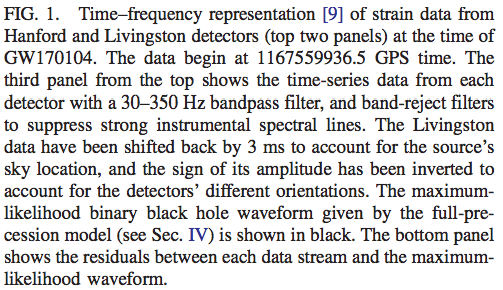
above: Figure 1.