30

Geiger and Marsden's experiment led Rutherford to believe that the positive charge and most of the mass of the atom was concentrated in a small region. I understand what led him to conclude the way the positive charge is positioned in the atom. But how did he conclude that most of the mass was in a small region (the nucleus)?

How did the distribution of the mass matter after all? Given that the electric force is greater than the gravitational force by many magnitudes, the force between the positice charge and the electrons was predominantly electric.

So how did Rutherford conclude that most of the mass is in the nucleus?

Diracology
  • 18,168
Kunal Pawar
  • 1,942

3 Answers3

41

This is a good example of how Science works.

Geiger and Marsden observed that some of the alpha particles were being backscattered. This is inconceivable if the alpha particle is scattered by a lighter particle.

If one considers a particle of mass $m$ and initial velocity $v_1$ striking a target of mass $m'$ at rest, without changing its direction, then its final velocity $v_2$ can assume two possible values, $$v_2=v_1,\quad\mathrm{or}\quad v_2=-v_1\left(\frac{m'-m}{m'+m}\right).$$ The second solution gives that backscattering is only possible if the target has greater mass than the incident particle. By the time, the mass of the electron was known to be much smaller than the mass of the alpha particle so a backscattering event would imply that the scattering centers were in fact heavy positive nuclei. And indeed those scatterings were observed.

To formally check this, Rutherford obtained a formula for the number of scattered particles as a function of the scattering angle using the hypothesis of heavy nuclei (which is justified by the above paragraph). Geiger and Marsden did the experiment and the data agreed with Rutherford formula.

Diracology
  • 18,168
38

Wikipedia explains this rather well but I'll pick out the relevant stuff for you.

Before the Geiger–Marsden experiment, the general idea was that atoms were built of some permeable positive substrate in which some negative particles were floating around; the so called plum-pudding model.

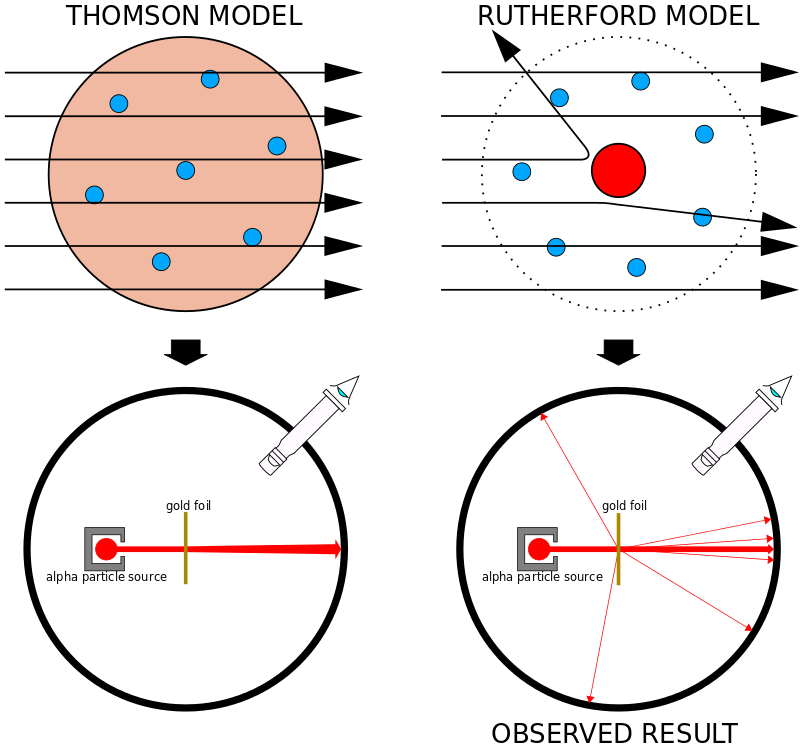
If we shoot $\alpha$ particles on this setup they should all pass through the atoms since the positive substrate is thought to be permeable! (left side of the figure)

But when people did the experiment they saw that most particles went through while some scattered $180^\circ$ backwards, some even bent a small angle! (right side of the figure)

Experiment

The plum-pudding model had no problem with the particles that went through undisturbed but what about the ones that were backscattered? People theorized that there must be some solid core in the atom against which the $\alpha$ particles could scatter. The core couldn't be too big since only a small fraction of the $\alpha$ particles backscattered.

This leads to a model in which most of the mass (to which $\alpha$ particles can scatter) are in the center of the atom with the negative charges around it!

adelphus
  • 135
gertian
  • 1,333
8

Rutherford performed a series of experiments where he measured back scattering of $\alpha$ particles a function of thickness of metal foil. In the third part of the experiment he observed that around 1 in 8000 $\alpha$ particles were able to back scatter. This was possible only if it encountered large Electric field. Such large electric field can't be created by distributed charge, but has to be created by some concentrated charge. So this explains the concept of nucleus.

And since nucleus has most of the charge (protons are heavier than electron) it has most of the mass of the atom.