19

At xmas, I had a cup of tea with some debris at the bottom from the leaves. With less than an inch of tea left, I'd shake the cup to get a little vortex going, then stop shaking and watch it spin. At first, the particles were dispersed fairly evenly throughout the liquid, but as time went on (and the vortex slowed, although I don't know if it's relevant) the particles would collect in the middle, until, by the time the liquid appeared to almost no longer be turning, all the little bits were collected in this nice neat pile in the center.

What's the physical explanation of the accumulation of particles in the middle?

My guess is that it's something to do with a larger radius costing the particles more work through friction...

Qmechanic
  • 220,844
Kricket
  • 291

9 Answers9

3

The word viscosity hasn't been used above, and yet it's crucial to understand the problem. Since tea is viscous, it obeys a type of 'non-slip condition': it's completely at rest against the sides and bottom of the cup. The tea forms a small 'boundary layer' (of ~ 0.04 cm)on the bottom, where there is a large velocity gradient, since outside of this layer the tea behaves as if it were inviscid. This boundary layer is called an Ekman layer - this should allow you to look up good references on the subject. Georg's model explained above is quite correct. I just wanted to add that this is a classical but very subtle exercise (you need to use Navier-Stokes in cylindrical coordinates in a rotating frame in two different regimes...), but in the end you can actually show that inside the boundary layer $$v_r = -\frac{\Delta \Omega}{2} r e^{-\hat{z}}\sin{\hat{z}},$$ where $\Delta \Omega$ is the difference in rotational velocity between the bottom and the top of the cup, $\hat{z} = z \sqrt{\frac{\Omega}{\nu}}$ (thus giving a typical size for the boundary layer...), $\Omega$ is the typical rotational velocity and $\nu$ the tea's viscosity.

Gerben
  • 840
2

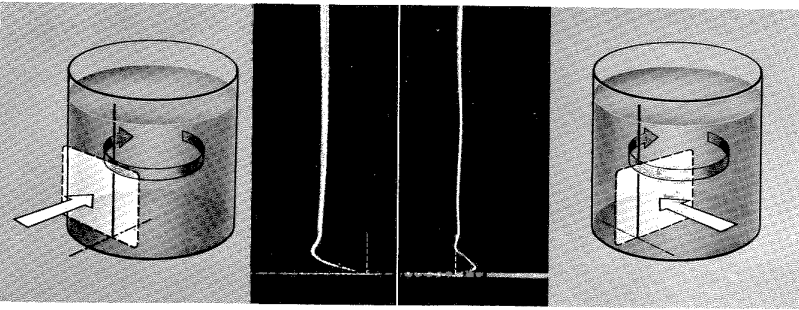
Had to do this for a university assignment, Gerben's answer and this answer explain it pretty well but I found a fantastic video that goes through an experiment and takes you to step by step through the process, thought I should share. (If you want a proper explanation and don't want to watch the video, MIT has some film notes here).

The non-intuitive result is basically due to secondary flows, as the primary rotational flow with Velocity=R(radius)*C(some constant) suggests that the tea leaves should be forced outward by centrifugal force. However, as can be seen from the experiment, this is not the case and a secondary flow needs to be introduced to explain the effect.

Seen below is the velocity profile of such a system, uniform until the flow nears the bottom of the vessel, where the velocity is bounded by the no-slip condition. Secondary Flow

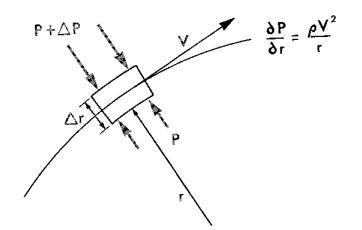
In order to satisfy the conservation of momentum equation given by Euler, the decrease in velocity forces the radius of the flowpath to shrink, accommodating a constant pressure gradient throughout the system. enter image description here

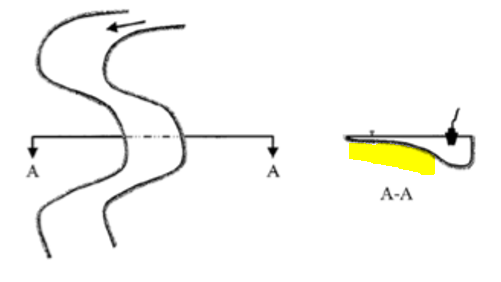
FYI This effect is also why boats always sail closer to the outer bank rather than the inner bank, would've thought it would be the other way round enter image description here

J Doe
  • 73
1

A simple explanation:

Firstly, the vortex becomes stable after you stop shaking the cup because as you shake the cup in the conventional way, the forces acting on the whole fluid are uneven, when you stop shaking the cup the vortex is able to evenly apply force to the fluid. (Friction between the sides of the cup and the turning liquid helps to stabilise the vortex.)

The solids in the suspension are denser than the liquid solution and so more momentum is needed to increase the centripetal force and throw the solid out further. The solution however, tea, is much less dense than the solid so it is thrown out further.

Your guess is pretty much right, because the radius would be greater if the same force was applied to a less dense.

Baker
  • 19
  • 1
1

I think the leaves congregate in the center as the tea decelerates due to the flow pattern established by the initial rotation. In effect the flow pattern in the tea will be a toroid flowing up the centre and down the outside effectively driving the denser particles (tea) at the bottom on the fluid into a pile in the middle.

See http://en.wikipedia.org/wiki/Tea_leaf_paradox

1

If you check Bernoulli's equation across streamlines (not along), you will see that particles with larger radius have higher static pressure than those with small radius, which actually drives the motion towards the center:

$${P\over\rho} + \int {V^2\over R}dn + gz = {\rm const}$$

When: $R \to {\rm small} \implies \int {V^2\over R}dn \to {\rm big} \implies P \to {\rm small}$

When: $R\to {\rm big} \implies \int {V^2\over R} dn \to {\rm small} \implies P \to {\rm big}$

Chris
  • 17,377
Milan
  • 11
0

My simple non-mathematical theory to explain this counter-intuitive behaviour is based on hydrostatic pressure.

The rotating liquid develops a vortex shaped surface that makes the centre of rotation the shallowest and the periphery the deepest region. The hydrostatic pressure at the periphery is therefore higher than at the centre, so there is a pressure gradient. A particle suspended in the rotating liquid, or resting on the bottom, has a greater force on the side facing the periphery than the force on the side facing the centre. This causes the particle to move towards the centre of rotation. The force on a particle at the centre is uniform in all directions, so it remains stationary.

If this theory is true we should expect that particles floating at the surface would not display this behaviour, because there would be no such hydrostatic pressure gradient as the liquid surface is uniformly at atmospheric pressure.

Also, preventing the rotating liquid surface to adopt a vortex shape (e.g. by enclosing the liquid surface by a transparent sheet?) should suppress this behaviour.

As yet I have not tested my theory in these ways!

0

I jokingly call it Vortex Physics, as it doesn't appear to obey the normal rules. At high speed, where centrifugal force prevails, the heavier particles are forced to the outside, like in a Dyson vacuum cleaner, or industrial cyclone dust separator, from which he got the idea. But at very low speed when the leaves start to drag the bottom, it behaves like a hammer, when you throw it. The heavy part (the head) stays near the middle, and the handle around the outside. They orbit around their common center of gravity like the earth and the moon. The earth wobbles a bit, but the moon does most of the orbiting. If you floated a hammer in a bowl and spun it, it would behave the same.

-1

Its the Centripetal force that causes the particles to come at the centre due to circular motion.

XYZ
  • 1
-2

The water molecules move more quickly along the periphery than in the center of the cup. The resulting force on a macroscopic object is directed inward, as I try to show in diagram. Oops, as I have no points to render images I will substitute for text art:

The vertical lines are a representation of the velocity field

                                          |
                                    |     |
                             |      |     |
         Center  _____|______|______|_____| Periphery
                 0    1      2      3     4

Any macroscopic object that extends, for instance, between radius 2 and 3 will suffer a force directed to the center. Tea leaves will move to the center.

UPDATE: This answer is still incomplete/incorrect even after the clarifications. (Velez)

Helder Velez
  • 2,685