A craft designed to work both in the atmosphere and in space might look something like this:
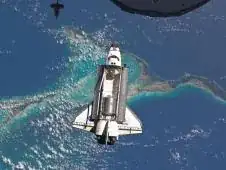
(Source: http://www.nasa.gov/mission_pages/shuttle/shuttlemissions/sts135/launch/sts-135_mission-overview.html)
To expand on this a bit:
We've been building atmospheric craft for over a century, and their general form hasn't changed much. The vast majority have a roughly cylindrical fuselage, horizontal wings to provide lift, landing gear, and a propulsion system that works by pushing air or exhaust gas backwards. (Helicopters are an obvious exception; flying wings are another, but they're rare.) It's likely that that's not going to change any time soon.
We haven't had many spacecraft that are also designed to work in the atmosphere. The most prominent example, of course, is NASA's space shuttle orbiter. Its overall shape is very much like an airplane. It has some features that are specific to working in space, or to getting to and from space (rocket engines, thermal tiles, cargo bay doors) -- but those features are integrated in such a way that they don't seriously interfere with its operation as an airplane (or, more accurately, as a glider).
And the requirements for operating in deep space (interplanetary, or even interstellar) aren't all that different from those for low Earth orbit. The craft needs to operate while floating in zero gee in near vacuum. If you could somehow put a working Space Shuttle orbiter a few light-years away, it would probably be able to operate. (Maintaining the internal temperature would probably be the biggest problem.)
A future craft that operates both in deep space and in an atmosphere would, I think, have to follow very similar design principles.
Deep space operation imposes very few requirements on the overall shape of a craft. The International Space Station is an example; it consists largely of long spindly structures that would be completely impractical anywhere other than a microgravity environment. On the other hand, atmospheric operation imposes some very strict requirements -- and meeting those requirements doesn't hurt the ability to operate in deep space.
Balloons are another kind of aircraft that don't resemble airplanes. But due to their low mass and large size, balloons can't move very quickly through the atmosphere, which would make launch and re-entry impractical. I suppose you could deflate the balloon for launch and inflate it for re-entry, but it would be very tricky.
In the very long term, improving technology could change all this, but that's nearly impossible to predict.


