42

Assume you have a near perfect monochromatic red laser light. The Fourier transform of the laser light is a delta function peaked at the frequency of the light.

Now assume someone places a shutter on the path of the moving light, cutting off a wave packet. The Fourier transform of the wave packet would now contain contributions from all possible frequencies.

Here is the paradox(?)

Initially wavelength measurement of all photons would reveal that they are all red photons. But the introduction of shutter somehow creates a wave packet, which has blue photons too.
The question is how do the red photons get converted into blue photons?

Normie
  • 1,466
  • 1
  • 12
  • 19

4 Answers4

15

1. How can we "interact" with a photon with a purely mechanical device such as a shutter?

Here is the culprit - the QED vertex:
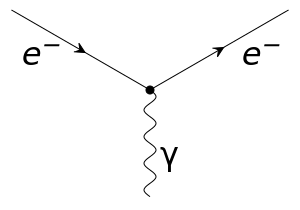
QED vertex

The mechanical shutter, whether made from metal or plastic, contains charged particles (electrons and atomic nuclei). Charged particles interact with photons via the QED vertex. On the most fundamental (and most pedantic) level, this is the mechanism at work.

Thought experiment: try shifting the photon frequency with a shutter made of neutrinos (which do not interact via the QED vertex). It won't work.

2. Draw me a QED diagram responsible for the interaction

The answer may depend on the nature of the shutter. So let's choose the simplest possible "shutter" - a dilute gas of free electrons, whose density is somehow being varied with frequency $\omega_2$. Note that there's no need to block the light completely - any change to the total scattering amplitude will still cause the frequency-shifting effect. Here is the relevant QED diagram:
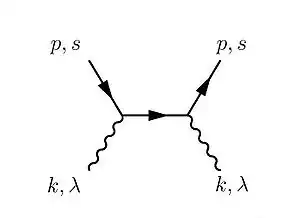
QED elastic scattering

A photon enters with wavevector $(\vec{k_1}, \omega_1)$ and exits with the same wavevector $(\vec{k_1}, \omega_1)$. You can think of this as elastic scattering by angle zero.

3. How can scattering with $\theta = 0$ possibly have any effect?

The zero-angle scattering amplitude interferes quantum-mechanically with the no-scattering amplitude to form the outgoing amplitude at angle zero - see the optical theorem.

4. How can scattering with $\Delta \omega = 0$ possibly have any effect?

Because the scattering amplitude of the photon at frequency $\omega_1$ is being modulated in time with frequency $\omega_2$, which leads to an EM field excitation at $\omega_1 + \omega_2$ - see the convolution theorem.

6

An experimentalist's answer:

Photons do not change frequency/energy without interaction, and photon photon interactions are very rare.

The lasing effect is quantum mechanical by construction and the frequency has the width of the quantum mechanical transition from the excited to the ground level, and it is not a delta functio, so whether cut up into packets or not, the energy width will be there.

IMO the classical model breaks down when coming down to the individual quanta it is composed of, and maybe this might be an experiment that displays that quantum mechanics is necessary and not the mathematics of wavepackets of classical electromagnetic waves.

Let us be clear: what are Fourier transforms? they are a mathematical tool which for classical electromagnetic waves are consistent with giving the frequency of light.

One can fit with Fourier transforms any shape, an apple for example. Does that mean that the frequencies are part of the apple?

My argument is that the packet created by cutting off parts of a laser beam, creating packets, may be fitted with a fourier transform that has a frequency as a variable, but that frequency will have little to do with the photon frequency that is building up the classical em wave of the laser. By conservation of energy the photons cannot change their frequency signature unless they interact. So the contradiction is the usual one found when one is crossing the boundary between classical and quantum mechanics.

anna v
  • 236,935
5

Indeed interesting question, we had discussions about this a few years back during my PhD. The answer can easily thought of when using fast eo style shutters, but it is more difficult when using slow (or fast) mechanical shutters.

Best way I can describe it without pictures is imagine the shutter as it moves down at various time steps, now imagine the diffraction caused by the shutter at each of these time steps, perform a Huygens-Fresnel propagation integral from each of these time steps and you find that the effective frequency in the propagation direction shifts. The effect however is very small, and you would need a mechanical shutter with an unheard of rise / fall time to cause a shift that is noticeable. Its a fun calculation to do and a nice thought experiment, puzzled us for a while as well!

MJC
  • 390
3

There is no paradox here. Consider a single photon. In the initial state, it is an eigenstate of a free Hamiltonian. It has a definite energy corresponding to the red wavelengh. It is a stationary state so it does not change in time. In other words, there is not "propagation"; it does not move anywhere. Now when you cut some part of the wave-function you need to introduce some potential, which pushes the wave-function out of some region of the space. This is your classical shutter. Clearly, this interaction does not commute with a free photon Hamiltonian. Now you measure the photon energy and you find a blue photon. Where does it come from? Obviously from the interaction with the potential. On the microscopic level, this interaction can be described by Feynman diagrams. But in Quantum Mechanics it is just enough to assume that this is some potential barrier. In other words, you can think of this a situation with time-dependent Hamiltonian; where you switch on and off some potential. The energy is not conserved in this picture. It does not matter if the initial photon is exact energy eigenstate or some wave-packet because a wave-packet is just a superposition of energy eigenstates and you can apply the same reasoning to each frequency.

Veritas
  • 1,273
  • 9
  • 16