I imagined a theoretical experiment about gravity. First of all, I know that it is very hard to build such sensitive test apparatus with our current technology but it is just theoretical experiment to enlighten the general relativity.
Let's imagine, We have a big perfect sphere balloon whose inner side of the surface is covered with light detecting sensors. There is one laser on center that can send laser beam to any direct from the center of the sphere. Laser beam hits the sensors that are placed the inner side of the balloon surface. Thus, the test apparatus can measure 2 angles in sphere coordinates both laser direction in center and the hit point on surface. We can calculate a curve equation from hit points of the laser lights via changing diameter of the balloon for any direction.
Could you please help me what we would observe if we build such test apparatus?
My Questions:
What should be the curve equations while the balloon is fixed on earth ?
Arrival time of the laser light to the surface from the center will be same or different, If we test all directions?
If we release the balloon in free fall , what would happen about the arrival time to surface and curve equations? (My estimation All direction of laser lights will behave as if there was no any mass in universe because of the general relativity equivalence principle for free fall.(Is it true?). Will the curve equations turn into line equation for each direction? )
Imagine that we know the whole curve equations to any direction and arrival time to surface for the direction when it is fixed on earth? Can we calculate the major mass via these curve equations? How?
EDIT:
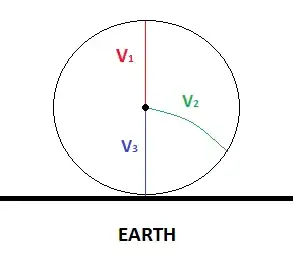

After @John Rennie's answer, I had got more questions. The subject became more interesting for me. I would like to add some more questions. If we test laser in 3 directions as shown in picture. (Please consider only Earth's gravity effect )
I wonder what the trajectory speeds of light for 3 directions would be? (I mention$|\vec{ V_1(t)}|$,$|\vec{ V_2(t)}|$,$|\vec{ V_3(t)}|$)
- $|\vec{ V_1(0)}|=|\vec{ V_2(0)}|=|\vec{ V_3(0)}|=c_0$ ? where $c_0$ is the speed of the light in air.
- If we compare the trejectory speeds after t , what we would say about $|\vec{ V_1(t)}|,|\vec{ V_2(t)}|,|\vec{ V_3(t)}|?$
And what can say about arrival times to surface? ($t_1,t_2,t_3$)


