Start with an unconstrained (circular) rod of an isotropic material. Apply a longitudinal tension stress. The relative change is volume $dV/V_o$ of the rod can be derived as below with Poisson's ratio $\nu$ and transverse strain $\epsilon_a$.
$$ \frac{dV}{V_o} = \nu^2\epsilon_a^3 + \left(\nu^2 - 2\nu\right)\epsilon_a^2 + \left(1 - 2\nu\right)\epsilon_a $$
An incompressible material is one that does not change volume as it is deforms when subjected to stress. Volume conservation in an isotropic material is $dV/V_o = 0$. Formulations using the bulk modulus show that the requirement can be fulfilled when $\nu = 1/2$.
Plot the relative volume versus strain as below.
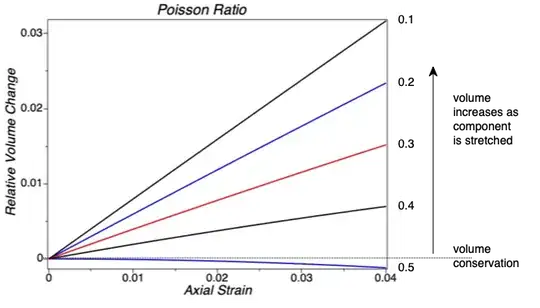
We see that isotropic materials that have $\nu \neq 0.5$ do not conserve volume as they are stretched. We see that even isotropic materials with $\nu = 1/2$ only conserve volume in the limit $\epsilon_a \rightarrow 0$. Interestingly, isotropic materials with $\nu = 1/2$ will shrink in volume when subject to longitudinal tension stress.
We can appreciate from this graph why cork $\nu \approx 0$ is a better material in a bottle of wine than using natural rubber $\nu \approx 0.5$. Pulling or pushing on cork longitudinally will cause almost no change in radius
$$ \frac{dV}{V_o} = \frac{dl}{l_o} + 2\frac{dr}{r_o} \approx \epsilon_a = \frac{dl}{l_o} \Rightarrow \frac{dr}{r_o} \approx 0$$
The natural rubber will by comparison have
$$ \frac{dr}{r_o} \approx \frac{1}{2}\frac{dl}{l_o}$$
meaning that it will be easier to remove from the wine bottle (it shrinks in radius as it is pulled out) but more difficult to re-insert back (it expands in radius as it is compressed back into the bottle).
In summary:
The assumption of incompressibility is equivalent to stating that $\nu = 1/2$ for an isotropic material under isotropic pressure.
Even if an isotropic material has $\nu = 1/2$, its volume is not conserved when it is subject to any level of anisotropic strain deformation.
The derivation of an expression for $dV/V_o$ for an anisotropic material likely demands the use of tensor notation. I leave this reference as a starting point for further enjoyment as desired.


