1

I know that to a hypothetical observer infinitely far away from the black hole (sometimes known as the Schwarzchild observer), all in falling objects appear to "slow down and asymptotically freeze" at the event horizon.We can straight away guess this from the blowing up of the coefficient of the $dt^2$ term in the Schwarzchild metric and can show it in the case of a free in-falling object using this relation: $$dt=\int \frac{dr}{-c\left( 1 - \frac{r_{s}}{r} \right)\sqrt{1-\left( 1 - \frac{r_{s}}{r} \right) m^2c^2/E^2}}. $$

Where the symbols have their usual meanings. This basically says that the time required to cross the horizon is infinite because the denominator blows up at $r_s$.(we may show it for any other type of in-falling object too but this is a simple example).

What is the appropriate coordinate system that describes the situation from a free falling observer's point of view, what is the geodesic for a free in-falling object? At the horizon will it be visible one instant and invisible the next?

alex
  • 1,195

2 Answers2

1

What is the appropriate coordinate system that describes the situation from a free falling observer's point of view[...]?

Coordinate systems don't relate to observers. GR doesn't have global frames of reference, only local ones.

At the horizon will it be visible one instant and invisible the next?

The ability to observe a certain event depends on the location of the observer in spacetime. It doesn't have anything to do with a coordinate system or with the observer's state of motion.

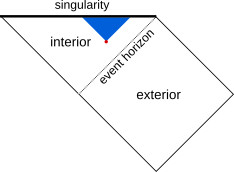
Here's a Penrose diagram:

Penrose diagram

I have a nonmathematical explanation of Penrose diagrams in ch. 11 of my book Relativity for Poets.

The red dot is an event. The blue triangle is that event's future light-cone. An observer who wants to observe the red dot needs to enter the blue area at some point.

0

No. "Falling past" means it would see the falling object below the horizon, which is impossible.

Edit after comment: this is what actually happens. The object falling into the EH and disappears. Although this disappearance means

  • the lengthening of its spectrum (by GR redshift)
  • and also its darkening, because as its time slows (compared to the far observer), it radiates away fewer and fewer photons.

Thus, not this happens what in the "common knowledge" would think (as if it would disappear behind a black curtain), but it doesn't look very differently.

One of the first experimental proofs behind the existence of the Black Holes is that the very characteristic spectrum of the gas falling in them (which can be explained only by the GR).

peterh
  • 8,872