The biggest contributor to a "red sunset" is scattering from small particles; I wrote an earlier answer about that. But I am assuming that you want the answer for "clean, dry air" (although you only specified "dry", I think the two go together). I am going to have to make a lot of assumptions, so the answer will be quite approximate.
Starting with the data given in "UV, Visible and IR attenuation for Altitudes to 50 km", we see that they posit that in the absence of particles the predominant loss mechanism is Rayleigh scattering off the molecules. They then explain that the refractive index is a good proxy for Rayleigh scattering cross section, and proceed to derive an expression for the attenuation that this generates. After about 20 pages of measurements of aerosol concentrations (which, as I said before, tend to dominate the mean free path of light in the atmosphere), we get to a large set of tables. The answer to your question is in table 4.13, part of which I reproduce here:
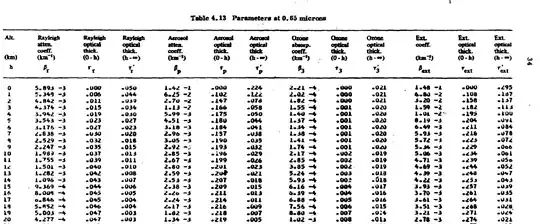
The number of interest is $5.893\times 10^{-3} ~\rm{/km}$ - the "Rayleigh attenuation coefficient at sea level for 0.65 micron light."
Now the eye is pretty good at making out the shape of a circle in the presence of background haze - let's assume that your criterion is met when you have reach 99% attenuation (1% of sunlight still going, 99% scattered into $4\pi$. Then the thickness of the layer of clean dry air at atmospheric pressure that you would need is computed from
$$0.01 = e^{-\mu t}\\
-\mu t = \log{0.01}\\
t = \frac{\log{100}}{\mu}$$
When $\mu = 5.893\times 10^{-3}$ km, the thickness of air needed is about 800 km


