I was also rather intrigued by that scene in INTERSTELLAR, and honestly, i am not knowledgeable enough to comment on such a theoretical situation, but let me share some on the information i gathered.
Tidal forces due to a massive body, can break apart a rigid body, due to the varied forces acting on various parts of the body, causing it to ultimately disintegrate. Suppose $M$ is the mass of the black hole, and $R$ is the radial length of the line joining its center to the center of a body of mass $m$ near it. Then , The tidal acceleration $a_t$ = 2$\Delta r$$.\frac{GM}{R^3}\hat r$ ( in the radial direction). Here $\Delta r$ denotes a the distance of a particle of the mass m measured from its center. The flesh of humans is unusually elastic, and in generally incompressible, but compared to a gravitational field that large, it can get stretched for some length before getting torn apart. The real fun starts, when $R$ gets really small(about a 1000m or so from the center of the black hole suppose). Thats when everything begins to get ripped to shreds. Reading upto this part you may think that your question has a negative answer, but thats not entirely true. Analysing further, i happened to recall a crucial statement in the movie 'If you are travelling fast enough, you may avoid the singularity and survive'. Someone in his team said this to Matthew McConaughey in the movie. See where that comes in ? Remember that the real elongation and ripping to shreds all starts, when $R^3$ is small enough to make even something as small as $\Delta r$ significant. So, if the object $m$ is aimed with an impact parameter(w.r.t the center of M) $b$ which is much larger, then $R^3$ will never have to be small enough. But for that,$m$ would need to move insanely fast, or it will never be able to miss the center(due to the huge gravitational pull). The picture looks something like this:
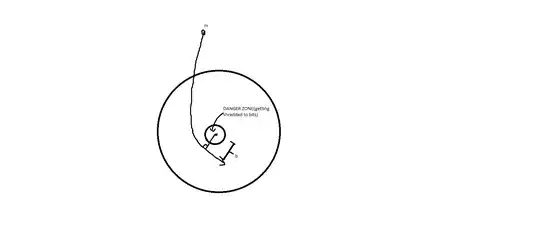
Hope this helped somehow, although even i am not very satisfied with it.
PS: What i could not find out at all , is what would happen if m missed the center once. Once inside the event horizon, it cannot really escape the black hole technically(or can it?). What will happen then? Again insane speeds might save it, but that can only happen a few times, and eventually it will end up at the singularity, will it not ? Any clarifications are welcome.


