I need to clarify a detail about the particles horizon (also called the causality horizon, not to be confused with the event horizon). For simplicity, consider an euclidian static universe, with a sudden beginning at $t_{\circ} = 0$ (the "Big Bang" of that model), and a brutal ending at $t = t_{\bullet}$ (the "Big Crunch" of the model). The cosmological scale factor is constant : $a(t) = 1$ for $t_{\circ} < t < t_{\bullet}$. (think of that model as a 3D "game-universe" that you launch at some time on your computer, then quit after a while. Poor virtual creatures living in the game !)
Here's a picture I made to represent that simple universe. Distance $\mathcal{D}$ is the proper distance from the stationary observer, shown as a blue vertical word-line on the picture. The red vertical line is the world-line of a stationary particle. $\mathcal{H}_{\mathcal{E}}$ is the event horizon of the observer, while the past light-cone $\mathcal{H}_{\mathcal{C}}$ is the causality (or particles) horizon at time $t_0$ (the present of the observer). $\mathcal{A}$ and $\mathcal{B}$ are two arbitrary events.

Now, what confuses me are the (very nice) pictures shown in the answer there : Is the cosmic horizon related to the Big Bang event?. I'm showing the pictures from that answer here for reference :
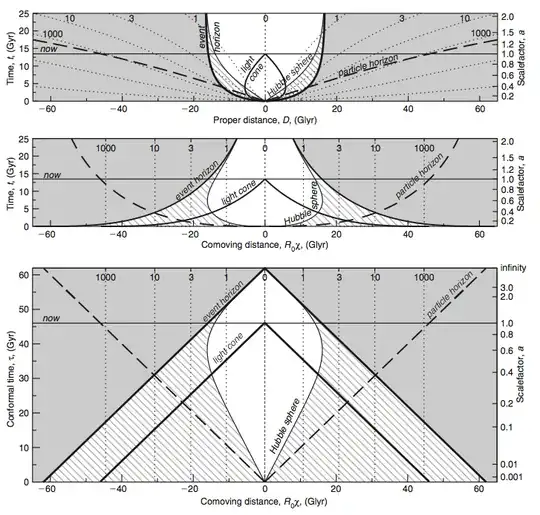
On these pictures, the particles horizon is depicted as an inverted (future-oriented) large cone, not as an evolving smaller (past-oriented) light-cone. Why ?
If I add this inverted light-cone on my picture above, event $\mathcal{A}$ would be outside that particles horizon. Yet it is an observable event for a time $t > t_0$ (as shown with the green dashed line).
I believe that the particles horizon shown on these pictures isn't right and should be labeled as something like "particles horizon distance" instead (not "particle horizon"). Am I wrong ?
EDIT : A variation of the first picture, with a better representation of the particle horizon (? I'm not convinced yet !) :


