If you are prepared to accept a simplistic answer, because it's the only one I can offer you at my current knowledge level, then here goes:
Symmetry is broken, outside the superconductor, photons have no mass, inside they have an effective mass.
Cooper pairs form inside the superconducting material and two electrons combine to form a boson. Their combined spins are either 1 or 0, so they can be treated as bosons.
Cooper pairs can pass through the superconductor, unlike single electrons that would hit off the atoms in the superconductor on a regular basis. With Cooper pairs, every push on one electron produces an equal and opposite pull in the other electron, so effective movement of the Cooper pair through the superconductor is possible without the resistance encountered by a single electron.
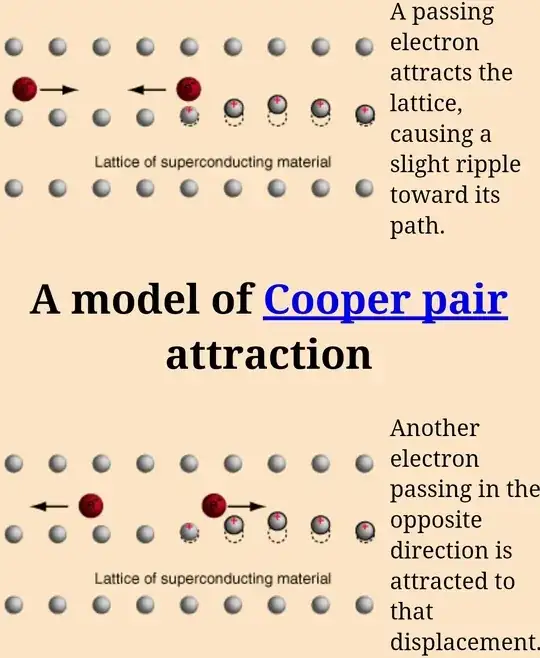
When moving electrons are subject to forces which accelerate them, this results in very low energy photons. Because of the fact that photons have an effective mass in superconductors, electrons that lack sufficient energy, such as the Cooper pairs, can't make photons, and therefore can't lose energy.
So what is the field that breaks the symmetry between photons outside the superconductor and those inside. Its the field created by Cooper pairs.
I fully admit that the above description is far too simple to answer any detailed questions. All of the above is based on the Sean Carroll book, "The particle at the end of the universe". It's popsci, sorry, but it's got no maths and it's a very basic summary.
I post this answer in the hope that someone may may correct the mistakes within it, as I have asked an almost similiar question to yours, Massless Particles and although you should read the helpful comments I received, to date I have not received an answer, possibly because I put the question too broadly.
Now a more sophisticated answer from Cooper Pairs and Phonons.
The behavior of superconductors suggests that electron pairs are coupling over a range of hundreds of nanometers, three orders of magnitude larger than the lattice spacing. Called Cooper pairs, these coupled electrons can take the character of a boson and condense into the ground state.
This pair condensation is the basis for the BCS theory of superconductivity. The effective net attraction between the normally repulsive electrons produces a pair binding energy on the order of milli-electron volts, enough to keep them paired at extremely low temperatures.
The transition of a metal from the normal to the superconducting state has the nature of a condensation of the electrons into a state which leaves a band gap above them. This kind of condensation is seen with superfluid helium, but helium is made up of bosons -- multiple electrons can't collect into a single state because of the Pauli exclusion principle. Froehlich was first to suggest that the electrons act as pairs coupled by lattice vibrations in the material. This coupling is viewed as an exchange of phonons, phonons being the quanta of lattice vibration energy. Experimental corroboration of an interaction with the lattice was provided by the isotope effect on the superconducting transition temperature. The boson-like behavior of such electron pairs was further investigated by Cooper and they are called "Cooper pairs". The condensation of Cooper pairs is the foundation of the BCS theory of superconductivity.


