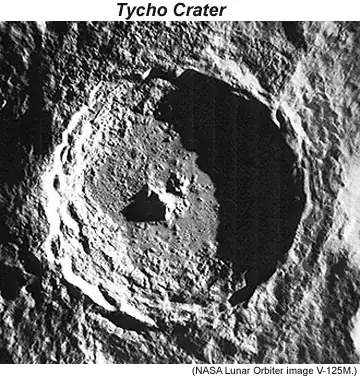
The central peak in many of the moon's large craters are visible with a telescope and they seem a little odd to me. Can someone explain how they form.
The central peak in many of the moon's large craters are visible with a telescope and they seem a little odd to me. Can someone explain how they form.


If you drop something into a pool of water, you will get a rebound effect in the middle where the object was dropped, and then waves will spread out around it. This rebound effect in the middle is the same phenomenon that causes central peaks in craters. The difference is just the scale: An impact that forms a >~15-km-diameter crater on the moon will cause the rock to act like the liquid to the point that you get the rebound effect and form a central peak.
Smaller craters on the moon will not have central peaks, and larger craters above ~120 km will form a peak-ring.
The transition diameter for these features -- a simple, bowl-shaped crater; a "complex" crater with a central peak; a peak-ring crater -- is inversely proportional to gravity. So, on Earth, the transition diameters are smaller -- you only need to get a ~3-4-km-diameter crater before you can form central peaks. On Mars, the transition diameter is around 6 km. To a lesser extent, target material strength will affect the transition diameter, as well.
But in the end, the central peaks are formed by rock rebounding, being pushed back up by the strength of the underlying rock after the initial impact event. Central peak formation happens within minutes of the impact itself, even in craters 10s-km across.

You can actually simulate this yourself. Pour some flour on a sheet of paper, then drop a marble on it. Try different thicknesses for the flour, different marble sizes, different heights for the drop, etc.
