The exact formula to calculate the electric field at a distance $z$ from the centre of a disk of radius $R$ is given at
http://hyperphysics.phy-astr.gsu.edu/hbase/electric/elelin.html
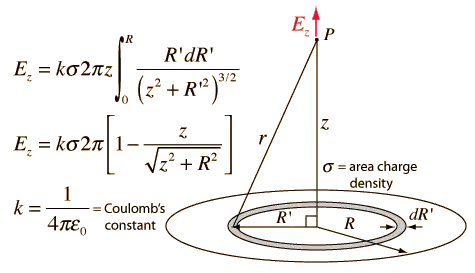
As you can see for $R\gg z$ the magnitude of electric field is constant and given by $E=\frac{\sigma }{2\varepsilon_{0}}$.
The $V=Ed$ formula can be applied to the case where two parallel plates kept at voltage $V$ (external) and separated by distance $d$. See the animation below from
http://www.regentsprep.org/Regents/physics/phys03/aparplate/
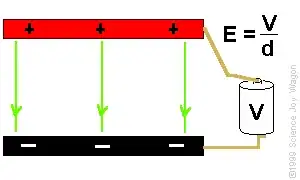
As you can see if the potential is constant as the distance gets smaller the electric field increases. If you want to apply the $E=\frac{\sigma }{2\varepsilon_{0}}$ formula here you need to calculate a new $\sigma$ for each $d$ because in this case $\sigma$ is not constant, it increases as the plates come closer as illustrated in the animation by more $+$ and $-$ charges on the plates.
Edit: Answers to the questions in the comments.
Question: What is $\sigma$ and why it increases as the two plates come together under a constant external potential $V$?
Answer: $\sigma$ is a measure of charge density. It can be calculated as total charge divided by total area. $\sigma$ increases as the plates come closer because the charges on each plate can attract more of the opposite charge to the other plate.
Question: How would one calculate the new electric field if the distance between the plates is reduced but there is no external voltage, that is the plates has constant $\sigma$?
Answer: There are two ways. If the $R\gg z$ case is valid then irrespective of the distance between the plates the electric field is constant and given by $E=\frac{\sigma }{\varepsilon_{0}}$.
If $R\gg z$ is not valid then one needs to use
$$E_{z}=\frac{\sigma}{2\varepsilon_{0}}\left ( 1-\frac{z}{\sqrt{z^{2}+R^{2}}} \right )$$
to calculate the electric field.


