2

Apparently a bunch of people totally misunderstood my previous question and choose to ignore the clarifying comments. Let me change the conditions to remove all the confusion.
enter image description here

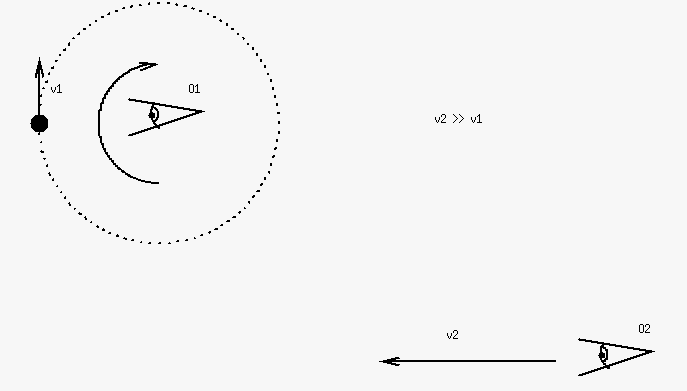
A group of particles forming a circle of uniform density is moving in a circular path (following that circle shape), at a moderate speed $v_1$ (as observed from a frame of reference bound to the center of the circular path, O1). Let's say this is a cloud of ions filling a cyclotron that had accelerated them to 0.2c and then just maintains their circular trajectory with magnetic field without accelerating them any further. (depicted is momentary speed vector of one of these particles)n accelerator.

An observer (O2) moving at $v_2$ near speed of light (say, 0.9c relative to the previous observer (O1) / the cyclotron) observes the positions and movement of these particles. How will they appear from that observer's point of view - what is their apparent their trajectory and how does their density vary from that observer's point of view?

SF.
  • 2,988

1 Answers1

1

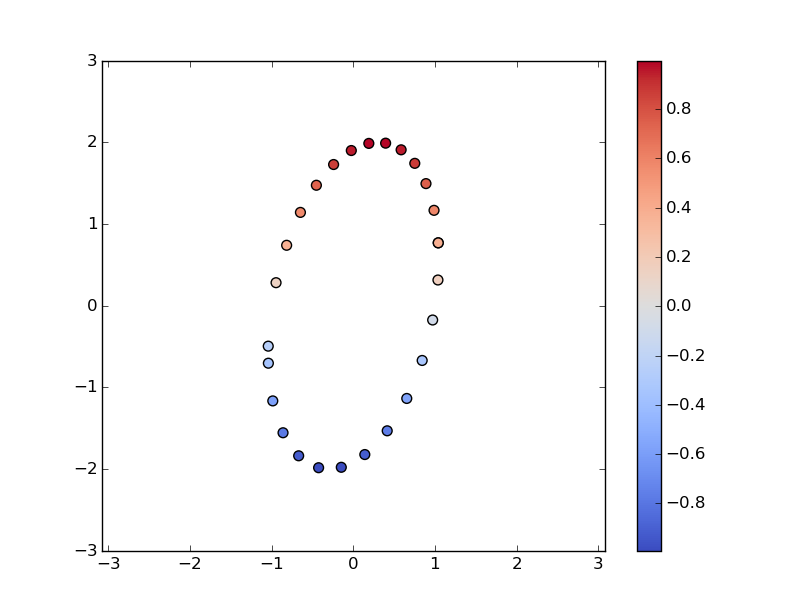
I tried to put it into a figure the results from reasoning in the framework of Special Theory of Relativity, this is what the observer would see:

enter image description here

Where you should notice several effects:

  • length contraction along observer's motion causes the ring to look like an elipse
  • equal velocities on equator where particles are crossing from top to bottom or vice-versa their velocities are perpendicular to observer's hence not affected (0.2c on either side)
  • fast transit through "bottlenecks" the apparent concentration of particles on top and bottom, which I mean by bottlenecks, are just an effect of length contraction, but particles are not really stuck there. Actually they are faster than in the rest of the ring (see velocity colorbar). Also the peak velocity on top is higher (.93c) than on bottom (.85c) because on the former they travel towards observer, while on the latter they travel away from him. But the observer sees all of them travelling towards him in both cases with the mentioned peak velocities.
  • spacing asymmetry top vs bottom the different speeds top vs bottom will affect the spacing between particles, the top looking more crowded than the bottom. However the time contraction will counter this effect and and at all times there should be the same amount of them on either side.
  • slanting also due to speed differences top vs bottom there will be a kind of slanting/forward-fall effect on the shape of the circle.

Note The figure is a representation of the effects and might exaggerate some of them, since is not made by calculating the actual values. The speeds-colorbar only shows the value of horizontal component and is also exaggerated, since minimum values should be .9c instead of 0.

rmhleo
  • 3,805